
Low-Fat Snack Air Popping Lines: Wholesale Supplier for Pellet Fryer Alternatives
- By Jinan MT Machinery
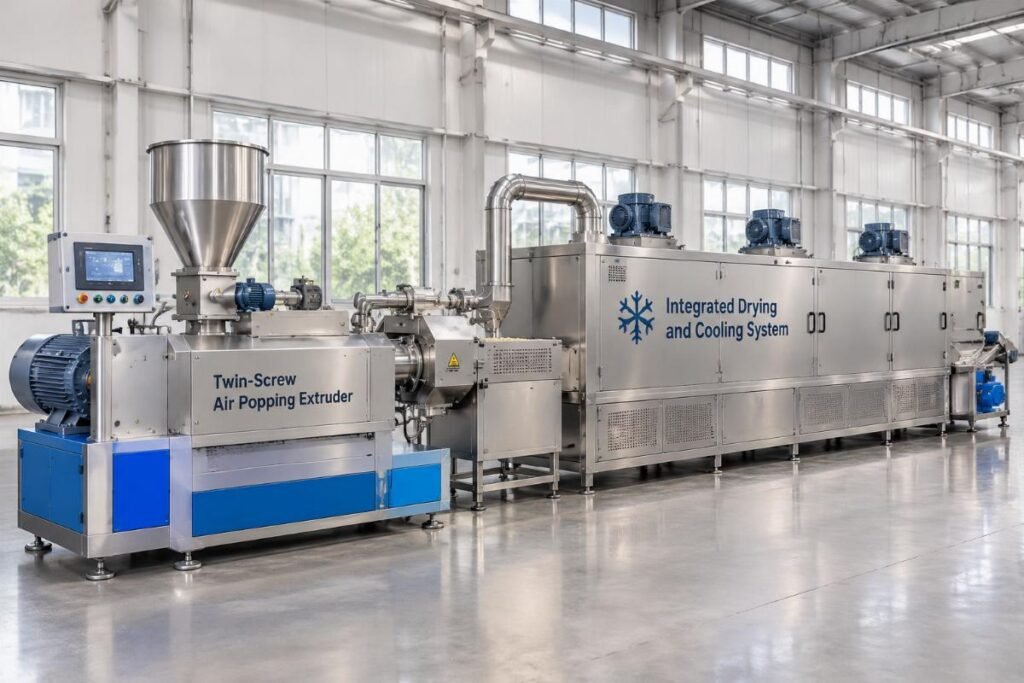
Air popping is not merely frying without oil; it demands precise thermodynamic shear control to achieve uniform expansion.
An Air popping line for low-fat snacks utilizes twin-screw extrusion to replace traditional pellet frying, delivering superior expansion rates, significantly lower operational costs, and zero oil degradation, provided the equipment features robust metallurgy and adaptable screw configurations to prevent catastrophic production downtime.
I still remember the suffocating heat of a factory floor in Lagos, staring at a supposedly advanced extruder spitting out half-cooked, dense corn curls. The client wanted to pivot to healthy snacks and opted for a budget twin-screw setup. Within months, severe screw wear destroyed the expansion rates, and the entire line was paralyzed for weeks. I stepped in to overhaul the售后 process, reworking the formula and replacing the barrels to drag the capacity back to normal. Transitioning from workshop installation to business development, I have witnessed countless manufacturers ruined by inferior machinery. Selecting an Air popping line for low-fat snacks requires looking far beyond superficial paper parameters.
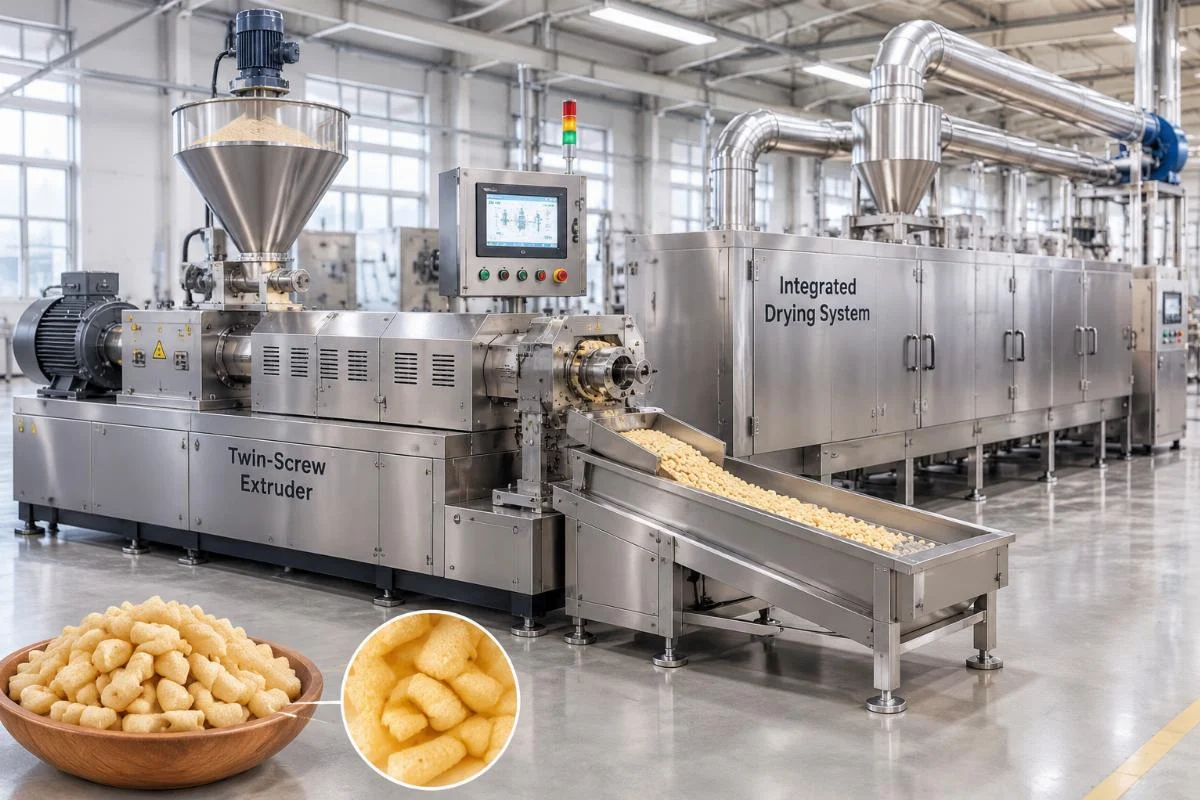
Transitioning from traditional frying to continuous extrusion is a massive leap, and understanding the mechanical realities is the first step toward a profitable operation.
Why Replace Pellet Fryers with Air Popping Lines?
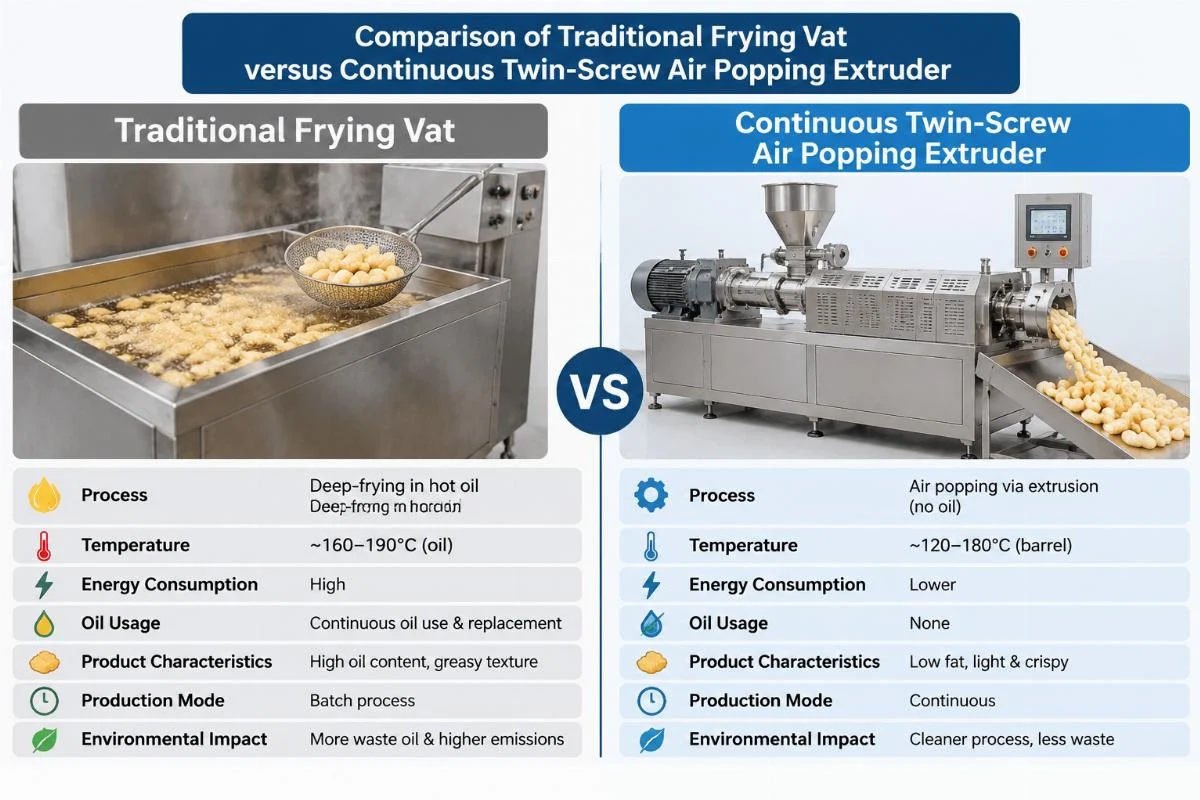
The shift from batch frying to continuous air popping is driven by the urgent need to eliminate oil degradation costs and meet stringent health regulations.
Manufacturers clinging to traditional pellet fryers often overlook the compounding expenses of oil filtration, disposal, and the inevitable health-conscious consumer shift. An Air popping line for low-fat snacks completely bypasses the frying vat, relying instead on the rapid flash-off of moisture within the barrel to achieve the desired puff. This thermodynamic shift drastically reduces the carbon footprint and operational overhead. However, the transition is not without pitfalls. Many buyers assume they can simply drop existing fried pellets into an air popper. In reality, the moisture content and starch gelatinization levels must be meticulously calibrated.
A snack manufacturer in Latin America attempted to scale up by simply buying a generic extruder and feeding it their standard fried pellets. The result was a catastrophic blockage. The standard barrels could not handle the dense, low-moisture matrix, leading to immense pressure buildup and motor burnout. They had to completely reformulate the pellets and upgrade to a specialized Air popping line for low-fat snacks with custom screw configurations to achieve throughput stability.
Twin-Screw vs. Single-Screw for Air Popping
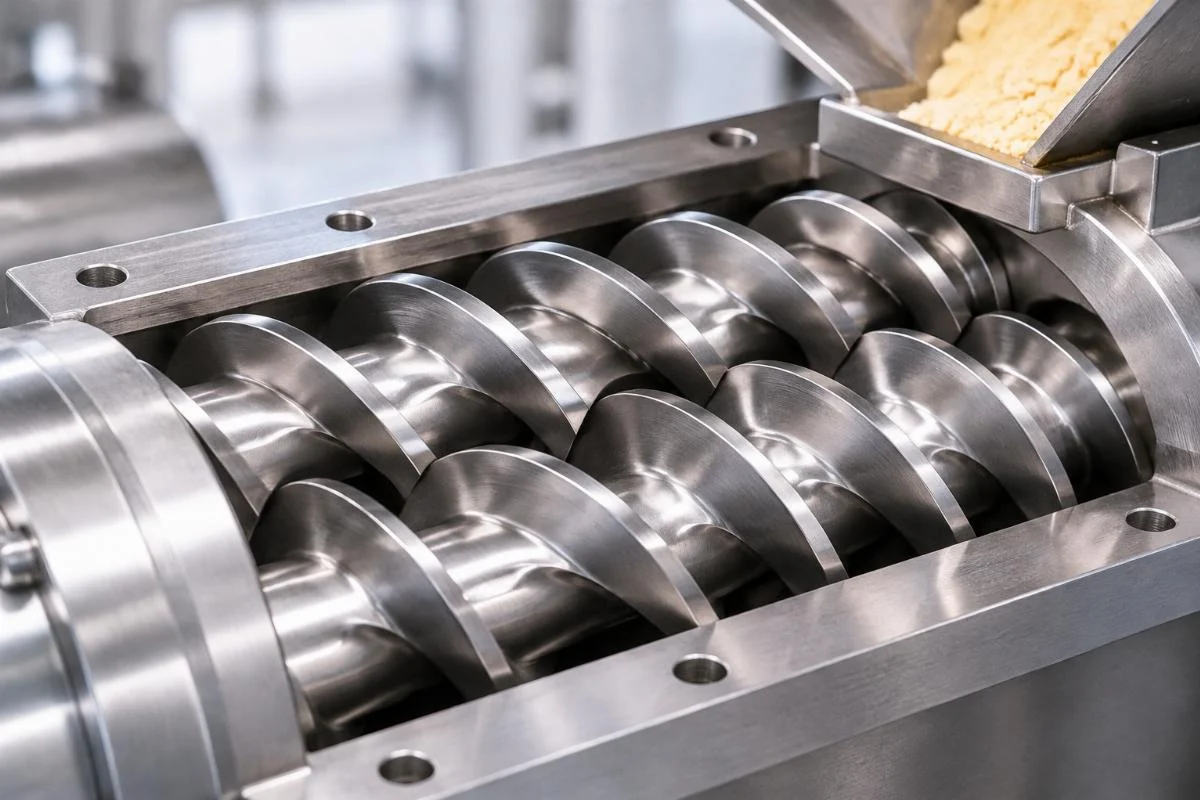
Twin-screw extruders provide the essential self-wiping shear control required for the uniform expansion of complex, low-fat formulas.
When evaluating an Air popping line for low-fat snacks, the choice between single and twin-screw technology is the most critical mechanical decision. Single-screw machines rely on friction against the barrel wall, which is highly inefficient for low-fat, high-starch matrices that lack natural lubrication. Twin-screw extruders, conversely, offer positive conveyance and precise Specific Mechanical Energy (SME) input. This allows for exact barrel temperature zoning and controlled shear, ensuring that the starch melts and expands uniformly without scorching.
To illustrate the operational differences, consider the following specification matrix:
| Feature | Basic Single-Screw Setup | Advanced Twin-Screw Configuration |
|---|---|---|
| Shear Control | Uncontrolled / Friction-dependent | Precisely Controlled / Self-wiping |
| Formula Adaptability | Vulnerable to blockages with low-fat | Robust handling of complex low-fat matrices |
| Temperature Zoning | Basic / Limited response | Advanced / Independent zone control |
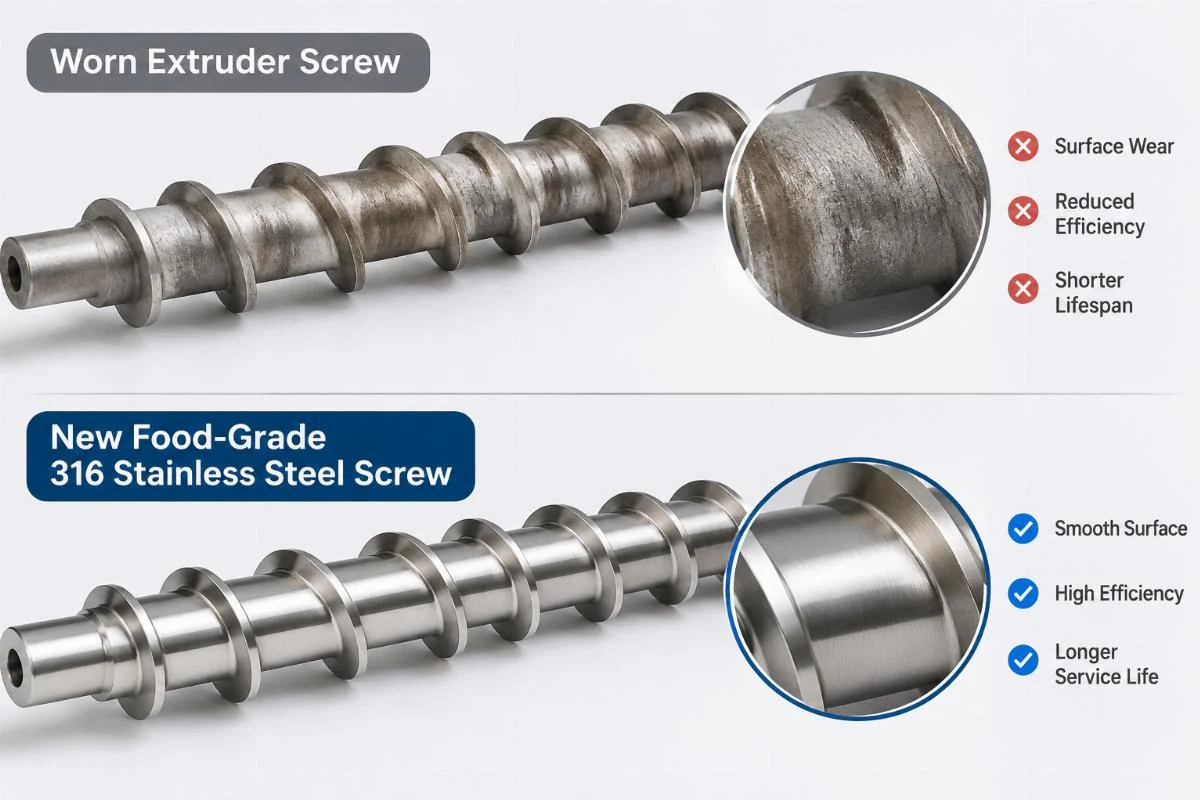
| Screw Wear Resistance | Basic metallurgy / High degradation | Food-grade 304/316 stainless / Extended life |
| Expansion Consistency | Noticeably reduced / High variance | Substantially extended / Uniform puffing |
A Middle East snack startup initially purchased a single-screw alternative to save on capital expenditure. They quickly found that switching to low-fat pellets caused constant blockages. The lack of positive conveyance meant the material simply slipped. They eventually had to scrap the single-screw and invest in a proper twin-screw Air popping line for low-fat snacks, which immediately resolved the throughput instability and delivered the crisp texture their market demanded.
Hidden Costs of Cheap Extrusion Alternatives
The true cost of an extrusion line lies not in the initial purchase price, but in the metallurgical lifespan of the screw and barrel, and the depth of formula R&D support.
It is a common misconception that all extruders are built similarly. The market is flooded with cheap alternatives that use inferior alloys. In the high-shear, high-temperature environment of an Air popping line for low-fat snacks, these substandard components wear down at an alarming rate. As the clearance between the screw and the barrel increases, the SME drops, and the expansion rate plummets. The resulting downtime for maintenance and part replacement costs several times the initial savings.
I recall a case where a client bought a cheap alternative for their new healthy snack venture. The severe screw wear dropped the expansion rates significantly within months. The snacks came out dense and hard, entirely unsellable. The prolonged downtime to machine new screws and re-calibrate the entire line was a financial disaster. When we intervened, we specified food-grade 304/316 stainless steel construction with specialized surface treatments. This metallurgical upgrade, combined with turnkey formula development support to adjust the starch-to-protein ratios, stabilized the production and eliminated the chronic wear issues.
Key Specs to Verify Before Purchasing
Before committing to an Air popping line for low-fat snacks, buyers must rigorously verify barrel material certifications, screw configuration flexibility, and integrated drying capacities.
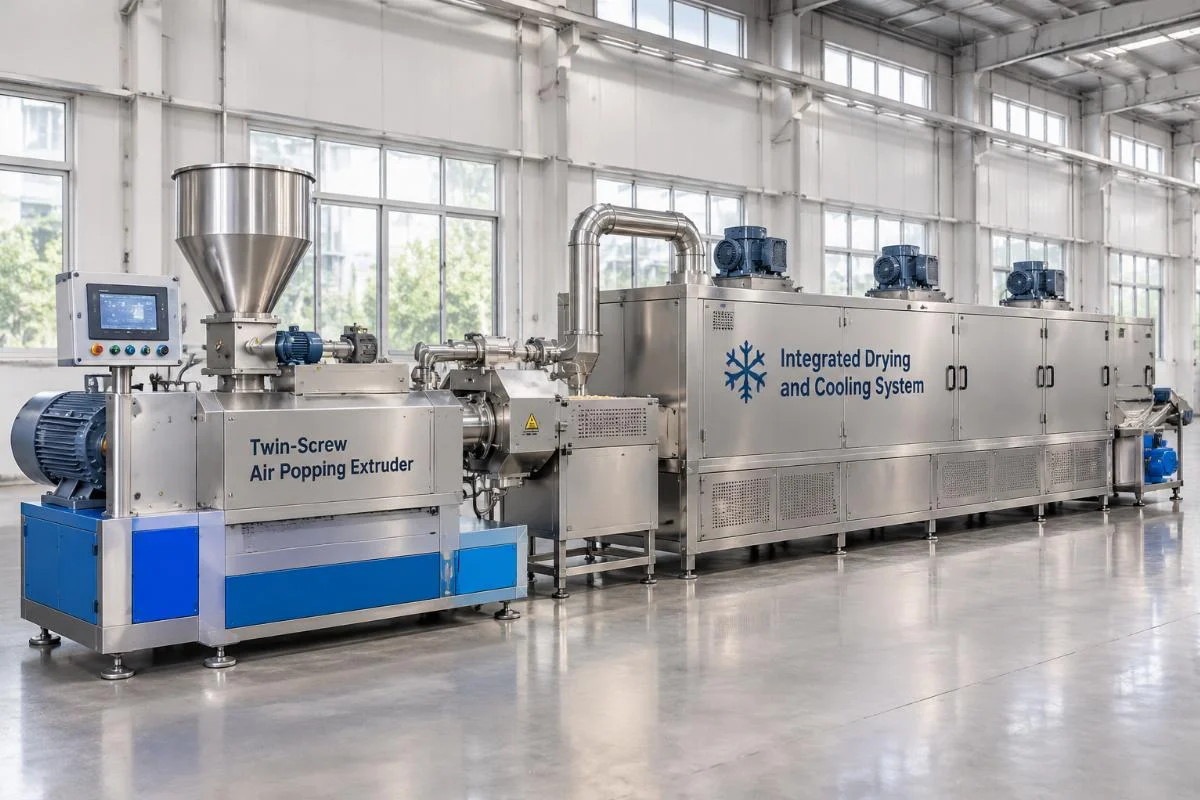
Purchasing an extrusion line is a long-term commitment. To avoid the pitfalls of cheap alternatives, you must look past the glossy brochures and demand verifiable engineering data. The screw L/D ratio must be sufficient to allow for proper melting, mixing, and pressure buildup. Furthermore, the integrated drying system must be perfectly scaled to the extruder’s output; a mismatch here will lead to either soggy snacks or brittle, over-dried products that shatter during flavor coating.
Here is a checklist of non-negotiable specifications for a reliable Air popping line for low-fat snacks:
- Material Certification: Must be food-grade 304/316 stainless steel, complying with international safety standards like CE and ISO.
- Screw Modularity: The screw elements must be interchangeable to allow for custom configurations based on different low-fat formulas.
- Drying Integration: The dryer must feature precise airflow and temperature controls to achieve the target moisture reduction rates without case hardening.
- Turnkey Support: The supplier must provide on-site installation, commissioning, and comprehensive formula development support.
A European contract manufacturer learned this the hard way when their capacity scaling failed. They upgraded from batch frying to continuous air-popping but mismatched the extruder output with an undersized dryer. The bottleneck ruined their batch consistency. By switching to a supplier that offered precise capacity scaling and a fully integrated drying solution, they finally achieved the continuous, stable production required for their massive retail contracts.
Conclusion
Selecting the right Air popping line for low-fat snacks is a complex engineering decision that prioritizes metallurgical durability and thermodynamic precision over initial price tags.
Transitioning from pellet frying to twin-screw air extrusion offers undeniable advantages in health trends and operational efficiency, but only if the equipment can withstand the rigorous demands of low-fat formulas. By demanding verifiable material certifications, modular screw designs, and comprehensive formula support, manufacturers can avoid catastrophic downtime and build a highly profitable, future-proof snack production line.

Engineering Perspective
An In-House R&D Team Behind Every Line
Jinan MT Machinery develops its process technology in-house. The team concentrates on the four areas that decide pellet shape, expansion and line stability.
- Expansion technology
- Twin-screw extrusion
- Die design
- PLC/MCC automation
Related Articles
 Nov 12, 2026 · Brands & Alternatives
Bühler vs Wenger vs Clextral Snack Extruder Wholesale Supplier
Evaluating snack extruder options reveals that premium European brands often cause costly downtime due to long spare parts lead times and rigid designs for… Read This Article Nov 12, 2026 · Brands & Alternatives
Semi-Auto vs Fully Auto Pellet Chips Lines Manufacturer
Choosing between semi-automatic and fully automatic pellet chips lines depends on matching local power capacity, labor costs, and factory space rather than just production… Read This Article Nov 12, 2026 · Brands & Alternatives
Clextral Evolum vs Meiteng DS Series Twin-Screw Snack Extruder Manufacturer
Evaluating the Clextral Evolum vs Meiteng DS twin-screw extruder helps snack manufacturers overcome grid instability and spare parts downtime in harsh climates. While the… Read This ArticleFree Process Check
Send Your Recipe for a Process Check
Jinan MT Machinery engineers review your recipe and return a free process plan within 24 hours. Tell us the product, output, raw material, local voltage and heat source.
Send Your Recipe on WhatsApp