

Higher screw speeds do not guarantee higher output; they often trigger material degradation and inconsistent puffing.
Selecting a twin-screw extruder for snack food requires matching machine specifications with local factory conditions, raw material intake, and shift planning, rather than merely comparing price sheets.
Stationed in Shenzhen handling overseas trade, I once shipped a twin-screw extruder for snack food to a buyer in Mexico. Focused entirely on beating a competitor’s price, I failed to verify the extreme heat and humidity of their local workshop. The moment the machine started, the gearbox overheated, and the raw material jammed into a solid mass within half an hour. The client furiously labeled the equipment useless scrap. I flew over immediately and spent weeks dismantling and repairing the machine in a sweltering facility. Transitioning from after-sales installation to the sales front line, that disaster permanently rewired my mindset: evaluating a snack food extrusion machine demands prioritizing environmental adaptability and on-site fault tolerance over bare parameter sheets.
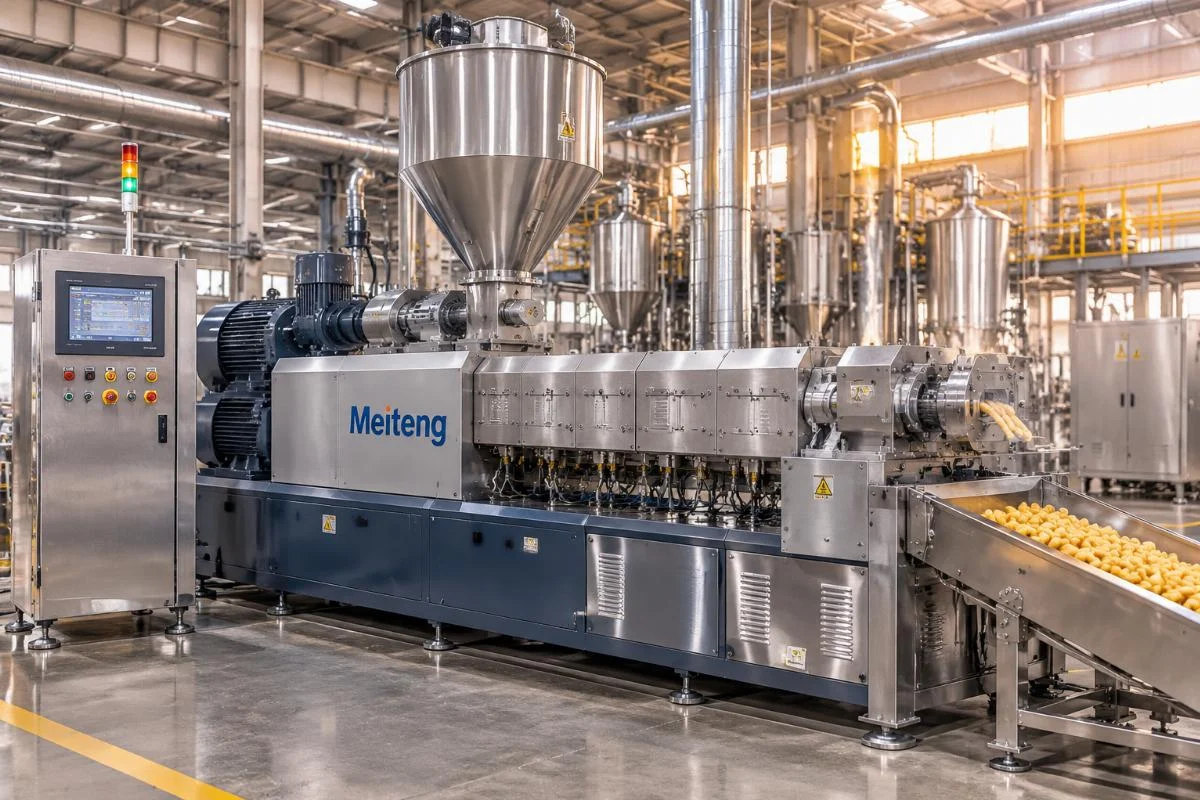
Transitioning from raw material preparation to final flavor coating, every stage of a snack food production line hinges on the core extrusion parameters matching your specific operational reality.
How to Match Extruder Capacity to Your Snack Line?
Capacity scaling must align with your raw material intake and shift planning, moving fluidly across the 200 to 3000kg/h range based on actual startup needs.
When startups evaluate a twin screw puffing machine, the obsession with maximum theoretical output often blinds them to practical production rhythms. A machine running at peak capacity continuously will suffer from severe barrel wear and inconsistent specific mechanical energy input. Conversely, undersized equipment forces endless shift extensions, draining operational budgets. The true art lies in balancing the L/D ratio, which directly dictates texturization and puffing consistency, against your daily tonnage targets.
| Capacity Tier | Raw Material Intake | Shift Planning | Operational Risk |
|---|---|---|---|
| Startup Tier | Limited batch intake | Single extended shift | High idle time, energy waste |
| Growth Tier | Moderate continuous intake | Dual standard shifts | Moderate barrel wear, stable output |
| Industrial Tier | Massive silo intake | Continuous multi-shift | High thermal load, requires robust cooling |
A cereal snack startup in South America initially wanted the largest available model to future-proof their investment. However, their local corn flour supply chain could only support limited batch intakes. Running a massive machine at partial load caused severe material degradation and erratic puffing. By stepping down to a mid-range DS-series model, they stabilized their specific mechanical energy input and eliminated product waste.
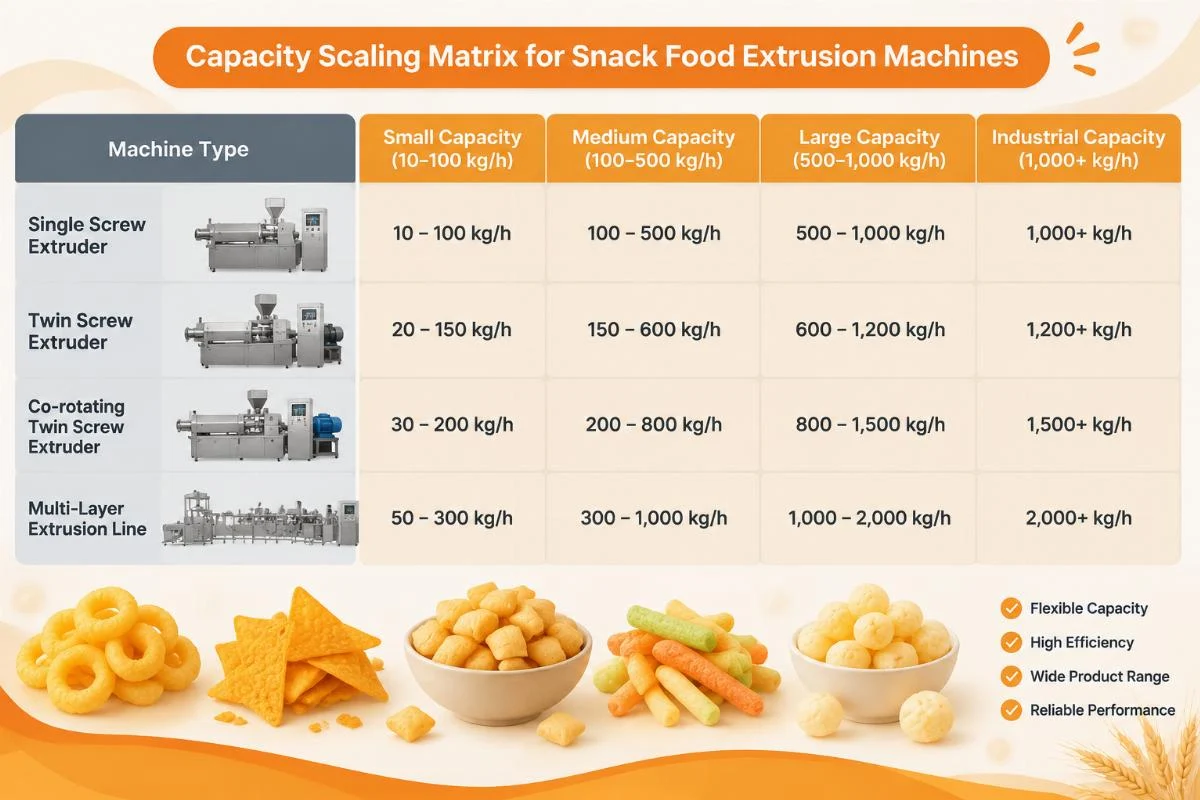
Matching your buy twin screw extruder decision to realistic daily intake prevents the hidden costs of underutilized heavy machinery.
Why Does Factory Environment Dictate Machine Configuration?
Ambient temperature and humidity strictly dictate cooling system sizing and motor specifications to prevent catastrophic downtime.
The physical environment where a snack food production line operates is often completely ignored during the procurement phase. In tropical or highly humid regions, standard air-cooled motors and basic gearbox cooling circuits simply fail to dissipate the generated heat. The result is rapid lubricant breakdown, gear seizure, and melted product inside the barrel.
| Environment Factor | Standard Configuration | Adapted Configuration | Failure Consequence |
|---|---|---|---|
| High Ambient Heat | Basic air cooling | Industrial water chilling | Gearbox seizure, motor burnout |
| High Humidity | Standard electrical cabinets | Sealed climate-controlled panels | Short circuits, sensor failure |
| Dusty Workshop | Open ventilation | Positive pressure filtration | Abrasive wear on moving parts |
A snack manufacturer in Southeast Asia experienced continuous halts because their standard twin-screw extruder for snack food could not handle the monsoon humidity. The moisture ingress shorted the control panels, and the ambient heat caused the gearbox oil to thin out, leading to metal-on-metal grinding. Upgrading to a climate-controlled electrical cabinet and an oversized water chilling loop completely eradicated the downtime.
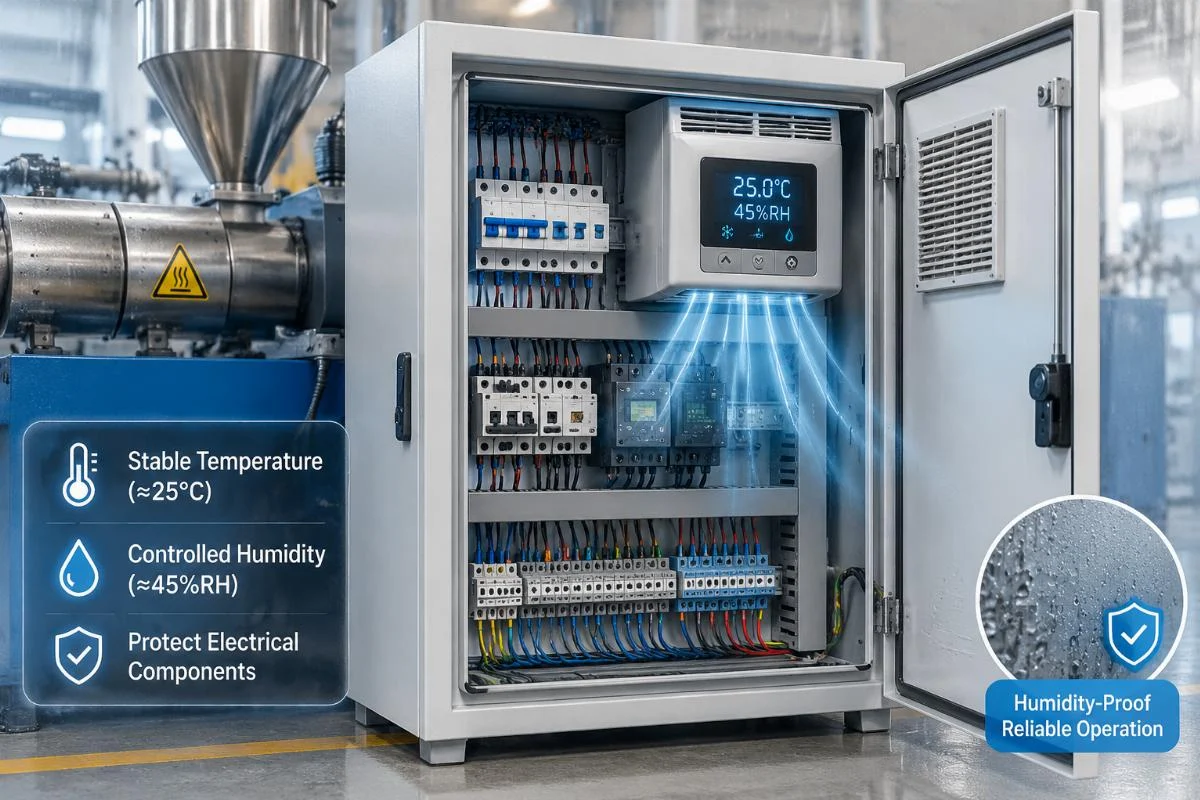
Ignoring local climate realities turns a highly efficient snack food extrusion machine into a perpetual maintenance burden.
What Material and Barrel Specs Ensure Food Safety?
Food-grade stainless steel compliance is non-negotiable, with material selection driven strictly by the acidity and abrasiveness of your flavor coatings.
Many buyers assume a standard material choice covers every application. This is a dangerous misconception. While standard alloys handle basic corn or potato starches perfectly, high-acid flavor coatings—like intense cheese dust or citrus-based seasonings—will rapidly corrode inferior metals, introducing heavy metal contamination into the food supply. Furthermore, abrasive ingredients demand specialized barrel treatments to maintain the precise clearances required for uniform puffing.
| Flavor Profile | Required Contact Material | Barrel Wear Rate | Maintenance Frequency |
|---|---|---|---|
| Basic Starch/Sugar | Standard Food-Grade | Noticeably reduced | Standard annual inspection |
| High-Acid/Spicy | High-Corrosion Resistant | Substantially extended | Bi-annual deep cleaning |
| Highly Abrasive | Specialized Hardened Alloy | Controlled | Frequent clearance checks |
A Latin American snack startup producing intense chili-lime puffs found their standard barrels pitting and rusting within months. The acidic seasoning reacted with the metal, ruining batches and failing safety audits. Switching to a DS-series model configured with high-corrosion resistant contact parts and specialized hardened alloys for the high-wear zones solved the contamination issue and drastically extended the service life of the components.
Selecting the correct metallurgy for your twin-screw extruder for snack food ensures compliance with international food safety standards and protects your brand reputation.
How to Evaluate Turnkey Support for Startups?
Comprehensive formula development and on-site operator training reduce trial-and-error costs significantly compared to buying standalone hardware.
Purchasing a snack food production line is not merely a hardware transaction; it is the acquisition of a culinary and mechanical process. Startups often possess the capital for the machinery but lack the proprietary recipes and process engineering knowledge to make them profitable. A supplier that merely drops off a pallet of steel leaves the buyer to spend months burning through expensive raw materials in futile test runs. True value lies in integrated process engineering.
| Support Element | Hardware-Only Vendor | Turnkey Solution Provider | Startup Impact |
|---|---|---|---|
| Recipe Formulation | None provided | Custom R&D support | Accelerated time-to-market |
| Installation | Manual guides | On-site commissioning | Immediate operational readiness |
| Training | Basic overview | Deep operator certification | Reduced human error waste |
A new entrant in the Middle East market bought a cheap twin screw puffing machine but lacked the expertise to balance moisture content, screw speed, and barrel temperature for their local sorghum blend. They wasted massive quantities of raw material. By partnering with a turnkey provider who sent engineers to their site for deep operator certification and custom R&D support, they finally achieved the perfect crunch and eliminated the waste.

When you buy twin screw extruder packages, ensuring the inclusion of deep process engineering transforms a risky gamble into a predictable, profitable operation.
Conclusion
Matching machine specifications to local factory conditions and raw material realities is the ultimate determinant of extrusion success.
Selecting the right twin-screw extruder for snack food demands looking far beyond basic price sheets to evaluate environmental adaptability, metallurgical compatibility, and comprehensive turnkey support. By prioritizing these operational realities, manufacturers secure a snack food production line that delivers consistent quality, ensures food safety, and drives long-term profitability from day one.
Equipment Mentioned in This Article
 3D papad machine
Automatic 3D Pellet Extruded Corn Puffed Snack Food Production Line
3D Pellet Extruded Snack Food Production Line for Starch Pellets — processes potato, corn, and cassava starch into papad and… View Machine Details frying chips machine
Industrial Deep Fryer for Potato Chips and Snack Food Production
Industrial Deep Fryer for Potato Chips and Snack Food Production — frying and de-oiling for 2D/3D pellets, papad, and potato… View Machine Details frying chips machine
Industrial Batch Fryer Machine Electric Automatic Deep Frying Snack Food
Industrial Batch Fryer for Fried Snacks — deep frying and de-oiling for 2D/3D snack pellets and chips using potato, cassava,… View Machine Details frying chips machine
Industrial High Speed Frying Machine for Snack Food Processing
Industrial High Speed Frying Machine for Snack Food Processing — continuous frying and de-oiling for 2D/3D pellets and potato chips.… View Machine DetailsRelated Applications

Engineering Perspective
An In-House R&D Team Behind Every Line
Jinan MT Machinery develops its process technology in-house. The team concentrates on the four areas that decide pellet shape, expansion and line stability.
- Expansion technology
- Twin-screw extrusion
- Die design
- PLC/MCC automation
Related Articles
 Nov 7, 2026 · Buying Guide
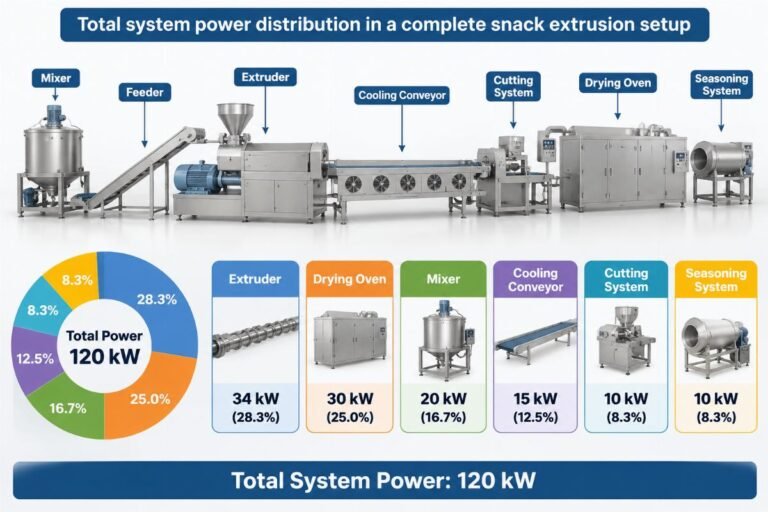
Energy Efficient Snack Pellet Extruder Line Manufacturer for Sale
Evaluating an energy efficiency snack pellet production line requires looking beyond single motor ratings to total system power and heat recovery to eliminate hidden… Read This Article Nov 7, 2026 · Buying Guide
De-Oiling Machine for Pellet Chips Fryer Line | Meiteng OEM Manufacturer
A properly matched de-oiling machine for pellet chips controls residual surface oil to extend shelf life and ensure seasoning adhesion without shattering fragile snacks.… Read This Article Nov 7, 2026 · Buying Guide
Meiteng Frying Chips Line Manufacturer: Turnkey Solutions for Your Production Target
Most buyers obsess over fryer temperatures, missing that mismatched drying and flavoring systems are the actual bottlenecks in a Meiteng frying chips line. True… Read This ArticleFree Process Check
Send Your Recipe for a Process Check
Jinan MT Machinery engineers review your recipe and return a free process plan within 24 hours. Tell us the product, output, raw material, local voltage and heat source.
Send Your Recipe on WhatsApp