
Extruded Corn Chips Production Line Manufacturer: Turnkey Solutions for New Investors
- By Jinan MT Machinery

A soggy corn puff does not mean your machine is defective; it means your screw configuration is fighting the local corn starch.
The core answer to scaling a successful startup is matching the corn chips extruder specs and screw profiles to your regional raw materials, rather than simply buying standard steel off the shelf.
I still remember standing on the factory floor of a snack startup in Surabaya. The investors had purchased a high-end twin-screw corn chips extruder but insisted on running their own local corn recipe. During the initial commissioning, the moisture content of their regional maize was completely different from the standard test batches. The puffs came out half-baked, dense, and soggy. The client panicked, convinced the machinery was fundamentally broken. It took days of on-site adjustments to the barrel temperature zones and screw element arrangement to finally match their specific raw material. That moment cemented a hard truth: a turnkey line is not just about shipping steel; it is about making the formula work on the ground.
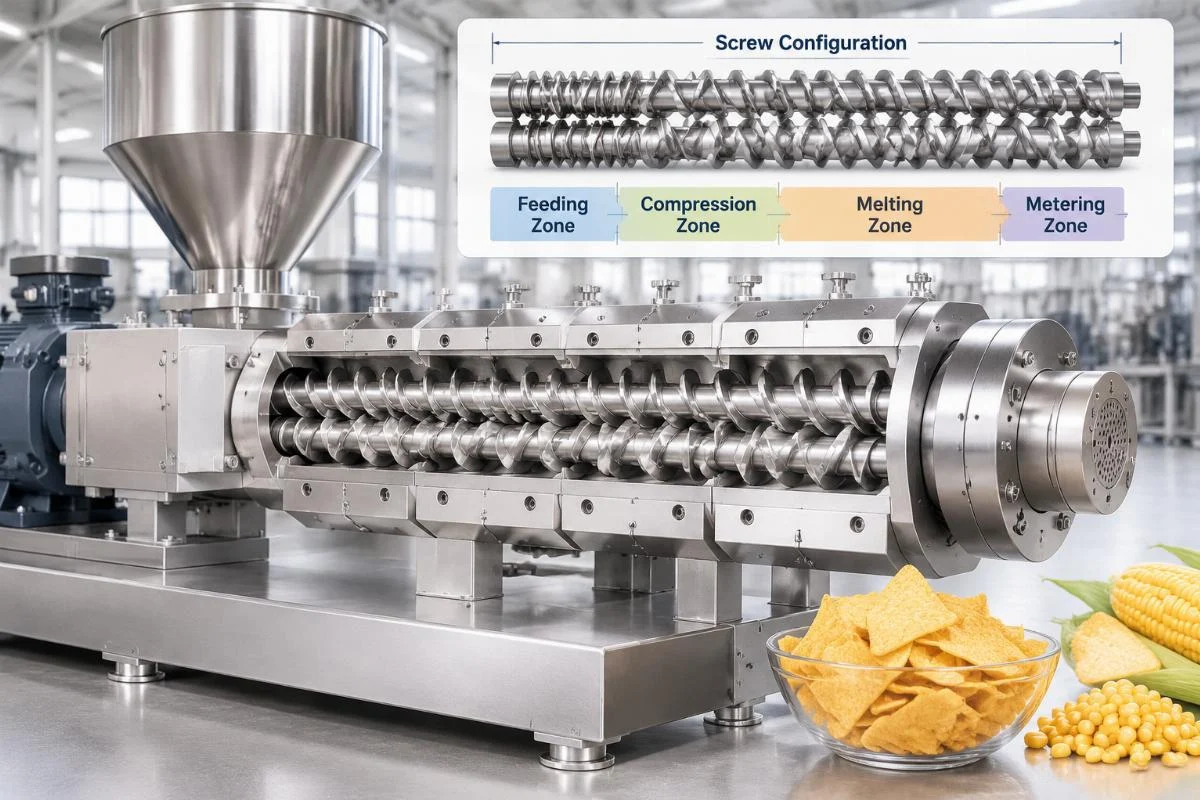
Transitioning from a standard recipe to a localized production reality requires understanding the mechanical heart of your facility.
What Core Specs Define a Corn Chips Extruder?
Selecting the right corn chips extruder requires comparing screw mechanics, thermal dynamics, and drive power against your specific puffing goals.
When evaluating a corn chips extruder, the internal geometry dictates the texture of your final snack. The specific mechanical energy (SME) delivered to the dough determines how thoroughly the starch gelatinizes before it exits the die.
Here is how the core specifications compare for startup applications:
| Specification Factor | Single-Screw Setup | Twin-Screw Setup (DS-Series) |
|---|---|---|
| Screw L/D Ratio | Basic / Limited | Controlled / Modular |
| Moisture Tolerance | Vulnerable | Robust |
| Shear & Mixing | Uncontrolled | Standard / Customizable |
| Starch Gelatinization | Basic | Full batch-level |
| Recipe Flexibility | None | Verifiable |
A common trap for new investors is assuming that a larger extruder guarantees a better return on investment. In reality, oversized barrels cause severe material degradation for small startups because the dough sits in the barrel too long, burning the starch before it can puff correctly. Conversely, a properly configured twin-screw corn chips extruder allows you to swap screw elements to control residence time and shear heat precisely.

How to Size Capacity for Your Startup?
Matching your target output with the drying and coating bottlenecks prevents the entire line from stalling.
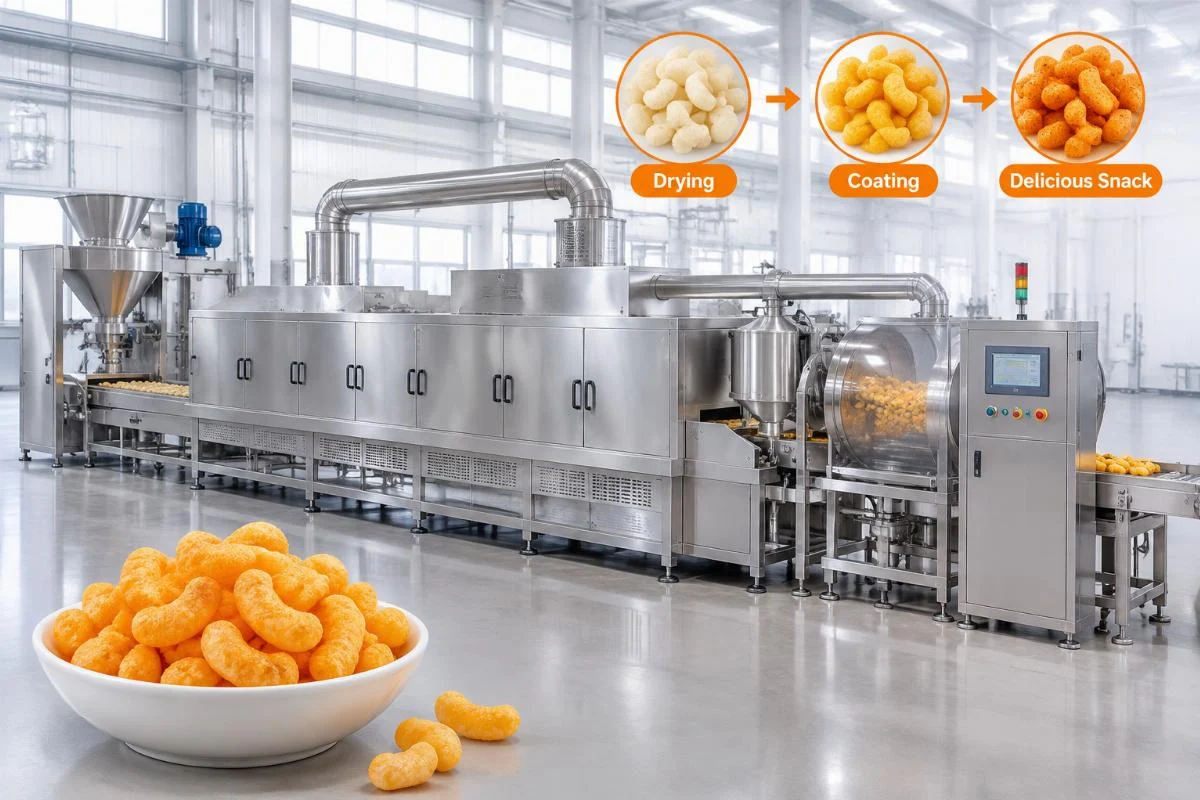
Scaling from a pilot batch to continuous production is where many startups fail. You might secure a corn chips extruder capable of high throughput, but if your dryer cannot handle the moisture removal, the line becomes a bottleneck.
When sizing your capacity, consider the entire material flow. Upgrading output without losing puff texture requires balancing the extruder feed rate with the thermal retention time in the dryer. A line designed for modest outputs can easily be scaled by adding parallel drying modules rather than buying a massive, single-pass dryer that ruins the delicate puff structure.
Furthermore, the coating stage must sync with the extruder. Matching the drum speed to the extruder output ensures an even flavor distribution without drowning the puffs. If the slurry retention is too high, the product turns soggy; if it is too low, the snack tastes bland.
Why Does Local Corn Moisture Ruin Puffing?
Adjusting temperature zones and screw elements is mandatory when regional raw materials deviate from standard moisture baselines.
Local corn moisture is the silent killer of puff quality. Agricultural moisture data shows that regional harvest conditions cause massive variance in raw material water content.
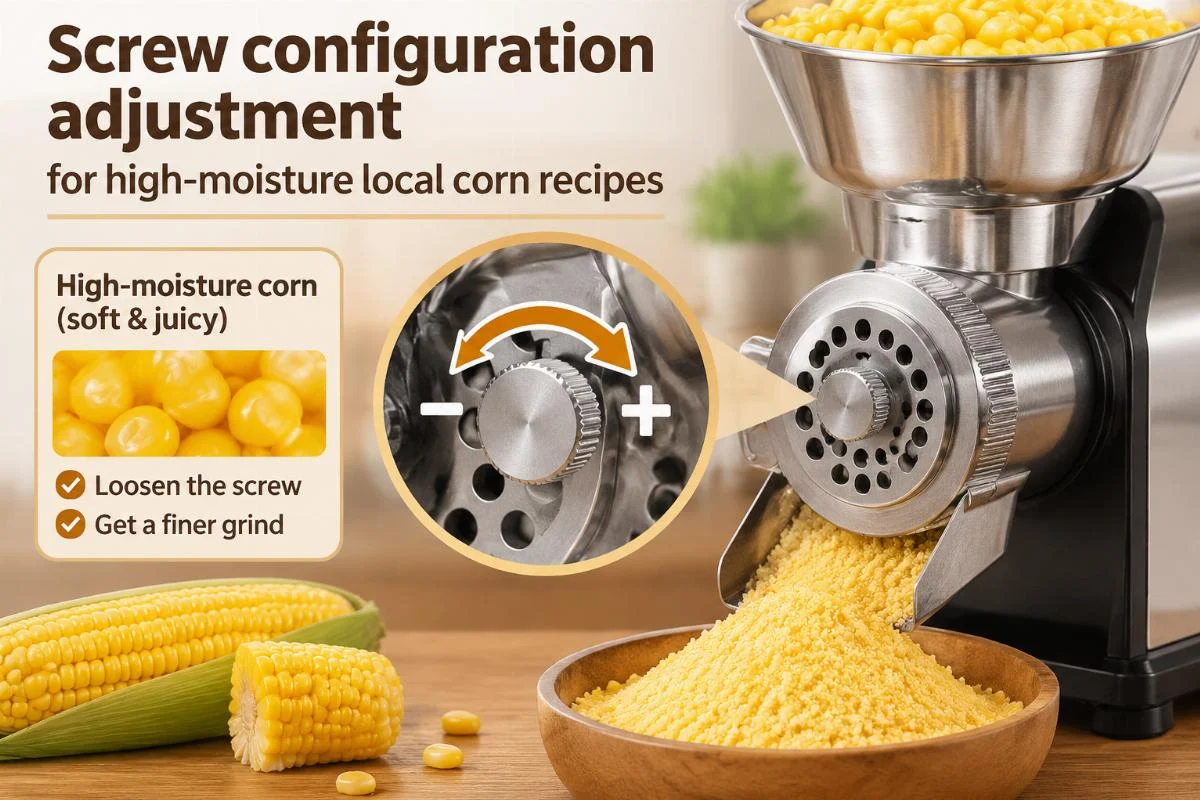
If your local corn arrives with higher moisture, the dough inside the corn chips extruder will not build enough pressure to puff upon exiting the die. The result is a dense, hard pellet. To fix this, you must alter the thermal zone profiling. By increasing the temperature in the metering zone and adjusting the screw configuration to increase shear, you can force the excess water to flash off as steam, creating the necessary expansion.
Conversely, if the corn is too dry, the friction inside the barrel will spike, potentially burning the product and damaging the screw elements. The solution lies in customizing the screw flight depth and adding kneading blocks to manage the friction heat. This level of adaptation is why off-the-shelf settings rarely work for long-term production.
What Does a True Turnkey Line Include?
A genuine turnkey solution covers everything from raw material intake to food-grade compliance, ensuring your facility meets international safety standards.
Buying a standalone machine is not enough; you need an integrated ecosystem. A true turnkey line starts with raw material handling, ensuring the corn is milled to the exact particle size required for smooth extrusion.
The heart of this ecosystem is the extrusion section, where food-grade stainless steel construction is non-negotiable for meeting international food safety standards.
Meiteng approaches this by integrating the DS-series twin-screw extruders with custom screw configuration services. Because every region’s corn behaves differently, the ability to physically reconfigure the screws on-site is what separates a working factory from a paperweight. The line must also include integrated drying, cooling, and flavor-coating systems, all designed to work in harmony.
Finally, food-grade compliance and proper ventilation are critical. The entire system must be designed to prevent cross-contamination and ensure operator safety, backed by rigorous installation and operator training.

Conclusion
Success in snack manufacturing relies on mechanical adaptation, not just machinery purchase.
Building a profitable snack business requires aligning your corn chips extruder specs with the physical realities of your local corn and your target market. By focusing on screw configuration, thermal profiling, and integrated line balancing, you transform raw regional ingredients into consistent, high-quality puffs.
Equipment Mentioned in This Article
 3D papad machine
Automatic 3D Pellet Extruded Corn Puffed Snack Food Production Line
3D Pellet Extruded Snack Food Production Line for Starch Pellets — processes potato, corn, and cassava starch into papad and… View Machine Details 3D papad machine
2D 3D Snack Pellet Production Line Manufacturer
2D 3D Snack Pellet Production Line for Diverse Shapes from Starches — twin-screw extrusion handles wheat, corn, and cassava. The… View Machine Details frying chips machine
Industrial Deep Fryer Machine Manufacturer Banana Potato Chips French Fries
Industrial Deep Fryer Machine for banana and potato chips features automatic basket lifting and oil filtration. The electric heating system… View Machine Details frying chips machine
100-2000L Tank Deep Fryer Commercial Chips Frying Machine
100-2000L Tank Deep Fryer for Snack Pellets and Chips — handles continuous deep frying and de-oiling for potato, cassava, and… View Machine DetailsRelated Applications

Engineering Perspective
An In-House R&D Team Behind Every Line
Jinan MT Machinery develops its process technology in-house. The team concentrates on the four areas that decide pellet shape, expansion and line stability.
- Expansion technology
- Twin-screw extrusion
- Die design
- PLC/MCC automation
Related Articles
 Nov 7, 2026 · Buying Guide
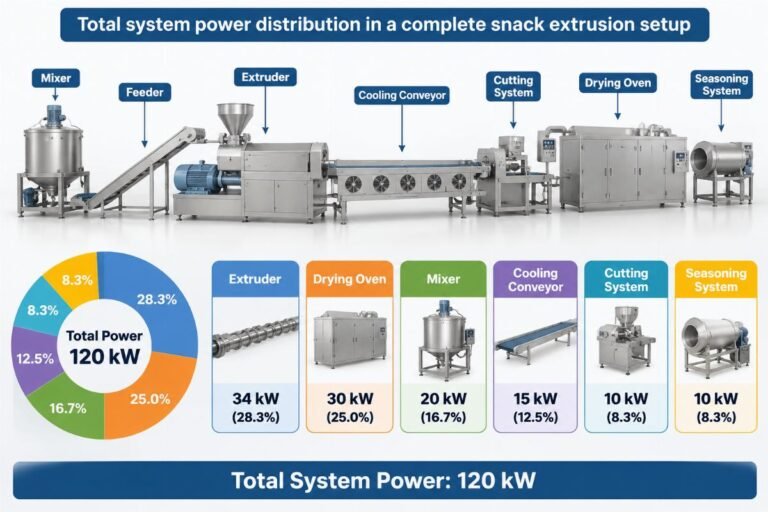
Energy Efficient Snack Pellet Extruder Line Manufacturer for Sale
Evaluating an energy efficiency snack pellet production line requires looking beyond single motor ratings to total system power and heat recovery to eliminate hidden… Read This Article Nov 7, 2026 · Buying Guide
De-Oiling Machine for Pellet Chips Fryer Line | Meiteng OEM Manufacturer
A properly matched de-oiling machine for pellet chips controls residual surface oil to extend shelf life and ensure seasoning adhesion without shattering fragile snacks.… Read This Article Nov 7, 2026 · Buying Guide
Twin-Screw Extruder for Snack Food: Wholesale Manufacturer
Selecting a twin-screw extruder for snack food requires matching machine specifications with local factory conditions and raw material intake rather than merely comparing price… Read This ArticleFree Process Check
Send Your Recipe for a Process Check
Jinan MT Machinery engineers review your recipe and return a free process plan within 24 hours. Tell us the product, output, raw material, local voltage and heat source.
Send Your Recipe on WhatsApp