
Meiteng 100–150 kg/h Pellet Chips Line: Complete Machine List Manufacturer
- By Jinan MT Machinery

Most buyers assume the extruder is the heart of the operation, but the drying and cooling system actually dictates the final texture and true capacity.
A fully operational 100-150 kg/h pellet chips line complete machine list requires a seamless turnkey configuration from raw material mixing to final packaging, ensuring no auxiliary equipment is missing to cause hidden production bottlenecks.
I still remember the tension at a trade show in Chicago years ago. An American buyer was pointing at a quotation, visibly frustrated because the proposed setup lacked a cooling conveyor and a seasoning drum. He was not just buying a single twin screw extruder chips machine; he was looking for a fully integrated small scale snack extrusion line. Having spent years running booths from Hanover to the Americas, I know exactly how much European and North American buyers obsess over a truly comprehensive equipment roster. For a compact setup, missing even one auxiliary unit means the entire operation grinds to a halt. The reality is that smaller setups are far more sensitive to auxiliary mismatches than massive industrial setups.
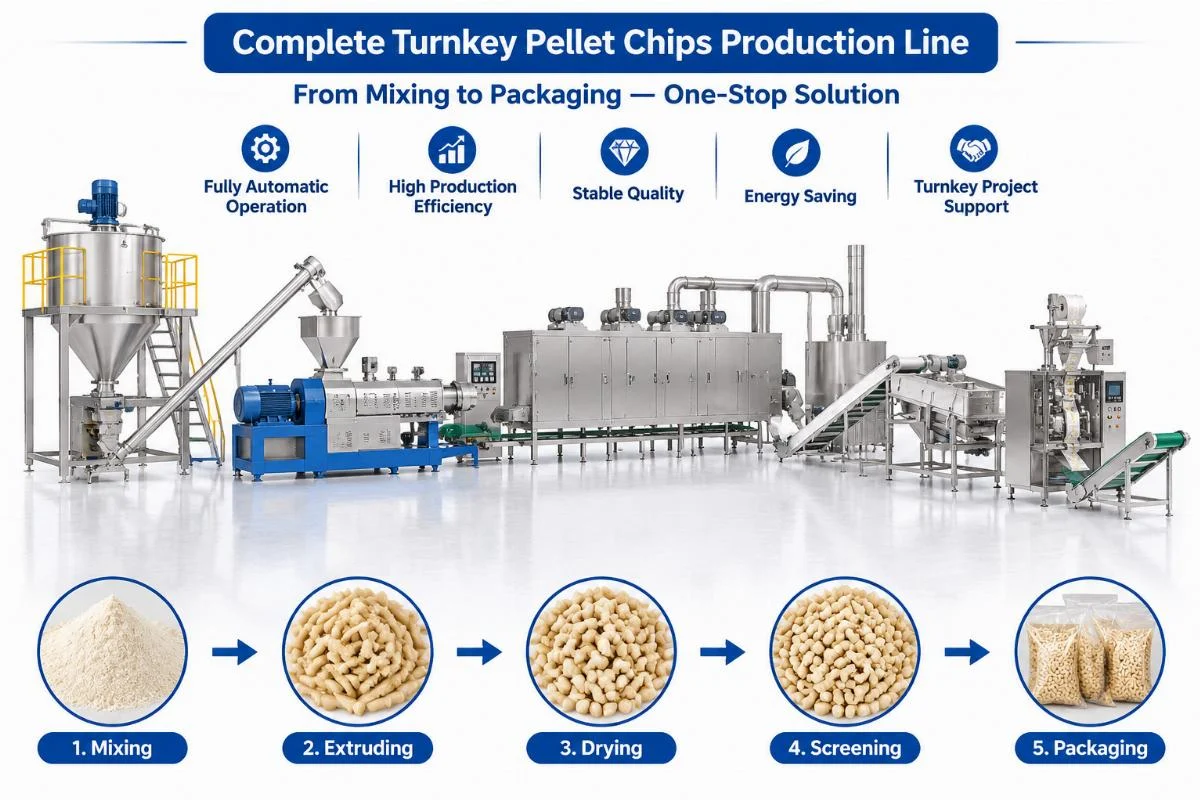
Let us break down exactly what goes into a proper 100-150 kg/h pellet chips line complete machine list and how to avoid the pitfalls that stall new food startups.
Why Do Small-Scale Lines Frequently Halt?
The vast majority of production stoppages in compact extrusion setups stem from missing or poorly matched auxiliary equipment rather than the core extrusion hardware itself.
Industry data over recent years consistently shows that auxiliary mismatches account for the lion’s share of bottlenecks in entry-level snack manufacturing. When a startup scales up from a test kitchen to a commercial floor, the focus is almost entirely on the twin screw extruder chips machine. The conveyors, coolers, and coating drums are treated as afterthoughts. I recall a specific case where a client in Latin America launched a small scale snack extrusion line but skipped the multi-pass cooling stage to save on initial capital. The result was a massive backlog of hot, fragile pellets that shattered before they could be seasoned. They experienced a severe capacity loss simply because the downstream equipment could not handle the thermal load.
Another frequent issue involves flavor application. Manual seasoning on a continuous 100-150 kg/h pellet chips line complete machine list leads to noticeable flavor waste and inconsistent coating. When operators try to keep up with the extruder output by hand, the oil and powder application ratios fluctuate wildly. A proper turnkey pellet chips production line must include an automated flavoring drum that synchronizes with the extruder speed.
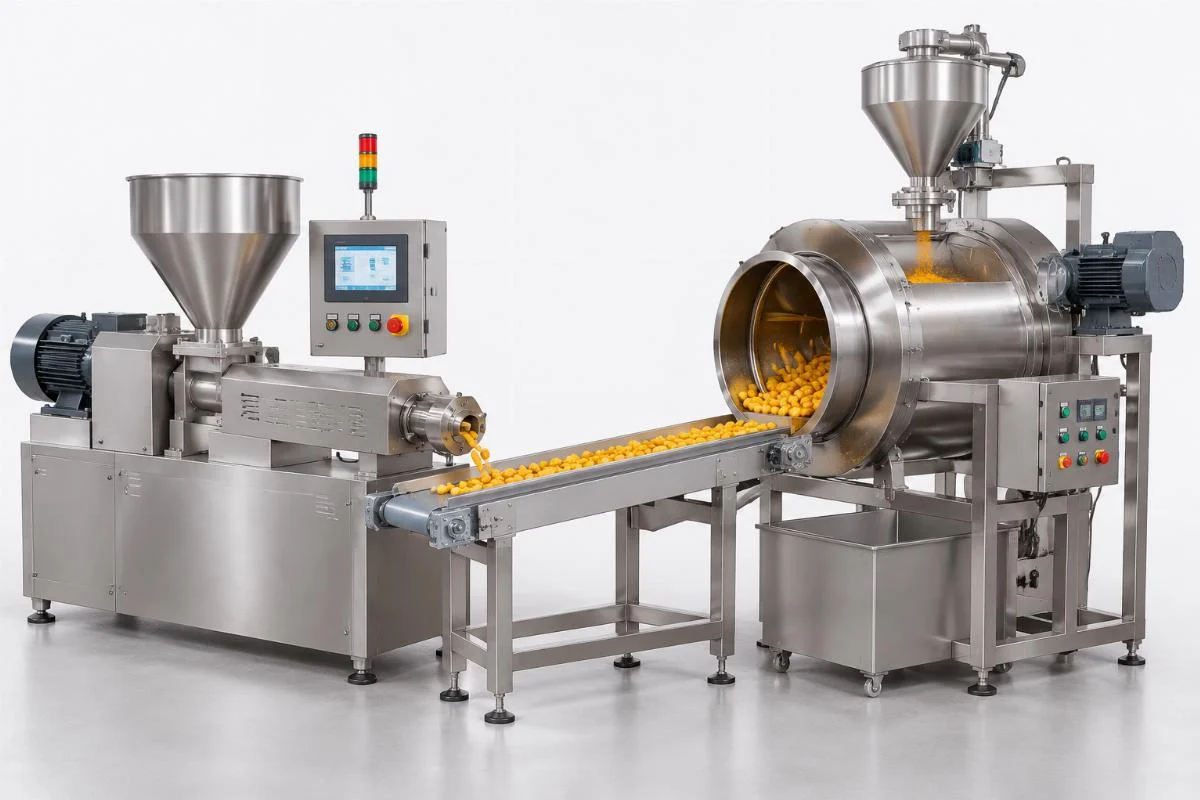
The insight here is clear: the extruder only shapes the product; the auxiliary systems define the final quality and throughput. If your 100-150 kg/h pellet chips line complete machine list does not explicitly detail every conveyor, cooler, and coater, you are buying a partial solution, not a functional factory.
What is the Complete Machine List from Mixing to Packaging?
A seamless multi-stage turnkey configuration ensures continuous material flow, transforming raw starch into retail-ready snacks without manual intervention.
When I review a 100-150 kg/h pellet chips line complete machine list with new clients, I walk them through a comprehensive sequence that covers every physical transformation of the dough. It starts with the raw material handling. A high-speed mixer is mandatory to ensure uniform moisture distribution in the flour blend before it enters the extruder. Uneven moisture leads to unstable pressure and inconsistent pellet expansion.
Next comes the core twin screw extruder chips machine, which gelatinizes the starch and forms the dense pellets. But the real magic happens immediately after. The pellets exit the die at high temperatures and must be transferred via a vibration cooling conveyor to prevent them from sticking together. This is followed by a multi-stage drying system that reduces the internal moisture to a safe level for storage or frying.
After drying, the pellets pass through a flavor coating drum where oil and seasonings are applied evenly. Finally, an automated packaging system weighs and seals the finished product.

Every single stage in this 100-150 kg/h pellet chips line complete machine list must be present. If a supplier offers you the extruder and the dryer but omits the vibration feeder between them, the hot pellets will clump and block the dryer inlet. A true turnkey pellet chips production line leaves zero gaps in the material journey.
How to Match Auxiliary Equipment for Compact Capacity?
Precise throughput matching across all stages prevents upstream material backlog and downstream equipment starvation, ensuring steady-state operation.
Matching the components of a 100-150 kg/h pellet chips line complete machine list is a delicate balancing act. In larger industrial setups, a slight mismatch in conveyor speed can be absorbed by massive buffer bins. In a compact small scale snack extrusion line, there is almost no buffer space. If the cooling conveyor runs slightly slower than the extruder output, the pellets pile up, cool unevenly, and lose their structural integrity.
I once consulted for a Middle East snack startup that bought a twin screw extruder chips machine rated for their target output, but paired it with a dryer designed for a much higher capacity. The dryer’s airflow was too aggressive for the thin layer of pellets moving through it, causing the snacks to over-dry and become brittle before the flavoring stage.
Conversely, if the packaging machine is too slow, the finished snacks back up at the end of the line, forcing the entire 100-150 kg/h pellet chips line complete machine list to shut down prematurely. The key is to calculate the throughput ratio from mixing to extrusion, and then ensure every subsequent conveyor and processing unit has a slightly higher capacity rating to accommodate minor surges.
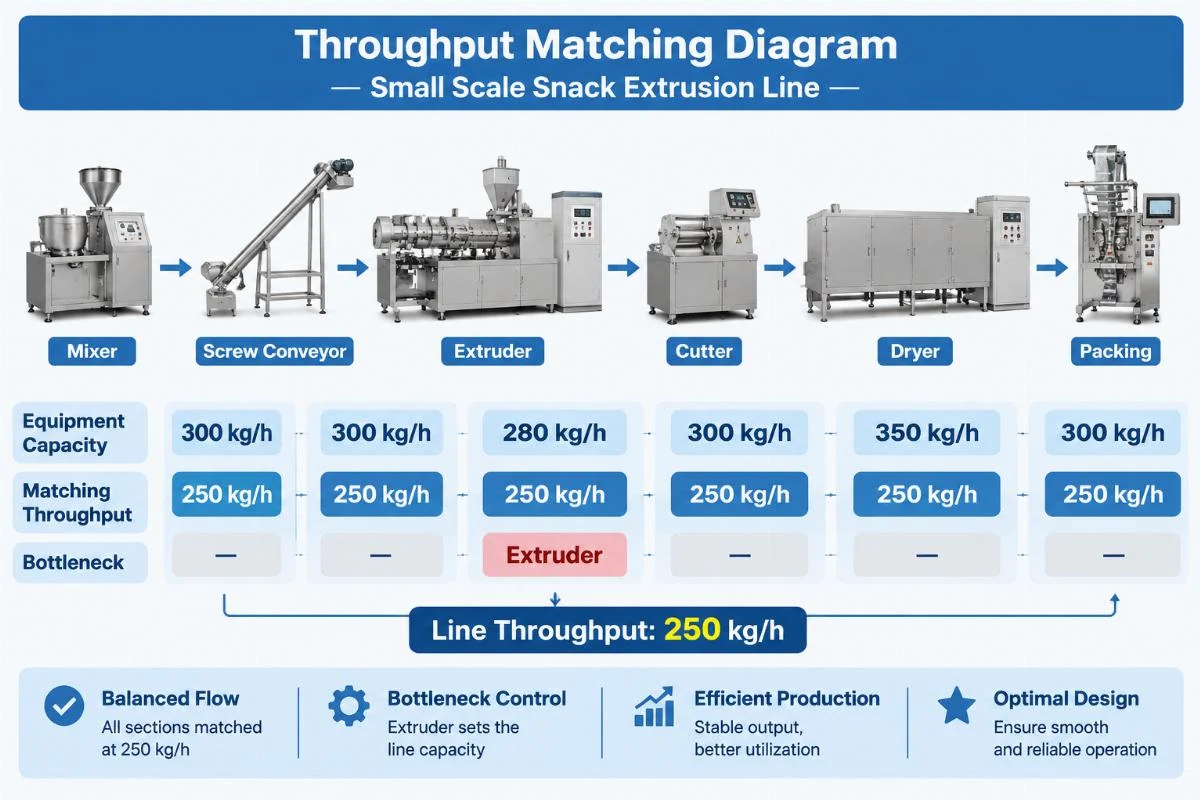
When evaluating a turnkey pellet chips production line, always ask the manufacturer how the auxiliary speeds are synchronized. A well-engineered 100-150 kg/h pellet chips line complete machine list will feature integrated variable frequency drives that allow the entire line to speed up or slow down in perfect unison.
Which Layout Optimizes Space for Small-Scale Facilities?
Compact multi-stage drying and vertical cooling designs significantly reduce the factory footprint without sacrificing the thermal processing capacity required for perfect texture.
Space is a premium commodity for food startups, and the physical layout of a 100-150 kg/h pellet chips line complete machine list can make or break a facility’s viability. Traditional linear layouts stretch the extruder, dryer, and cooler in a single long row, consuming massive amounts of floor space.
During a facility planning session for a European client, we redesigned their turnkey pellet chips production line to utilize a compact, multi-pass drying configuration. By stacking the drying chambers vertically and using a U-shaped cooling conveyor path, we achieved a noticeable footprint reduction.
This compact layout does not just save rent; it improves operational efficiency. Operators can monitor the twin screw extruder chips machine and the flavoring drum from a single central control panel, reducing the need for excessive walking and manual checks. The 100-150 kg/h pellet chips line complete machine list must therefore include not just the machines themselves, but the spatial engineering to fit them into a realistic warehouse or workshop.
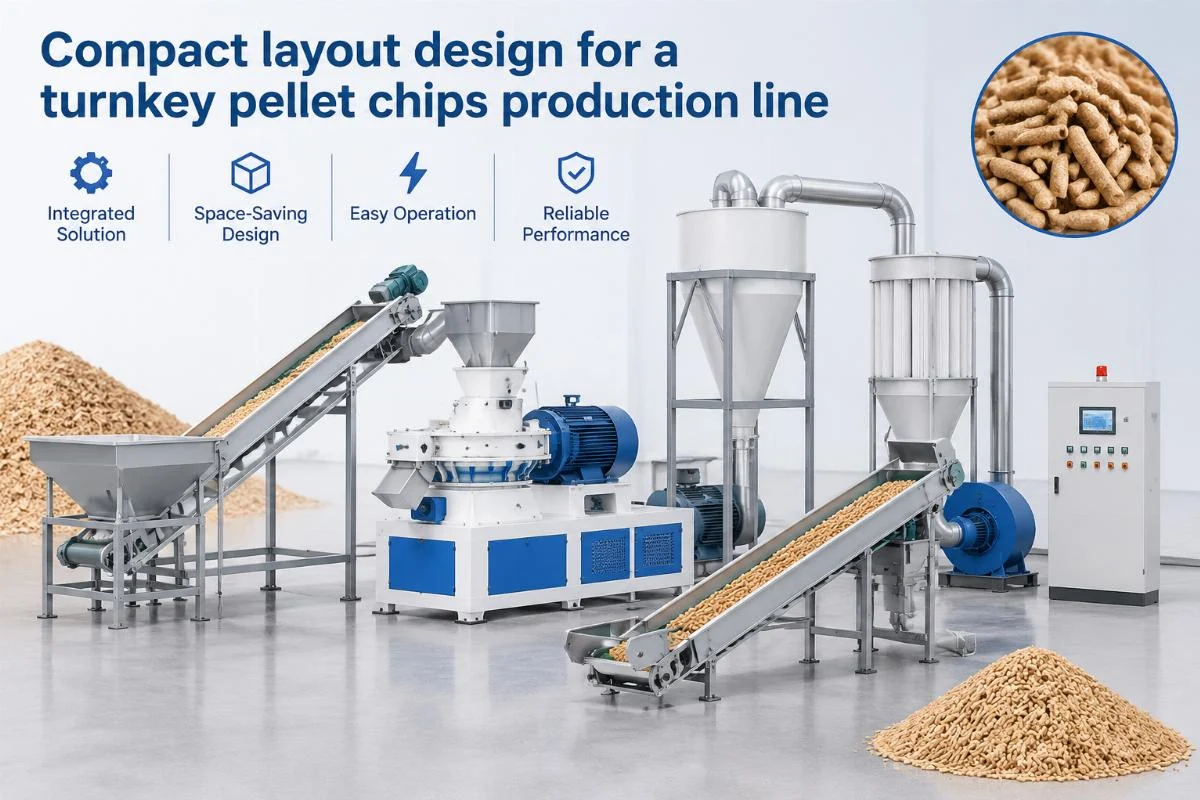
Furthermore, a tightly integrated layout minimizes the length of open conveyors, which reduces the risk of product contamination and heat loss. When sourcing your 100-150 kg/h pellet chips line complete machine list, prioritize suppliers who offer 3D layout planning as part of their turnkey service. The physical arrangement of a small scale snack extrusion line is just as critical as the mechanical specs of the individual motors.
Conclusion
A successful compact extrusion setup relies on the seamless integration of every auxiliary component, not just the power of the main motor. Securing a comprehensive 100-150 kg/h pellet chips line complete machine list ensures that mixing, extrusion, drying, flavoring, and packaging operate in perfect harmony. By prioritizing precise throughput matching and space-optimized layouts, startups can avoid costly downtime and achieve consistent product quality from day one.
Equipment Mentioned in This Article
 frying chips machine
Industrial Deep Fryer Machine Manufacturer Banana Potato Chips French Fries
Industrial Deep Fryer Machine for banana and potato chips features automatic basket lifting and oil filtration. The electric heating system… View Machine Details frying chips machine
100-2000L Tank Deep Fryer Commercial Chips Frying Machine
100-2000L Tank Deep Fryer for Snack Pellets and Chips — handles continuous deep frying and de-oiling for potato, cassava, and… View Machine Details frying chips machine
Electric Batch Frying Machine for French Fries Fast Food Chicken Wing
Industrial Batch Fryer for Fried Snacks and French Fries — features electric or gas heating with automatic basket lifting for… View Machine Details frying chips machine
Industrial Deep Fryer for Potato Chips and Snack Food Production
Industrial Deep Fryer for Potato Chips and Snack Food Production — frying and de-oiling for 2D/3D pellets, papad, and potato… View Machine DetailsRelated Applications

Engineering Perspective
An In-House R&D Team Behind Every Line
Jinan MT Machinery develops its process technology in-house. The team concentrates on the four areas that decide pellet shape, expansion and line stability.
- Expansion technology
- Twin-screw extrusion
- Die design
- PLC/MCC automation
Related Articles
 Nov 16, 2026 · Product & Series Guides
DS Line Rotary Cutter for 2D Snack Pellets Manufacturer
Optimizing Rotary Cutter Options for 2D Snack Pellets eliminates edge burrs and reduces scrap rates by synchronizing cutter speed with extruder screw speed. Selecting… Read This Article Nov 16, 2026 · Product & Series Guides
2D Pellet Die Set for Wheels, Squares, Shells & Tubes Wholesale Supplier
Selecting the right 2D pellet die set requires matching specific shapes with the correct compression ratio to prevent screw jamming and transit corrosion. Discover… Read This Article Nov 16, 2026 · Product & Series Guides
DS85 vs DS95 Pellet Chips Extruder Manufacturer for Sale
Choosing the right DS85 vs DS95 extruder prevents barrel blockage when processing high-meat pellet chip formulas. The DS85 delivers energy efficiency for standard recipes,… Read This ArticleFree Process Check
Send Your Recipe for a Process Check
Jinan MT Machinery engineers review your recipe and return a free process plan within 24 hours. Tell us the product, output, raw material, local voltage and heat source.
Send Your Recipe on WhatsApp