
Arrange Factory Visit to Snack Pellet Machine Supplier Meiteng
- By Jinan MT Machinery

PPT presentations in a conference room prove nothing; the real proof of manufacturing capability happens on the test bench with your specific raw materials.
To successfully arrange factory visit snack pellet machine supplier evaluations, you must bypass the showroom, inspect the machining workshop for food-grade material thickness, run live material trials to verify expansion ratios, and check electrical compatibility to prevent catastrophic inverter failures upon arrival.
Years ago, right after closing a deal at a trade show in Chicago, I flew to a client’s facility to oversee the installation of a twin-screw extrusion line. We powered up the main drive, and within minutes, the inverter burned out completely. The buyer was furious and refused to pay the final installment. The root cause was entirely avoidable: nobody had properly cross-referenced the local industrial power frequency and voltage requirements during the initial technical review. That mid-six-figure loss taught me that verifying machine mechanics is only half the job. When I later transitioned into sales and started bringing international buyers to our manufacturing facility in Jinan, I changed the itinerary completely. We skip the glossy brochures and head straight to the heavy machining area, followed immediately by the live test benches. If you want to arrange factory visit snack pellet machine supplier audits that actually protect your investment, you need to look past the polished exterior and focus on the operational realities.

Let us walk through the exact checkpoints you need to execute when you arrange factory visit snack pellet machine supplier inspections.
What Should You Check First in the Machining Workshop?
You must verify the physical thickness of the food-grade stainless steel and the alloy composition of the screws before looking at any assembled demo units.
When buyers arrive, the natural instinct is to admire the fully assembled, polished extruders on the display floor. However, a shiny exterior hides critical structural compromises. The first step when you arrange factory visit snack pellet machine supplier tours is to demand access to the raw material storage and the heavy machining workshop. You need to see the actual plates and bars before they are cut and welded.
Food safety standards dictate that contact parts must be constructed from specific grades of stainless steel to prevent corrosion and contamination. You are looking for verified material certificates that confirm the use of high-grade austenitic stainless steel for all food contact surfaces. Simply asking if the machine is stainless is not enough; you must see the mill certificates matching the batch numbers.
Furthermore, the screws and barrels endure immense mechanical stress and abrasive friction from raw ingredients. The alloy used for the screw elements must possess exceptional wear resistance to maintain the precise clearance over extended operational periods. During my visits with procurement managers, I always have the workshop manager pull a raw screw element from the shelf. We check the surface treatment and the alloy grading. If a manufacturer hesitates to show you the raw materials or relies on verbal assurances rather than traceable documentation, that is a massive red flag.
Risk Checklist for Machining Inspection:
- Unverified stainless steel grades leading to rapid corrosion in high-moisture environments.
- Substandard screw alloys causing premature wear, which destroys the expansion ratio consistency.
- Lack of traceable mill certificates for raw material batches.
- Welding seams on food contact parts showing porosity or incomplete penetration, creating bacterial traps.

Why is Running a Live Material Trial Non-Negotiable?
You must test the puffing degree and moisture content using your exact raw materials to verify the machine’s actual processing capacity.
Theoretical capacity charts mean nothing if the machine cannot handle the specific formulation you intend to produce. When you arrange factory visit snack pellet machine supplier assessments, insisting on a live material trial is the only way to bridge the gap between laboratory conditions and your factory floor reality.
Different raw materials behave vastly differently under heat, pressure, and shear. A formulation high in protein will require a completely different screw configuration and thermal profile compared to a starch-heavy corn puff recipe. During a trial at our Jinan facility, we feed the buyer’s exact ingredients into the test bench. We measure the expansion ratio, check the bulk density, and verify the moisture content of the extruded pellets.
I recall a startup owner from Latin America who wanted to produce a specific plant-based protein snack. The supplier’s standard settings produced a dense, under-puffed product. By adjusting the screw configuration and the temperature profile on the test bench in real-time, we achieved the exact porous texture they needed. If they had not brought their own raw materials, they would have purchased a machine that was fundamentally mismatched to their product goals.
Risk Checklist for Material Trials:
- Relying on the supplier’s standard test flour, which ignores the unique rheological properties of your specific recipe.
- Failing to measure the moisture content post-extrusion, leading to severe drying inefficiencies later in the line.
- Ignoring the expansion ratio consistency across a prolonged test run, masking potential thermal instability.
- Not testing the flavor coating adhesion on the actual extruded pellet density.

How Do You Verify Electrical and Technical Compatibility?
You must match the local industrial voltage and frequency to the machine’s control systems to prevent immediate component destruction.
This is where many international procurement deals fall apart. The mechanical design might be flawless, but if the electrical infrastructure is mismatched, the machine is useless. When you arrange factory visit snack pellet machine supplier evaluations, the electrical verification phase is where you protect your capital expenditure.
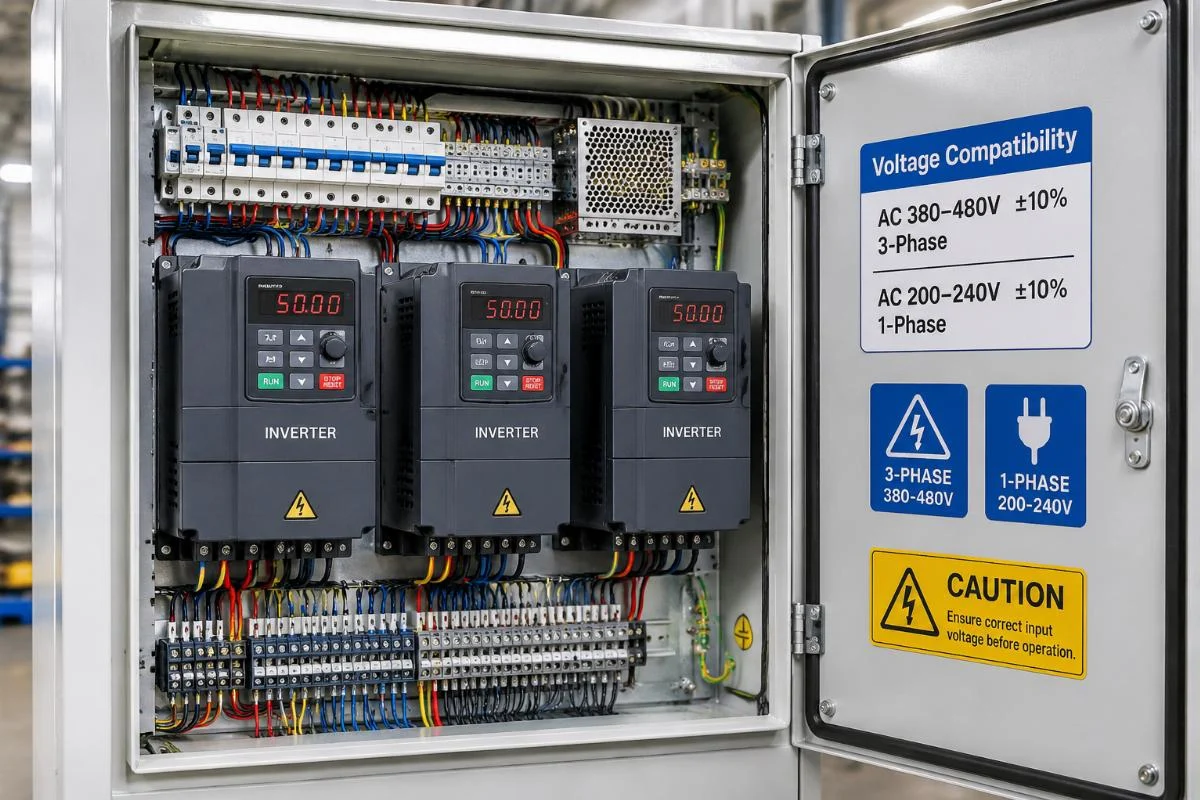
Industrial power standards vary drastically across the globe. A machine configured for a specific voltage and frequency will suffer catastrophic failures if plugged into an incompatible grid. The heating elements, the main drive motors, and the sensitive inverter drives all rely on precise electrical inputs.
I always walk the buyer to the electrical control cabinet. We open the doors and inspect the component ratings. We verify that the inverter is specifically rated for the local frequency. If a buyer is operating in a region with a different frequency standard, the manufacturer must customize the drive parameters and potentially swap out the cooling fans and motor windings. Failing to do this results in the exact scenario I faced years ago: a burned-out inverter and a halted production line. Furthermore, you must verify that the manufacturer offers remote diagnostic support. Modern control systems allow technicians to log in remotely and troubleshoot logic errors, saving massive amounts of downtime.
Risk Checklist for Electrical Compatibility:
- Standardized motors that overheat and fail prematurely due to frequency mismatches.
- Inverters lacking the specific firmware or hardware ratings for the local grid, leading to immediate burnout.
- Control panels lacking the necessary IP ratings for the local environment, such as high humidity or conductive dust.
- Absence of remote diagnostic modules, forcing expensive on-site service calls for minor logic faults.
What Installation and Training Documents Must You Request?
You must secure comprehensive turnkey line design documents, verified sanitary certifications, and structured operator training plans before finalizing the purchase.
Buying an extruder is not just buying a single machine; it is integrating a complex system into your facility. When you arrange factory visit snack pellet machine supplier meetings, the final phase focuses on the documentation that guarantees a smooth launch and long-term compliance.
You need to review the turnkey line design, which includes the layout for the raw material intake, the extrusion host, the multi-layer drying systems, and the flavoring drums. The spatial design must account for your specific facility constraints and local safety regulations.
Equally critical are the sanitary certifications. If you are producing food for human consumption or high-grade pet food, your facility will be subject to strict audits. You must request the valid, verifiable certificates for the entire line. Do not accept a certificate that only covers the extruder while ignoring the downstream cooling and packaging conveyors.
Finally, the human element is the most common point of failure. A highly automated line is useless if the operators do not understand the thermal and mechanical principles behind the extrusion process. You must review the operator training plan. This should not be a brief walkthrough; it must include structured sessions on recipe adjustment, preventative maintenance, and emergency troubleshooting.
Risk Checklist for Documentation and Training:
- Incomplete turnkey layouts that ignore critical airflow requirements for the drying and cooling sections.
- Expired or narrowly scoped sanitary certificates that fail to cover the entire material contact path.
- Lack of detailed preventative maintenance schedules, leading to unexpected mechanical breakdowns.
- Superficial operator training that leaves the production team unable to handle minor recipe variations or fault codes.

Conclusion
A successful factory evaluation relies on physical material verification, live formulation testing, and strict electrical compatibility checks. When you arrange factory visit snack pellet machine supplier audits, bypassing the showroom to focus on the machining workshop, test benches, and control cabinets ensures your production line meets actual operational demands. Secure your investment by demanding traceable documentation and comprehensive training, transforming a simple equipment purchase into a reliable, long-term manufacturing partnership.
Equipment Mentioned in This Article
 3D papad machine
3D Snack Pellet Production Line Fried Extruder Machine
3D Snack Pellet Production Line for Starch-Based Snacks — twin-screw extrusion processes potato, cassava, and corn starch into diverse shapes.… View Machine Details 3D papad machine
Fully Automatic 3D Snack Pellets Extruder Making Machine for Chips
Chips 3D Snack Pellet Extruder Line for 2D/3D Shapes — co-rotating twin-screw extrusion processes potato and cassava starches into papad,… View Machine Details 3D papad machine
2D 3D Snack Pellet Production Line Manufacturer
2D 3D Snack Pellet Production Line for Diverse Shapes from Starches — twin-screw extrusion handles wheat, corn, and cassava. The… View Machine Details 3D papad machine
Automatic 3D Pellet Extruded Corn Puffed Snack Food Production Line
3D Pellet Extruded Snack Food Production Line for Starch Pellets — processes potato, corn, and cassava starch into papad and… View Machine DetailsRelated Applications

Engineering Perspective
An In-House R&D Team Behind Every Line
Jinan MT Machinery develops its process technology in-house. The team concentrates on the four areas that decide pellet shape, expansion and line stability.
- Expansion technology
- Twin-screw extrusion
- Die design
- PLC/MCC automation
Related Articles
 Nov 10, 2026 · Procurement & Trade FAQs
Snack Pellet Line for UAE: Twin-Screw Extruder Manufacturer & Turnkey Service
Buying a snack pellet line UAE requires engineering systems that survive extreme heat and voltage fluctuations, not just finding the lowest price. You must… Read This Article Nov 10, 2026 · Procurement & Trade FAQs
Fast Replacement Pellet Dies from China Manufacturer Meiteng
Minimize extruder downtime by understanding that replacement pellet die delivery time relies on precise formula matching and custom compression ratios rather than just express… Read This Article Nov 10, 2026 · Procurement & Trade FAQs
Snack Pellet Line for Poland & EU: Meiteng Twin-Screw Extruder Manufacturer
Importing a snack pellet line into Poland and the EU requires navigating strict CE machinery directives, EORI customs registration, and adapting equipment to local… Read This ArticleFree Process Check
Send Your Recipe for a Process Check
Jinan MT Machinery engineers review your recipe and return a free process plan within 24 hours. Tell us the product, output, raw material, local voltage and heat source.
Send Your Recipe on WhatsApp