
DS32 Lab Twin-Screw Extruder for Snack Pellet Trials Manufacturer
- By Jinan MT Machinery
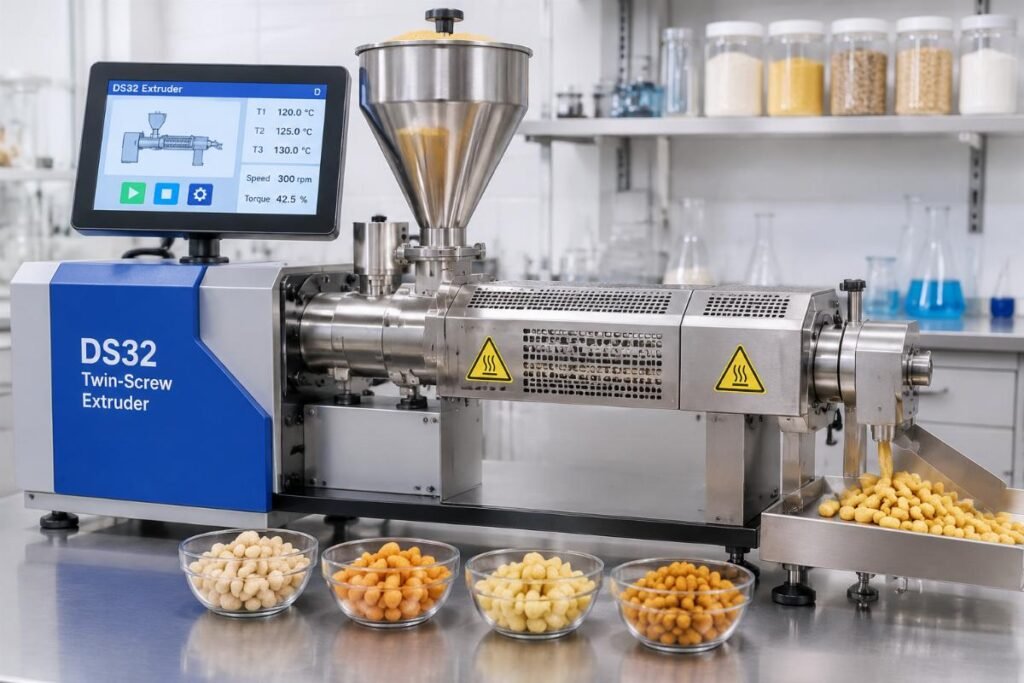
Most buyers assume a lab extruder is just a scaled-down production machine, but recipe validation actually hinges on matching screw geometry to specific starch ratios.
The DS32 lab twin-screw extruder prevents catastrophic paste-ups during snack pellet recipe trials by utilizing precise screw configurations and segmented temperature control, allowing startups to finalize formulations before committing to mass production.
I still remember the Chicago trade show years ago. I was sourcing equipment for a new puffed snack venture and blindly ordered a compact twin-screw unit based purely on its listed throughput. When we finally ran our high-starch recipe, the物料 turned into a solid, carbonized mass inside the barrel. We spent days tearing down the machine, scraping out ruined raw materials, and realizing our screw setup was completely wrong for the viscosity. That failure cost us a mid-six-figure loss in wasted time and ingredients. Now, when I guide clients through snack pellet recipe trials, I never just hand over a spec sheet. We map the exact starch behavior and target expansion rate first. Running a DS32 lab twin-screw extruder is about validating the physics of the dough, not just pushing buttons.
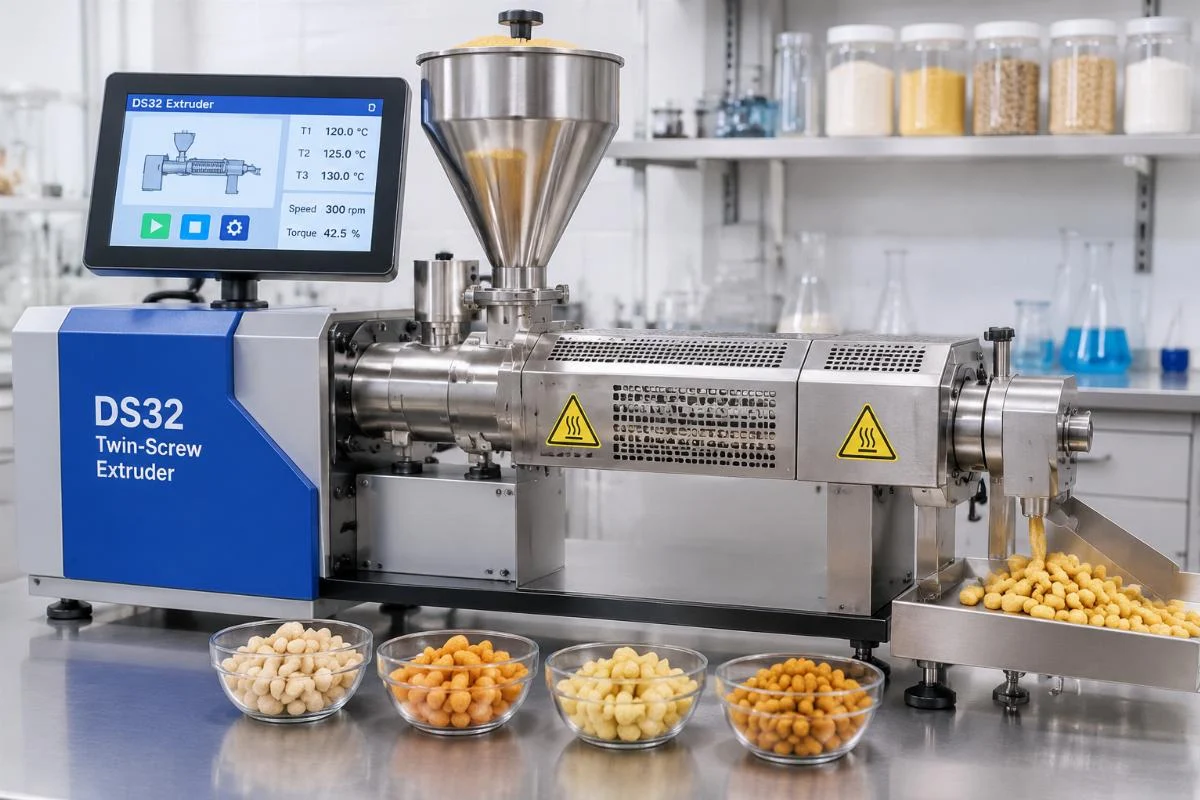
Getting the parameters right on a small scale twin screw extruder is the only way to ensure your commercial launch won’t end in a barrel jam.
Why Standard Lab Extruders Fail in Snack Trials?
Blindly copying mass-production parameters onto a small-scale unit is the primary reason high-starch snack recipes fail during initial trials.
When buyers transition from kitchen prototypes to mechanical extrusion, they often assume the thermal profile of a large machine can be directly replicated on a benchtop unit. This is a fundamental misunderstanding of shear heat generation. In a smaller barrel, the surface-area-to-volume ratio is vastly different, meaning friction and shear forces dominate the melting phase much faster than external heater bands. If you apply a standard high-temperature profile to a high-starch dough in a compact machine, the localized overheating causes immediate carbonization. The starch cross-links and hardens, locking the screws in place.
Consider a snack startup in Latin America trying to develop a corn-based pellet. They took a generic temperature curve from a larger competitor and applied it to their compact test unit. The result was a complete barrel seizure within minutes of feeding. The moisture flash-off wasn’t controlled, and the starch gelatinized too rapidly, turning into a concrete-like plug. They had to dismantle the entire barrel assembly, a process that halted their R&D for weeks.
When we consult on these snack pellet recipe trials, the first step is always analyzing the raw material’s gelatinization threshold. A DS32 lab twin-screw extruder is designed with independent zone controls that respond to the actual shear heat generated by the specific screw elements inside, rather than just relying on the barrel heaters. By understanding that friction is the real driver of melt temperature in small-batch testing, operators can adjust the screw speed and feed moisture to keep the dough in the optimal plastic state without crossing the burn line.
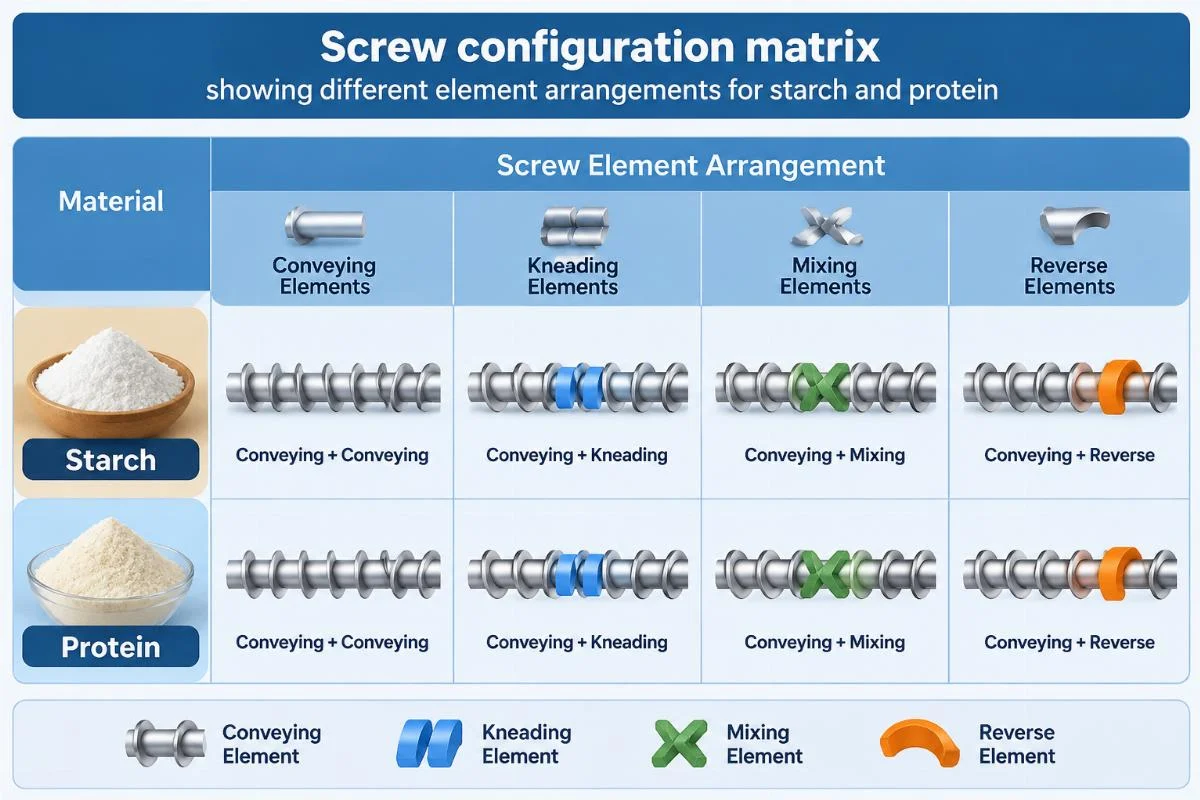
DS32 Screw Configuration Matrix for Different Recipes
The success of any snack pellet recipe trial depends entirely on matching the screw element arrangement to the specific protein and starch ratios of your formulation.
A small scale twin screw extruder is essentially a modular reactor. The barrel is empty until you install the screw elements. If you use a standard conveying setup for a high-protein, low-starch matrix, the material will simply slide through without developing the necessary texture. Conversely, using heavy kneading blocks for a delicate, high-starch corn base will generate excessive shear heat and destroy the expansion potential.
To solve this, we utilize a specific configuration matrix when running trials on the DS32 lab twin-screw extruder. This matrix ensures the shear force and residence time align perfectly with the ingredient behavior.
| Recipe Type | Starch/Protein Ratio | Required Shear Level | Screw Element Strategy | Expansion Outcome |
|---|---|---|---|---|
| High-Starch Corn Pellet | Dominant Starch | Moderate | Conveying with mild kneading | Noticeably high uniform puffing |
| High-Protein Legume Snack | Dominant Protein | High | Intense kneading blocks | Robust texturization |
| Multi-Grain Fiber Blend | Balanced | Variable | Staggered reverse elements | Controlled density |
| Delicate Rice Crisp | Fragile Starch | Low | Wide-pitch conveying | Substantially extended volume |
A European snack manufacturer once struggled with a lentil-based pellet that kept coming out dense and hard. They were using a standard corn screw profile. By shifting to a high-shear kneading configuration on the DS32 lab twin-screw extruder, the protein matrix finally achieved the necessary molecular alignment. The expansion rate jumped from a dense pellet to a light, crispy snack without changing the raw formula.
The beauty of this system is that the screw elements can be rearranged in hours. You can test a high-starch recipe in the morning, swap the elements, and run a high-protein trial in the afternoon. This flexibility is what turns a failed recipe into a commercial success.
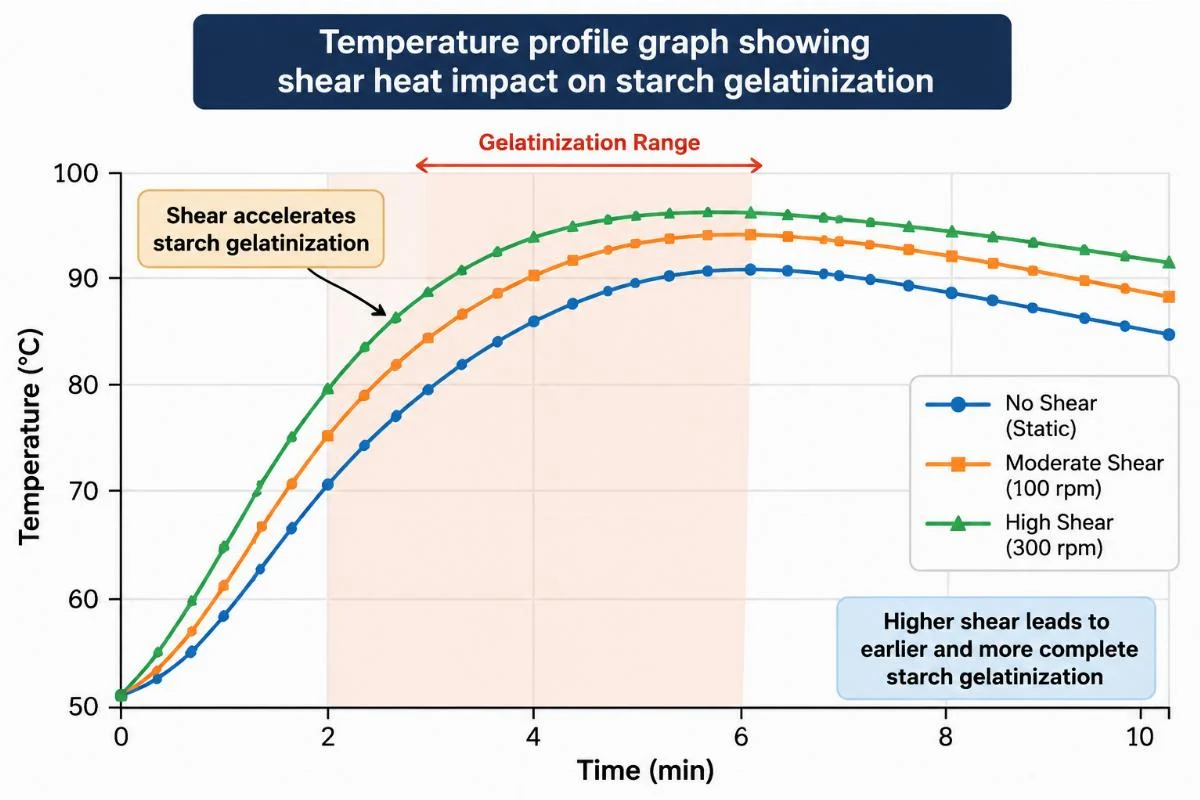
Temperature Control Strategy for Optimal Puffing
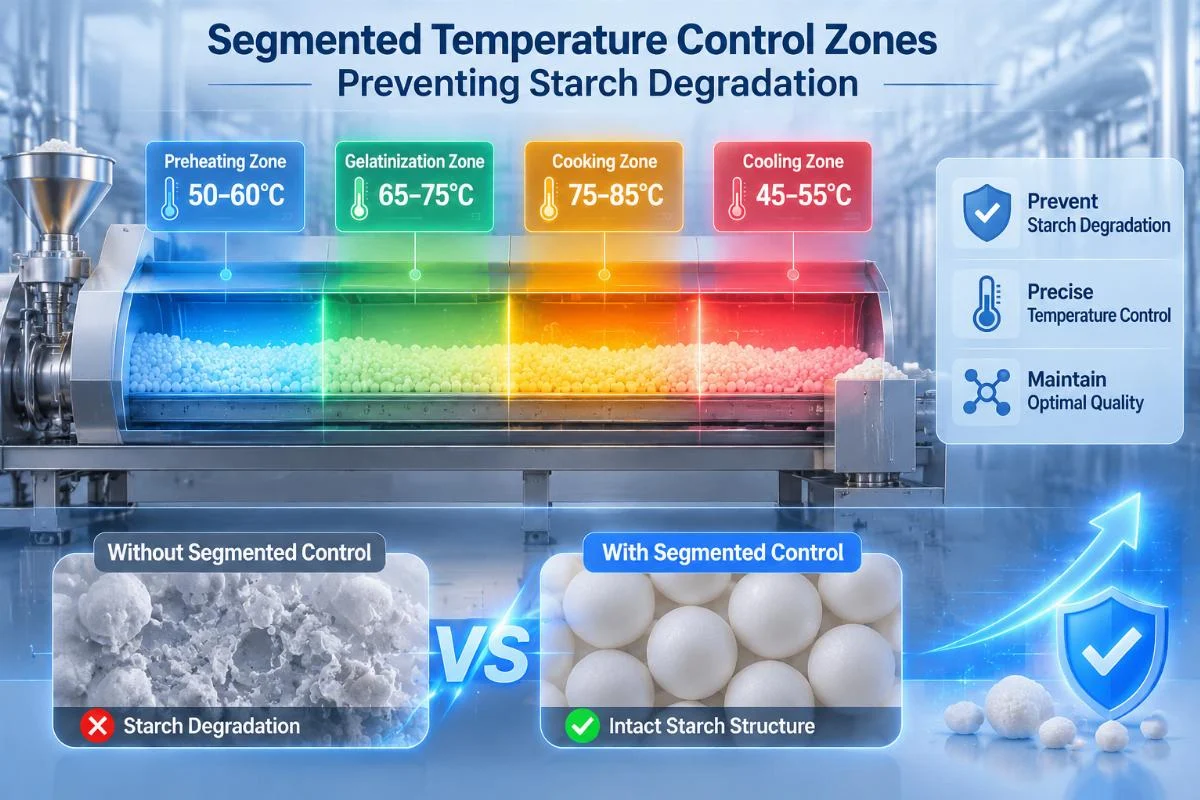
Precise, segmented temperature control is the only way to prevent localized carbonization and ensure consistent puffing across the entire die face.
Many operators treat the barrel heaters as the sole source of thermal energy. In reality, especially during snack pellet recipe trials, the mechanical energy from the screws generates the majority of the heat. If the control system cannot react to these rapid friction spikes, the product quality will fluctuate wildly from the first minute to the last.
The strategy for the DS32 lab twin-screw extruder involves a staggered thermal profile that accounts for the phase changes of the dough.
- Feed Zone: Keep temperatures relatively low to prevent premature bridging or sticking at the feed throat.
- Compression/Kneading Zone: Allow the shear heat to build naturally, using minimal external heating. The goal is to reach the gelatinization point through friction.
- Metering/Die Zone: Precise external heating is applied here to ensure the melt is perfectly homogeneous before it hits the die, ensuring uniform expansion.
A client in the Middle East was producing a potato-starch pellet that was blistering on the surface. The issue wasn’t the recipe; it was that their previous machine lacked the cooling capacity in the kneading zone. The shear heat was pushing the starch past its degradation point. By utilizing the independent cooling loops on the DS32 lab twin-screw extruder, we actively extracted heat during the high-shear phase. The surface blistering vanished completely, and the pellet structure became uniform.
This level of control is critical. Without it, you are just guessing. With it, you can map the exact boundary between a perfectly puffed snack and a carbonized lump.
How to Scale Up from DS32 Trials to Mass Production
The data gathered on a DS32 lab twin-screw extruder provides the exact blueprint needed to scale recipes to commercial lines like the DS65 without losing product integrity.
The ultimate goal of any small scale twin screw extruder is to de-risk the mass production investment. However, scaling up is not as simple as multiplying the throughput. The residence time, shear history, and thermal dynamics change significantly when moving from a lab barrel to a production barrel. If you just copy the lab settings to a large machine, you will likely end up with under-processed or burnt product.
When we run snack pellet recipe trials on the DS32 lab twin-screw extruder, we are not just looking for a good-tasting snack. We are documenting the specific mechanical energy input, the exact screw profile geometry, and the thermal limits of the dough. This data forms the foundation for the scale-up logic.
For example, if a recipe requires a specific sequence of kneading blocks to achieve the right texture on the DS32, the production line (such as the DS65) will use a mathematically proportional screw profile that maintains the same shear intensity per unit volume. The specific speed and feed rates are then calculated to match the residence time recorded during the lab trials.
A startup in Southeast Asia used the DS32 lab twin-screw extruder to perfect a complex vegetable-infused corn puff. Once the recipe was locked, the specific energy data was transferred to their full-scale DS65 line. Because the screw geometry and thermal boundaries were already mapped, the commercial line produced saleable product on the very first day of operation. There was no weeks-long trial-and-error phase on the expensive production equipment.
By treating the DS32 lab twin-screw extruder as a data-gathering reactor rather than just a mini-producer, you ensure that your transition to mass production is seamless, predictable, and profitable.

Conclusion
Validating a snack recipe requires matching screw geometry and thermal dynamics to the specific raw material, not just running a smaller machine.
The DS32 lab twin-screw extruder allows startups to map the exact shear and temperature boundaries of their formulations, preventing catastrophic barrel seizures and ensuring that the transition to mass production lines like the DS65 is based on solid, verifiable data rather than guesswork.
Equipment Mentioned in This Article
 3D papad machine
3D Snack Pellet Production Line Fried Extruder Machine
3D Snack Pellet Production Line for Starch-Based Snacks — twin-screw extrusion processes potato, cassava, and corn starch into diverse shapes.… View Machine Details 3D papad machine
Fully Automatic 3D Snack Pellets Extruder Making Machine for Chips
Chips 3D Snack Pellet Extruder Line for 2D/3D Shapes — co-rotating twin-screw extrusion processes potato and cassava starches into papad,… View Machine Details 3D papad machine
2D 3D Snack Pellet Production Line Manufacturer
2D 3D Snack Pellet Production Line for Diverse Shapes from Starches — twin-screw extrusion handles wheat, corn, and cassava. The… View Machine Details 3D papad machine
Automatic 3D Pellet Extruded Corn Puffed Snack Food Production Line
3D Pellet Extruded Snack Food Production Line for Starch Pellets — processes potato, corn, and cassava starch into papad and… View Machine DetailsRelated Applications

Engineering Perspective
An In-House R&D Team Behind Every Line
Jinan MT Machinery develops its process technology in-house. The team concentrates on the four areas that decide pellet shape, expansion and line stability.
- Expansion technology
- Twin-screw extrusion
- Die design
- PLC/MCC automation
Related Articles
 Nov 15, 2026 · Product & Series Guides
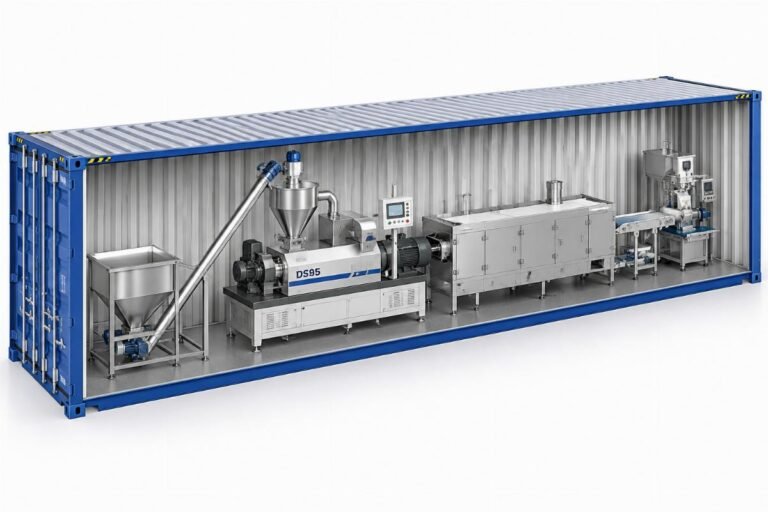
DS95 Pellet Snack Line Manufacturer for High-Output Export Factories
The DS95 Pellet Snack Line maximizes high-volume pellet production through optimized twin-screw extrusion while solving critical export logistics and local power matching challenges. Discover… Read This Article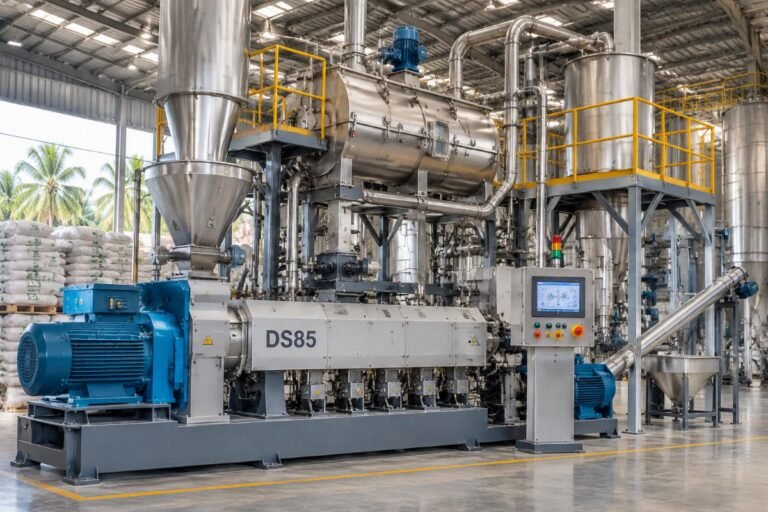 Nov 15, 2026 · Product & Series Guides
DS85 Twin-Screw Extruder Manufacturer for Medium-Scale Pellet Chips Plants
Overcoming poor conditioning temperature and uneven moisture distribution is essential to unlock the true capacity of a DS85 Twin-Screw Extruder in medium-scale pellet plants.… Read This Article Nov 15, 2026 · Product & Series Guides
DS70 Snack Pellet Line Layout & Output: Manufacturer for Sale
Maximizing DS70 Snack Pellet Line output requires practical spatial layout and realistic machine matching rather than relying on theoretical specifications. Discover how to optimize… Read This ArticleFree Process Check
Send Your Recipe for a Process Check
Jinan MT Machinery engineers review your recipe and return a free process plan within 24 hours. Tell us the product, output, raw material, local voltage and heat source.
Send Your Recipe on WhatsApp