
DS50 Small Snack Pellet Line Manufacturer for Startups & Pilot Plants
- By Jinan MT Machinery

Small pilot lines are not merely scaled-down versions of commercial machines; they demand significantly stricter thermal and moisture logic to function correctly.
The DS50 Small Snack Pellet Line serves as the critical first step for startups to validate formulas and thermal dynamics before attempting commercial scaling, ensuring recipe stability and preventing batch failures during continuous runs.
Walking through the exhibition halls in Foshan, I frequently meet startup founders armed with business plans, looking for the perfect equipment to launch their snack or plant-based brands. Years ago, while assembling twin-screw extruders in Jinan, I believed that simply building a robust machine was enough to guarantee success. That assumption was shattered when a European plant-based team ordered a small pilot line. They struggled with severe moisture control issues, and the compact machine’s heat dissipation failed during continuous operation. The result? The expanded pellets completely stuck to the die, nearly ruining an entire batch. Watching them troubleshoot made me realize that selecting a pilot line is never about buying a miniature toy; it is about passing the first commercialization test by aligning formula mechanics with machine thermodynamics. When evaluating a DS50 Small Snack Pellet Line, founders must look beyond basic hardware specs and understand the shear heat dynamics at play.

Transitioning from a kitchen recipe to a commercial product requires navigating the hidden variables of extrusion physics.
Why Do Most Startup Pilot Lines Fail in Continuous Runs?
The majority of pilot line failures stem from heat buildup and poor moisture control, which ruin expansion ratios, rather than inadequate machine specifications.
When startups first test their recipes, they often run the equipment for short bursts. However, commercial validation requires extended continuous runs. During these prolonged operations, the mechanical energy from the screws generates significant shear heat. In smaller machines, the surface-area-to-volume ratio is different, meaning thermal dissipation behaves uniquely compared to larger commercial extruders. If the thermal logic is ignored, the barrel temperature drifts upward uncontrollably. This unmanaged heat alters the moisture-to-expansion ratios, leading to inconsistent pellet density and surface defects.
Furthermore, moisture variance is a silent killer in small-scale extrusion. Even minor fluctuations in raw material moisture content can cause the dough viscosity to change dramatically. In a small barrel, this leads to pressure spikes and die sticking. A common misconception is that hardware specs alone guarantee success. In reality, it is the precise formula-machine matching that prevents die sticking. I have seen teams blame the DS50 Small Snack Pellet Line for their failures, only to discover that their ingredient pre-conditioning was entirely uncontrolled. The machine was merely reacting to the inconsistent input it was given.

How Does the DS50 Line Solve Thermal and Moisture Logic?
The DS50 line utilizes optimized screw configurations and precise temperature zoning to ensure stable pellet forming, effectively managing shear heat and moisture variance.
Solving the thermal and moisture puzzle requires a machine designed with pilot-scale realities in mind. The DS50 Small Snack Pellet Line addresses these challenges through its modular barrel design and advanced screw configuration. By allowing operators to adjust the screw elements, the machine can tailor the shear intensity to the specific rheology of the formula. This flexibility is crucial for plant-based proteins or complex snack blends, where different ingredients require varying levels of mechanical energy to achieve the desired texture.
Temperature control is equally critical. The DS50 features independent heating and cooling zones along the barrel. Unlike basic models that rely on simple on-off heating bands, this line employs precise fluid cooling or targeted air cooling to counteract the shear heat generated during high-speed runs. This ensures that the thermal profile remains stable from the feeding zone to the die face. When the thermal logic is locked in, the moisture inside the dough flashes uniformly upon exiting the die, creating a consistent, porous structure without the dense, unexpanded cores that plague poorly controlled runs.

What Makes DS50 the Right First Step for Commercialization?
The DS50 validates recipes and de-risks the transition to full-scale production by providing scalable thermal and mechanical data.
The ultimate goal of any pilot run is to gather data that can be directly translated to mass production. The DS50 Small Snack Pellet Line is engineered to mimic the mechanical and thermal environment of its larger commercial counterparts. When a startup successfully runs a recipe on the DS50, the specific screw profile, temperature settings, and moisture parameters can be scaled up with high accuracy. This seamless transition saves immense amounts of time and raw materials that would otherwise be wasted testing unproven variables on a massive commercial line.
Moreover, running a pilot line is as much about operator training as it is about recipe validation. Startups need their teams to understand how the dough responds to pressure and heat changes. The DS50 provides a manageable, lower-risk environment for operators to learn these nuances. By mastering the DS50 Small Snack Pellet Line, a startup ensures that when they eventually scale up, their team already possesses the practical knowledge to maintain product consistency, effectively bridging the gap between a kitchen concept and a commercial reality.

Conclusion
Validating a recipe requires mastering thermal and moisture dynamics, not just running a smaller machine. The DS50 Small Snack Pellet Line provides the precise control and scalable data necessary for startups to prove their formulas and prepare for commercial production without the risk of catastrophic batch failures.
Equipment Mentioned in This Article
 3D papad machine
2D 3D Snack Pellet Production Line Manufacturer
2D 3D Snack Pellet Production Line for Diverse Shapes from Starches — twin-screw extrusion handles wheat, corn, and cassava. The… View Machine Details 3D papad machine
3D Snack Pellet Production Line Fried Extruder Machine
3D Snack Pellet Production Line for Starch-Based Snacks — twin-screw extrusion processes potato, cassava, and corn starch into diverse shapes.… View Machine Details 3D papad machine
Fully Automatic 3D Snack Pellets Extruder Making Machine for Chips
Chips 3D Snack Pellet Extruder Line for 2D/3D Shapes — co-rotating twin-screw extrusion processes potato and cassava starches into papad,… View Machine Details 3D papad machine
Automatic 3D Pellet Extruded Corn Puffed Snack Food Production Line
3D Pellet Extruded Snack Food Production Line for Starch Pellets — processes potato, corn, and cassava starch into papad and… View Machine DetailsRelated Applications

Engineering Perspective
An In-House R&D Team Behind Every Line
Jinan MT Machinery develops its process technology in-house. The team concentrates on the four areas that decide pellet shape, expansion and line stability.
- Expansion technology
- Twin-screw extrusion
- Die design
- PLC/MCC automation
Related Articles
 Nov 16, 2026 · Product & Series Guides
DS Line Rotary Cutter for 2D Snack Pellets Manufacturer
Optimizing Rotary Cutter Options for 2D Snack Pellets eliminates edge burrs and reduces scrap rates by synchronizing cutter speed with extruder screw speed. Selecting… Read This Article Nov 16, 2026 · Product & Series Guides
2D Pellet Die Set for Wheels, Squares, Shells & Tubes Wholesale Supplier
Selecting the right 2D pellet die set requires matching specific shapes with the correct compression ratio to prevent screw jamming and transit corrosion. Discover… Read This Article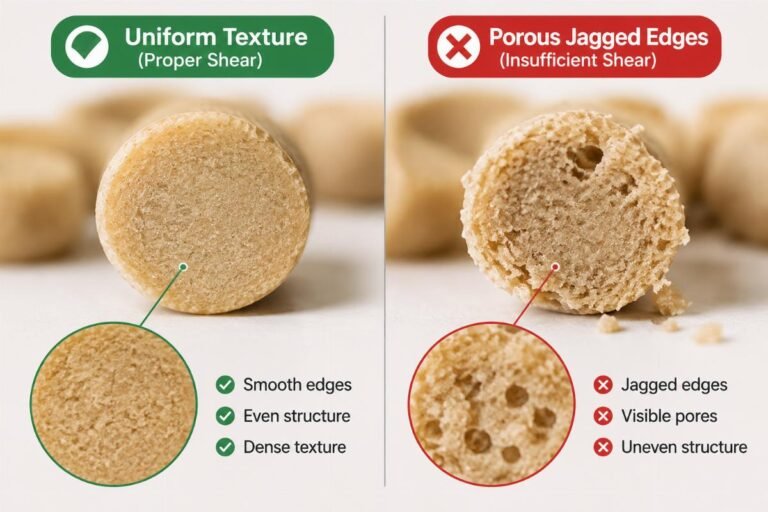 Nov 16, 2026 · Product & Series Guides
DS85 vs DS95 Pellet Chips Extruder Manufacturer for Sale
Choosing the right DS85 vs DS95 extruder prevents barrel blockage when processing high-meat pellet chip formulas. The DS85 delivers energy efficiency for standard recipes,… Read This ArticleFree Process Check
Send Your Recipe for a Process Check
Jinan MT Machinery engineers review your recipe and return a free process plan within 24 hours. Tell us the product, output, raw material, local voltage and heat source.
Send Your Recipe on WhatsApp