
Hollow Pillow & Tube Pellet Snack Extrusion Line Manufacturer
- By Jinan MT Machinery
Mold design rarely causes shape deformation; thermal and moisture imbalances are responsible for the vast majority of structural failures.
Achieving a perfect hollow pillow and tube pellet snacks extrusion line setup relies on dynamically balancing raw material moisture, barrel temperature, and screw speed, rather than just relying on mechanical tooling.
I still remember the sweltering afternoon in a Riyadh production facility years ago. We had just fired up a new twin screw extruder for hollow snack pellets, and the dough was flowing smoothly through the die. But within minutes, the tube pellets collapsed and stuck together into a solid, unrecognizable mass. The client was furious. I had been so focused on the mechanical alignment of the die that I ignored the ambient humidity and the batch-to-batch variation in the flour moisture. The dough was simply too wet for the local temperature, causing it to fuse rather than expand.. That day, standing in front of a ruined batch, I realized that selling a hollow pillow and tube pellet snacks extrusion line is never just about handing over a machine and a parameter sheet. It is about understanding the invisible variables in the factory environment. Now, before discussing any screw configuration, I always ask about the local climate, the raw material storage conditions, and the specific batch characteristics.
Once you understand that the environment dictates the process, the real work of shaping begins.
Why Do Hollow Snacks Fail to Keep Their Shape?
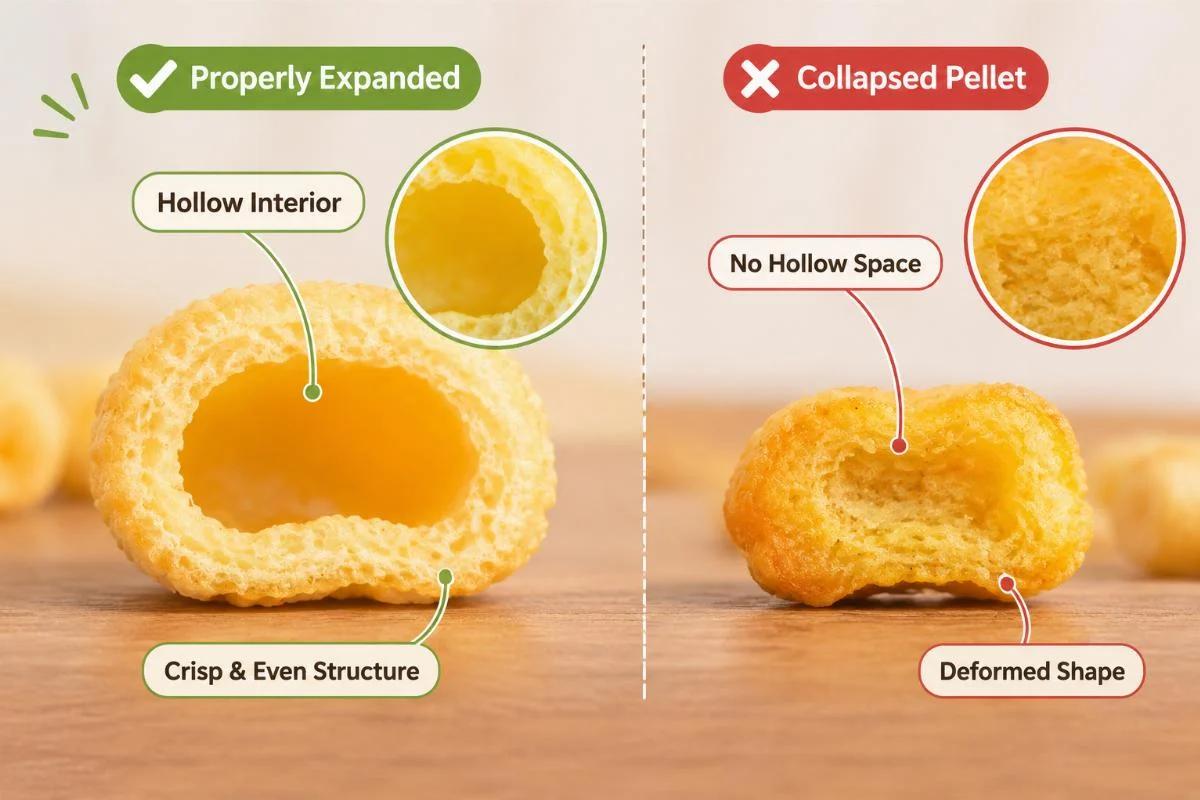
Most manufacturers mistakenly blame the die design when their hollow snacks collapse, warp, or fuse together, ignoring the underlying thermal and moisture dynamics.
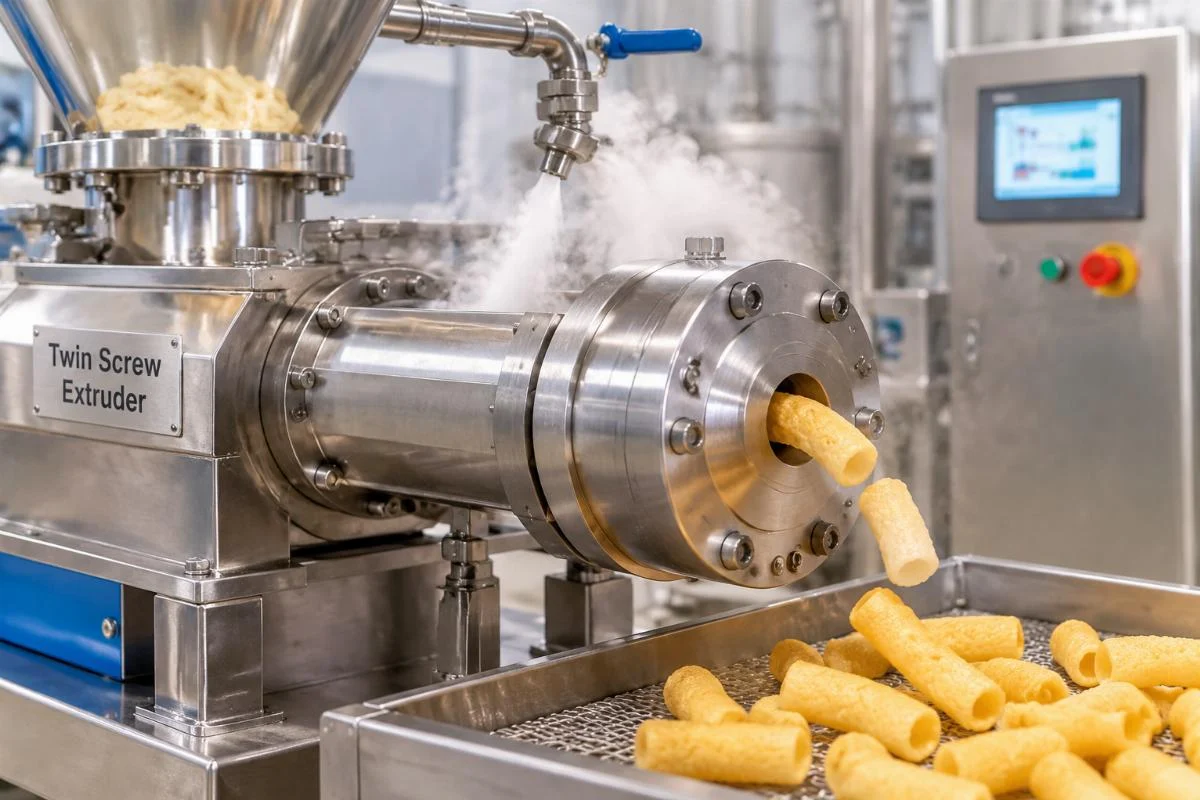
When a tube shaped puff snack making machine produces deformed products, the immediate reaction is often to order a new die or adjust the cutting blade. However, industry failure analysis consistently shows that the root cause lies in the physical state of the dough before it even reaches the die face.. If the moisture content of the raw material fluctuates, the gelatinization process inside the barrel becomes unpredictable.
In a recent project across multiple regions in Africa, a startup faced severe issues with their tube pellets collapsing immediately after extrusion. They assumed the die temperature was too low. However, upon reviewing their raw material intake, we found that the flour batches had absorbed significant moisture during the rainy season. The excess water turned into steam too early in the barrel, destroying the structural integrity of the dough matrix before it could form a stable hollow core. By simply adjusting the feeder rate and introducing controlled steam injection further down the barrel, the structural stability was restored..
The hollow structure is incredibly fragile. It requires a precise balance where the dough is plastic enough to expand but viscous enough to hold its shape upon exiting the die. If the shear heat generated by the screws is not properly managed, the dough can over-gelatinize, becoming too brittle to maintain a hollow center. Conversely, if the temperature is too low, the dough remains too dense, resulting in a solid pellet rather than a hollow one. Therefore, the failure to keep the shape is almost always a failure to control the thermodynamic environment inside the barrel.
How Does the Twin-Screw Extruder Actually Form the Tube?
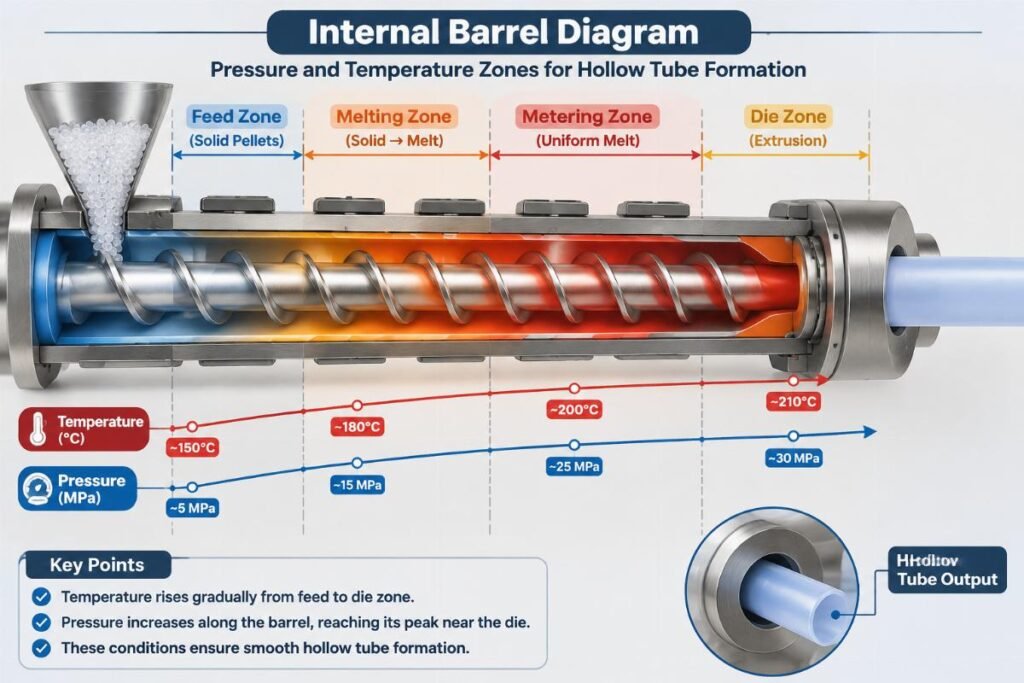
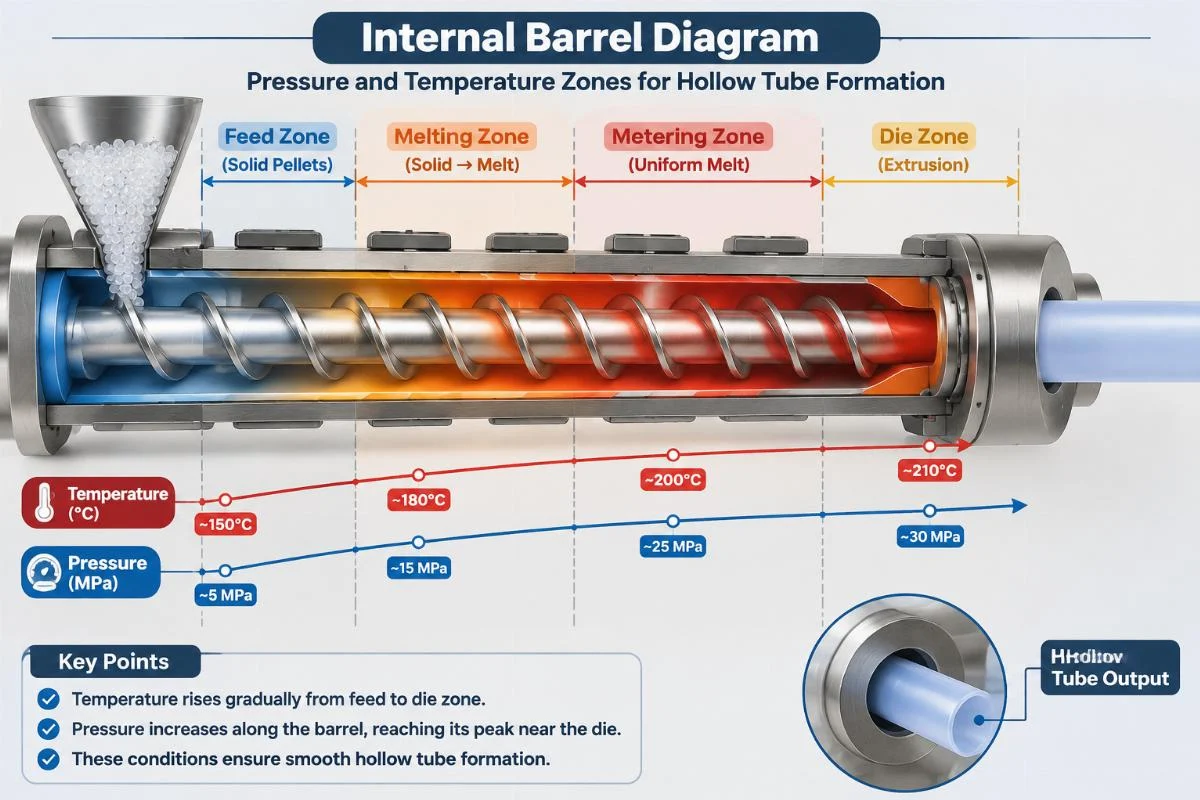
The formation of a hollow tube is not merely a mechanical extrusion process but a complex thermodynamic transformation where shear heat and pressure gelatinize the dough before die expansion.
To understand how a twin screw extruder for hollow snack pellets creates a hollow center, one must look at the pressure and temperature profile along the barrel. The screws do not just push the dough forward; they knead, shear, and cook it. As the dough moves through the compression zones, the mechanical energy from the rotating screws is converted into thermal energy..
For a tube shape, the die is equipped with a central pin or a specific flow divider that forces the dough to split and flow around it, merging on the other side to form a continuous tube. However, this mechanical splitting only works if the dough has reached the correct rheological state. If the dough is under-processed, it will not fuse properly behind the pin, resulting in a split tube. If it is over-processed, the pressure buildup will cause the dough to fracture or expand uncontrollably the moment it exits the die.
During a commissioning trip in Latin America, we encountered a situation where the pillow snacks had uneven hollow centers. The client had increased the screw speed to boost output, a common but flawed strategy. The higher speed dramatically increased the shear heat, causing the dough to reach its gelatinization point too early. The pressure peaked before the die, leading to explosive and uneven expansion. By recalibrating the screw configuration to reduce shear in the metering zone and synchronizing the cutter frequency, we stabilized the pressure drop at the die face.. The hollow center became uniform, proving that the tube is formed by controlling the energy input, not just the metal tooling.
What Are the Critical Parameters for Pillow vs. Tube Shapes?
Pillow shapes demand precise steam injection and moisture control, whereas tube shapes require strict die temperature management and cutter synchronization to prevent collapse.
While both products are hollow, their structural requirements dictate different parameter strategies. A pillow snack relies on a uniform expansion in all directions to create its rounded, puffed shape. This requires a highly homogeneous dough matrix with consistent moisture distribution. Steam injection is often utilized in the final stages of the barrel to introduce rapid, controlled expansion right at the die. If the steam is not evenly distributed, one side of the pillow will expand more than the other, leading to asymmetrical products.
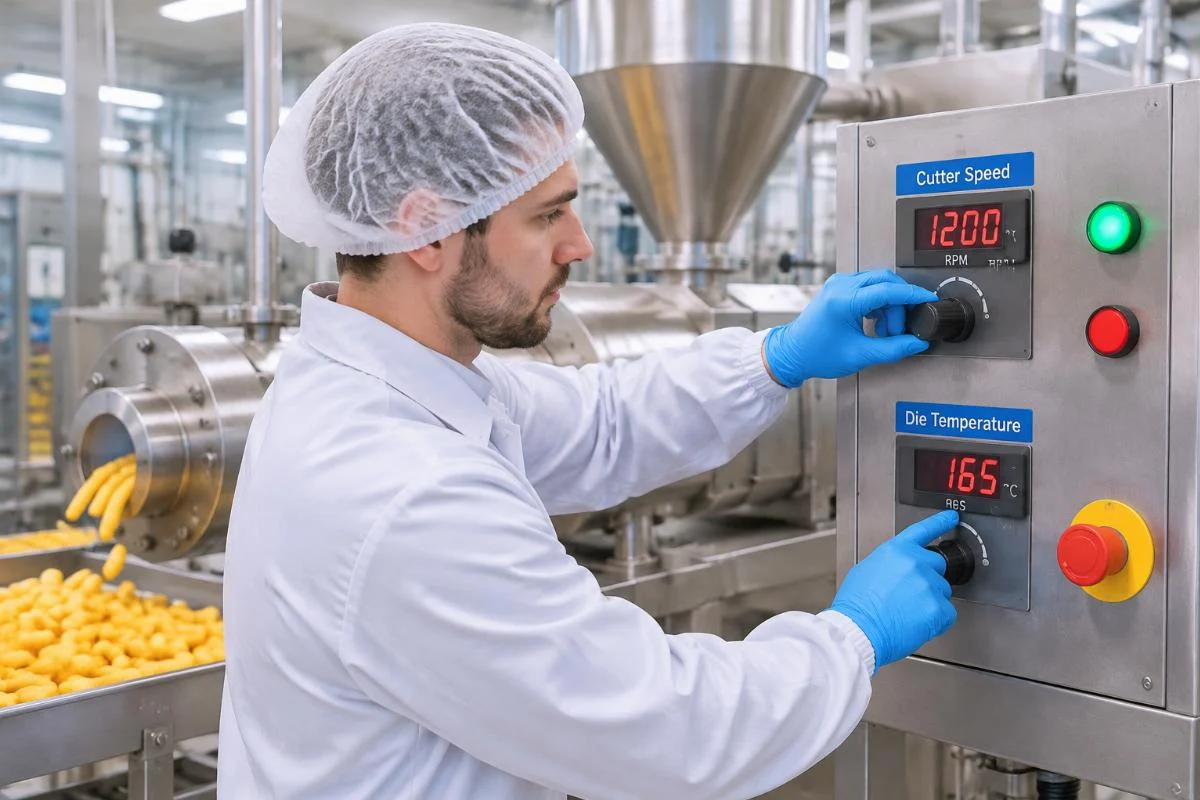
On the other hand, a tube shape is highly susceptible to gravity and cooling rates. As the continuous tube exits the die, it must be cut cleanly without crushing the delicate walls. This is where the cutter speed and the die face temperature become critical. If the die temperature is too low, the outer surface of the tube cools and hardens too quickly, while the inner surface remains soft, causing the tube to warp or flatten.
| Parameter Focus | Pillow Shape Requirements | Tube Shape Requirements |
|---|---|---|
| Moisture Control | Highly homogeneous distribution for uniform radial expansion | Strict control to prevent wall collapse post-extrusion |
| Thermal Management | Precise steam injection for rapid, even puffing | Strict die face temperature to maintain structural integrity |
| Cutting Dynamics | Standard synchronization for clean separation | High-precision cutter frequency to avoid crushing thin walls |
| Shear Heat | Controlled to ensure complete gelatinization without brittleness | Managed to prevent premature expansion before the die |
In a Middle East startup, the high ambient temperature was causing the dough to stick to the cutter blades, ruining the cut ends of the tube pellets. The solution was not to change the cutter design, but to adjust the cooling water circulation around the die head and slightly reduce the moisture content of the raw material blend.. By treating the entire environment as part of the extrusion process, the sticking issue was eliminated.
How to Choose the Right Extrusion Line for Your Factory?
Selecting the correct hollow pillow and tube pellet snacks extrusion line requires matching the screw configuration and motor power to your specific local humidity and raw material batches, rather than just looking at output capacity.
When startup owners approach the market for a tube shaped puff snack making machine, they often focus entirely on the requested capacity per hour. However, a machine that runs perfectly in a dry, temperate climate might fail completely in a humid, tropical environment if the screw configuration and motor torque are not appropriately specified. The screw elements must be designed to handle the specific shear requirements of your raw material blend, providing enough mechanical energy to gelatinize the starch without generating excessive, uncontrolled heat.
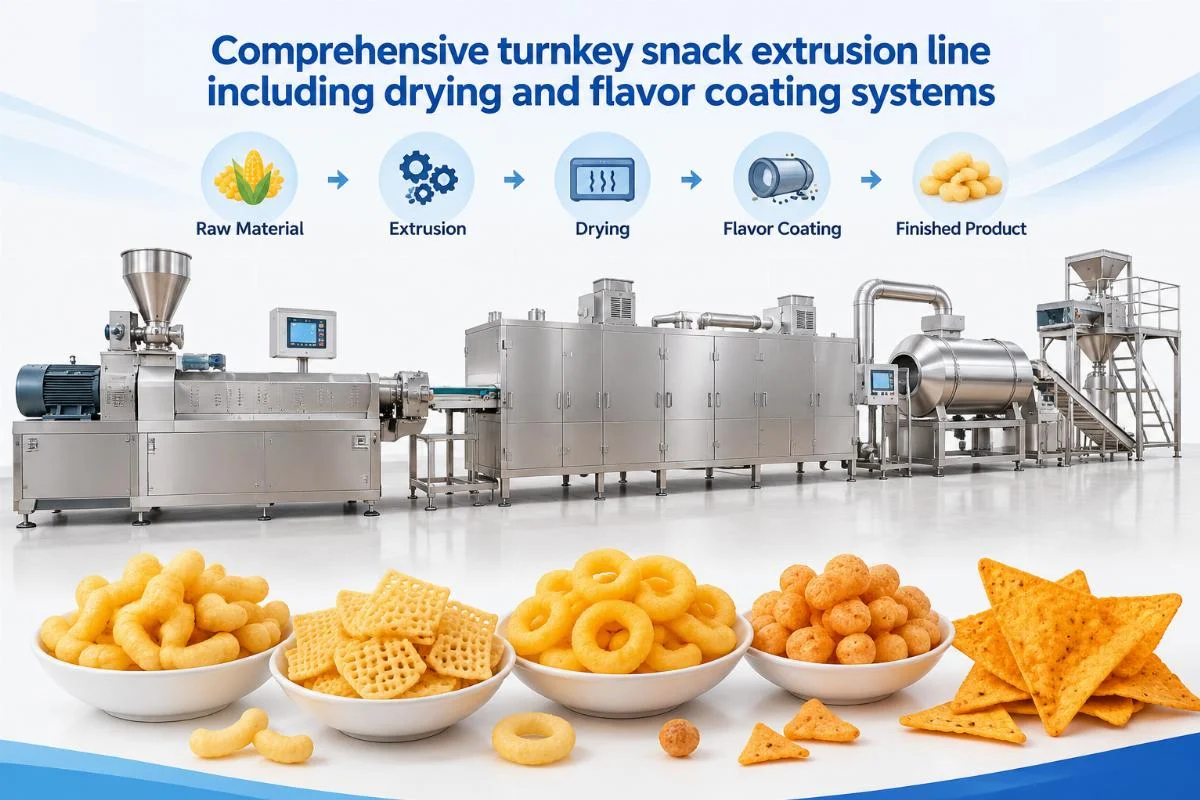
At Meiteng, we approach the design of a hollow pillow and tube pellet snacks extrusion line as a comprehensive engineering project. We do not simply ship a standard machine; we analyze your factory’s environmental conditions and your specific formula requirements. Our turnkey solutions include customized screw configurations tailored to your raw material’s rheology, ensuring that the shear heat and pressure profiles are optimized for your local climate.
Furthermore, we provide extensive formula development support. If your local flour batch has a different protein or moisture content than what you used in your initial trials, our R&D team will adjust the formulation and the machine parameters accordingly. We also handle the integration of the entire downstream process, including the drying, cooling, and flavor-coating systems, which are essential for stabilizing the hollow structure after extrusion..
By choosing a partner who understands the intricate balance between thermodynamics, raw material variability, and mechanical design, you ensure that your hollow pillow and tube pellet snacks extrusion line delivers consistent, high-quality products from day one. The right line is not just about moving dough; it is about mastering the invisible forces that create the perfect hollow snack.
Conclusion
Perfect hollow shaping is a triumph of thermodynamic control over mechanical tooling. Mastering the hollow pillow and tube pellet snacks extrusion line requires a deep understanding of moisture dynamics, shear heat management, and environmental variables. By prioritizing these critical parameters and partnering with a manufacturer who offers customized, turnkey solutions, food producers can consistently achieve the structural integrity and quality that the market demands.
Equipment Mentioned in This Article
 3D papad machine
2D 3D Snack Pellet Production Line Manufacturer
2D 3D Snack Pellet Production Line for Diverse Shapes from Starches — twin-screw extrusion handles wheat, corn, and cassava. The… View Machine Details 3D papad machine
3D Snack Pellet Production Line Fried Extruder Machine
3D Snack Pellet Production Line for Starch-Based Snacks — twin-screw extrusion processes potato, cassava, and corn starch into diverse shapes.… View Machine Details 3D papad machine
Fully Automatic 3D Snack Pellets Extruder Making Machine for Chips
Chips 3D Snack Pellet Extruder Line for 2D/3D Shapes — co-rotating twin-screw extrusion processes potato and cassava starches into papad,… View Machine Details 3D papad machine
Automatic 3D Pellet Extruded Corn Puffed Snack Food Production Line
3D Pellet Extruded Snack Food Production Line for Starch Pellets — processes potato, corn, and cassava starch into papad and… View Machine DetailsRelated Applications

Engineering Perspective
An In-House R&D Team Behind Every Line
Jinan MT Machinery develops its process technology in-house. The team concentrates on the four areas that decide pellet shape, expansion and line stability.
- Expansion technology
- Twin-screw extrusion
- Die design
- PLC/MCC automation
Related Articles
 Nov 15, 2026 · Applications & Industries
Puffed Corn Snacks & Pellet Chips Line Manufacturer Meiteng
Combining puffed corn snacks and pellet chips production line maximizes equipment utilization and reduces initial capital expenditure for startup manufacturers. Real yield depends on… Read This Article Nov 14, 2026 · Applications & Industries
High-Protein Snack Pellets Extruder Line: Pea & Soy Protein Manufacturer
Producing High-Protein Snack Pellets via Pea and Soy Protein Extrusion often fails due to inadequate shear force and mismatched thermal profiles causing protein denaturation.… Read This Article Nov 14, 2026 · Applications & Industries
Kenya Pellet Snack Extrusion Line Manufacturer DS70 for Sale
Setting up a pellet snack production line Kenya requires matching DS70 twin-screw extruder capacity to your startup scale and strictly pre-clearing HS codes for… Read This ArticleFree Process Check
Send Your Recipe for a Process Check
Jinan MT Machinery engineers review your recipe and return a free process plan within 24 hours. Tell us the product, output, raw material, local voltage and heat source.
Send Your Recipe on WhatsApp