
Meiteng Deoiling & Cooling Conveyors for Frying Chips Line Manufacturer
- By Jinan MT Machinery
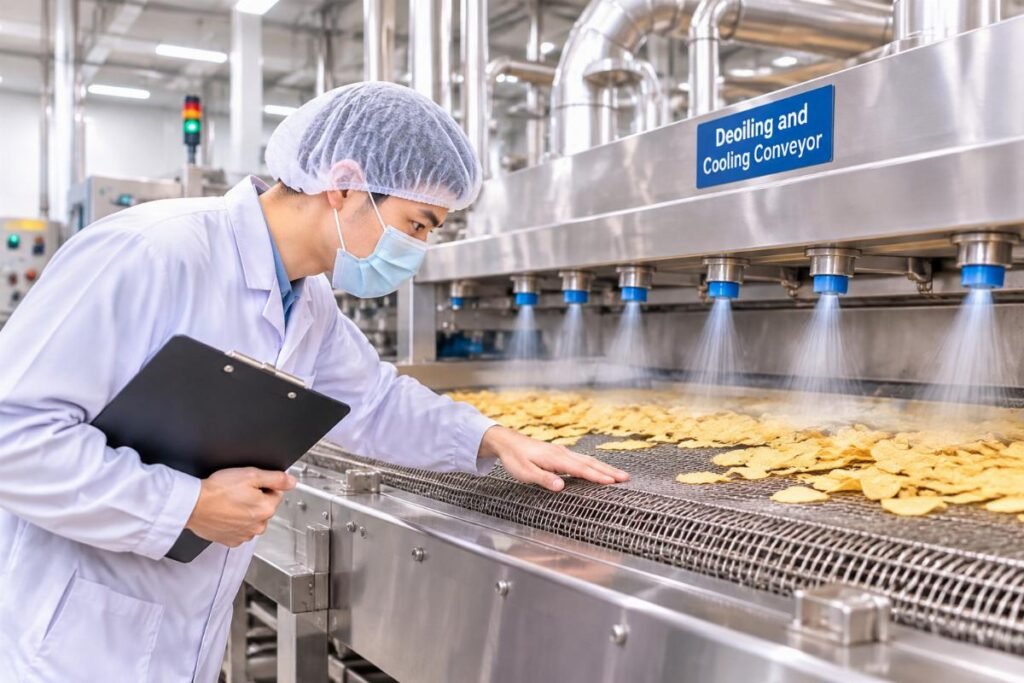
Stronger airflow does not guarantee better deoiling; it often blows lightweight puffed snacks off the belt.
Properly matching Deoiling and Cooling Conveyors prevents moisture condensation and oil retention, ensuring fried chips meet shelf-life and texture standards by synchronizing mesh speed, airflow volume, and thermal dynamics.
I remember standing on the factory floor in Binh Duong, Vietnam, watching a batch of freshly fried chips enter the cooling section. The mesh speed was completely mismatched with the extruder output. The chips came out still warm, and once bagged, they condensed with moisture and molded entirely, resulting in a total batch spoilage. Since then, I have obsessively fine-tuned airflow and variable frequency parameters for Deoiling and Cooling Conveyors. Running equipment on the front lines teaches you that post-frying cooling and deoiling can easily ruin the hard work of the frying stage if not integrated correctly. Selecting equipment requires looking beyond the main fryer to the entire line match.
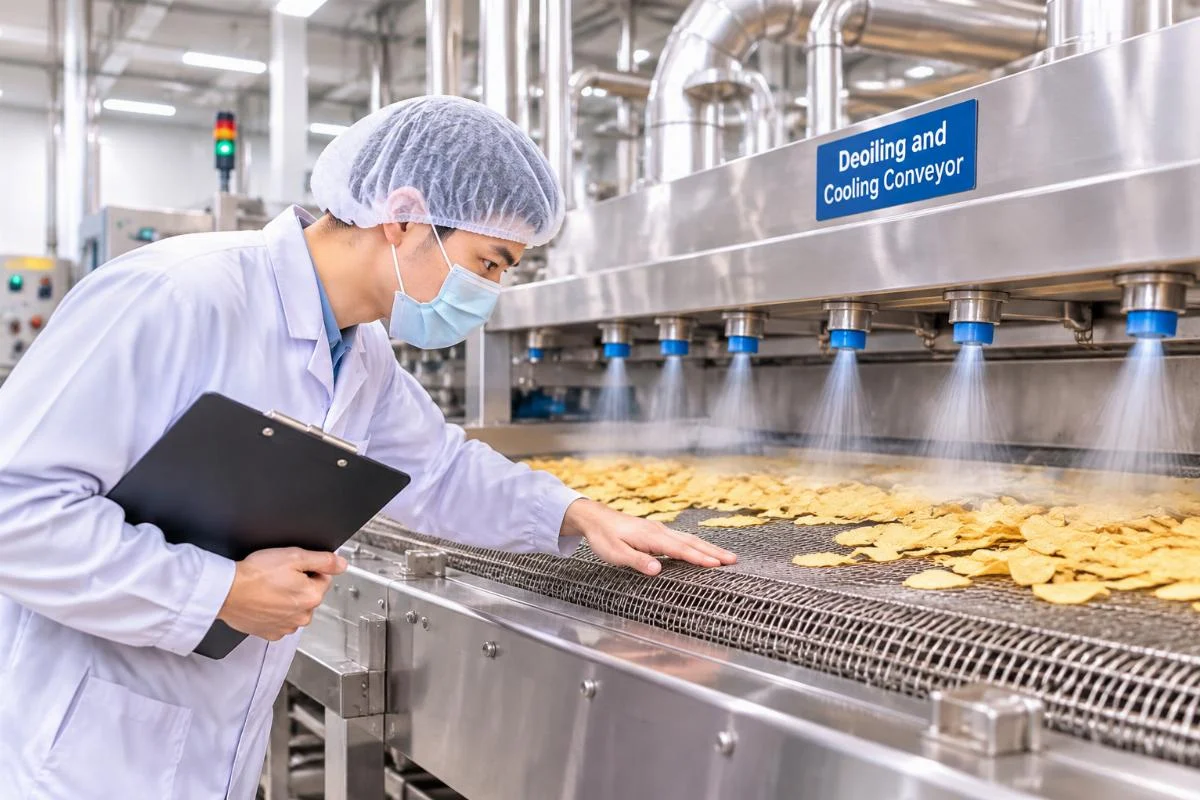
Let us break down exactly how to select and integrate these systems to avoid costly production errors.
Why Do Fried Chips Spoil After Packaging?
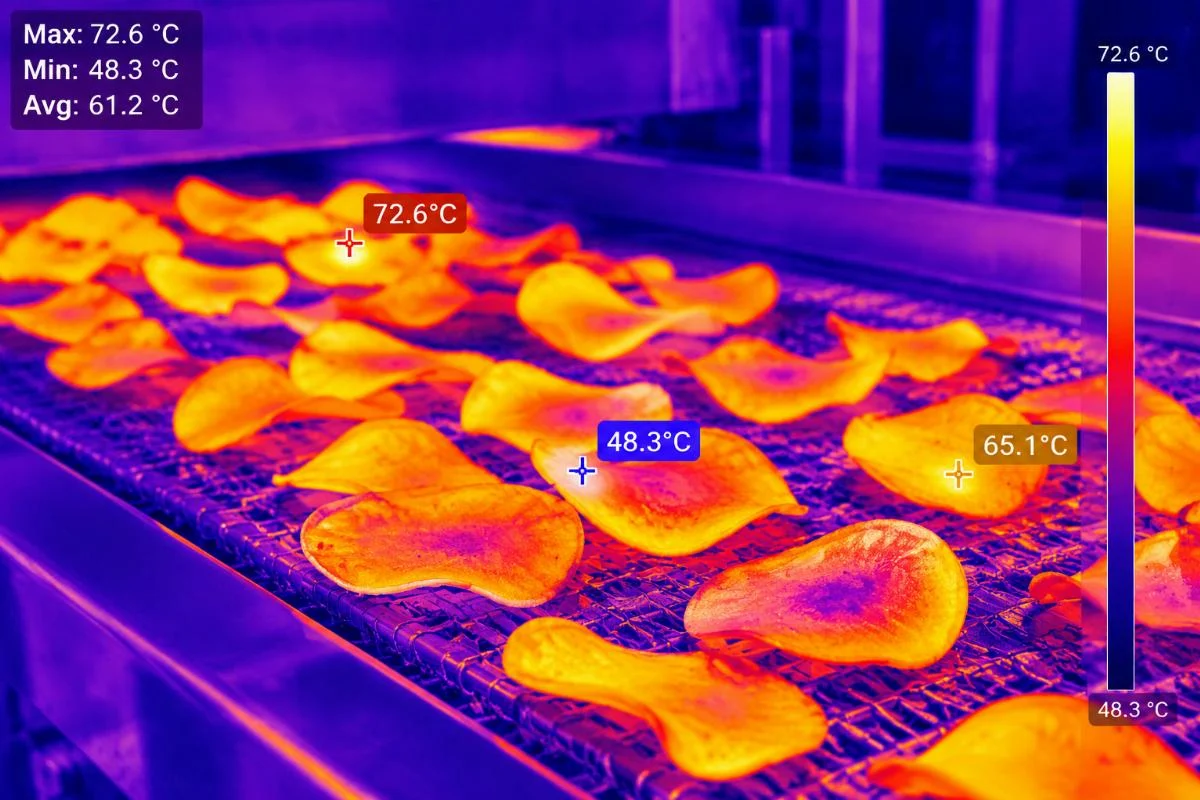
Moisture condensation inside the packaging is the primary culprit, directly caused by improper cooling temperatures dropping below the dew point.
Many operators assume that a longer cooling section is inherently safer for product stability. The counter-intuitive reality is that excessive cooling length drops the product temperature below the ambient dew point before packaging, causing invisible moisture condensation on the chip surface. This residual moisture accelerates lipid oxidation and microbial growth, destroying the shelf-life.
When Deoiling and Cooling Conveyors are poorly designed, the thermal gradient is too steep. The surface cools rapidly while the core retains heat. Once sealed in a barrier film, the core heat migrates outward, warms the trapped air, and creates a micro-climate of high humidity inside the bag. Proper thermal management requires a controlled, gradual temperature drop rather than aggressive over-cooling.
How to Match Mesh Speed with Extruder Output?
Synchronizing the belt speed with the extruder capacity is critical to prevent product accumulation and ensure uniform cooling.
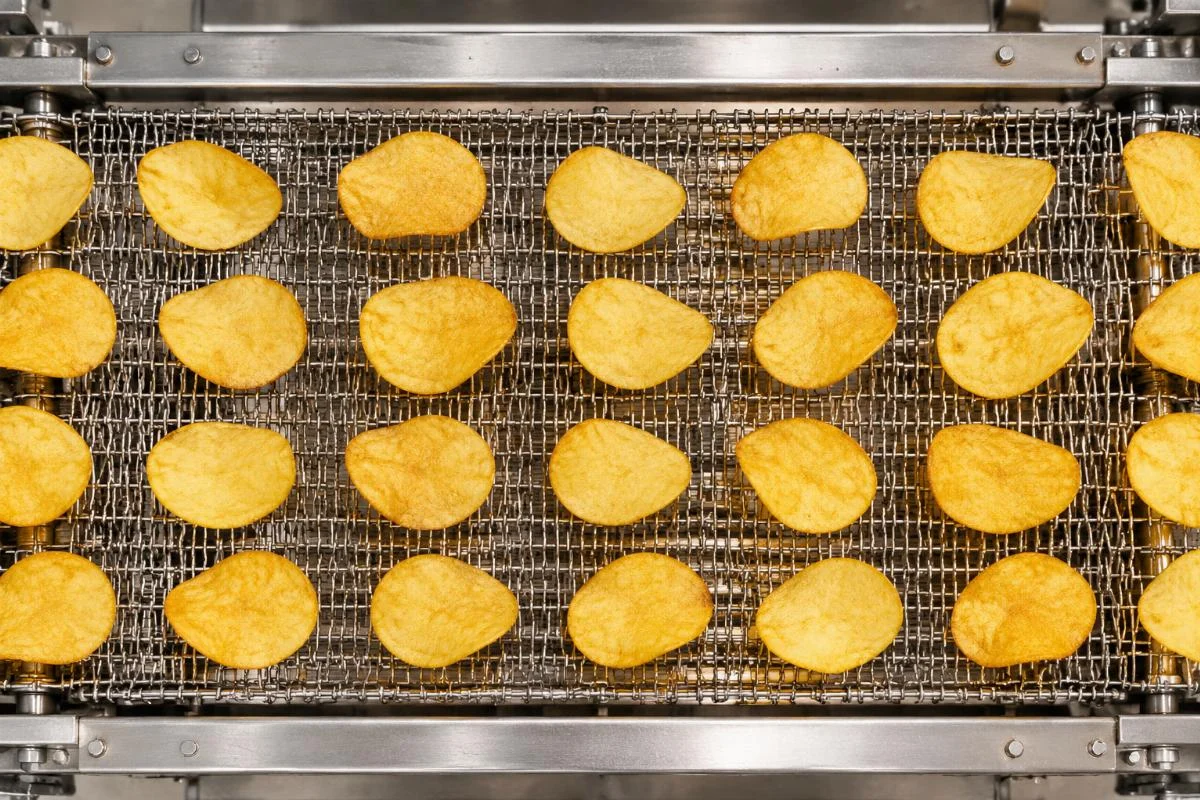
A mismatch in mesh speed is a frequent cause of batch spoilage. If the belt moves too slowly for a high-capacity extruder, chips pile up, trapping heat and oil. If it moves too fast, the residence time in the cooling tunnel is insufficient. Below is a specification comparison matrix for matching Deoiling and Cooling Conveyors based on line capacity.
| Extruder Capacity | Belt Speed Control | Airflow Distribution | Thermal Residence |
|---|---|---|---|
| Small Scale | Basic fixed speed | Uncontrolled ambient | Vulnerable to core heat retention |
| Medium Scale | Standard mechanical adjustment | Standard single-zone fan | Resistant to minor fluctuations |
| Large Scale | VFD synchronized with extruder | Multi-zone controlled airflow | Robust thermal gradient management |
Consider a medium-scale snack food manufacturer in Latin America. They upgraded their extruder but kept the old cooling line. The Deoiling and Cooling Conveyors ran at a fixed speed, causing chips to overlap on the belt. The bottom layer never dried properly, leading to rancidity within weeks. By upgrading to a VFD-synchronized system, the belt speed automatically adjusted to the extruder output, ensuring a single-layer flow and uniform air exposure.
What is the Optimal Airflow Volume for Deoiling?
Balancing oil removal and product integrity requires variable frequency drive tuning rather than maximum fan output.
The misconception that maximum airflow yields the best deoiling result is dangerous. High-velocity air easily blows away lightweight puffed snacks, causing product loss and machine blockages. The optimal approach uses Deoiling and Cooling Conveyors equipped with variable frequency drives to tailor the airflow velocity to the specific product density.
The process requires a systematic approach:
- Initial Low-Frequency Start: Begin with the fan at a low frequency to establish a gentle air cushion, preventing product blow-off.
- Incremental Ramp-Up: Gradually increase the VFD frequency while observing the product bed. Stop exactly when surface oil begins to shear off without disturbing the product position.
- Zonal Adjustment: Set higher airflow in the primary deoiling zone and reduce it in the final cooling zone to prevent surface chilling.
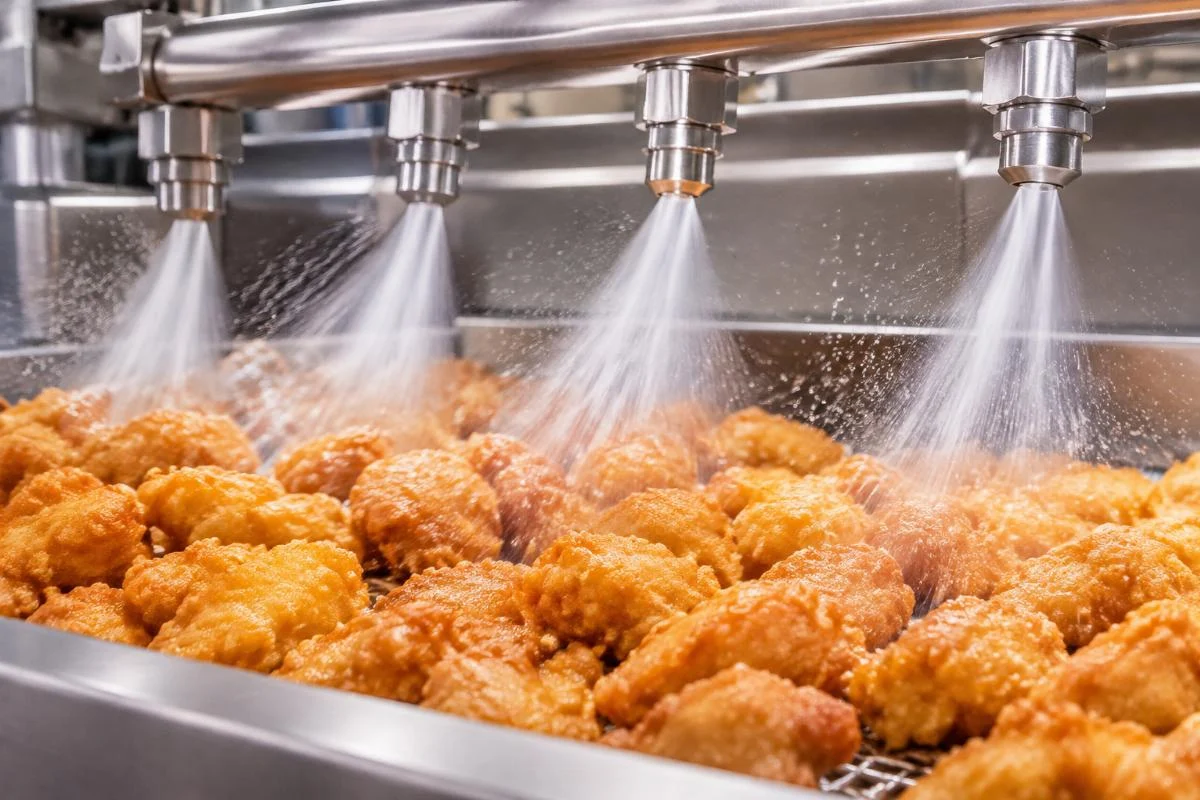
A snack food deoiling machine operating without VFD control often strips the seasoning coating along with the excess oil. By implementing precise VFD matching, a manufacturer noticeably reduced surface oil while maintaining the structural integrity of delicate corn puffs.
How to Integrate the Cooling Line with the Frying System?
Seamless temperature drop and hygiene compliance depend on turnkey line design and food-grade construction.
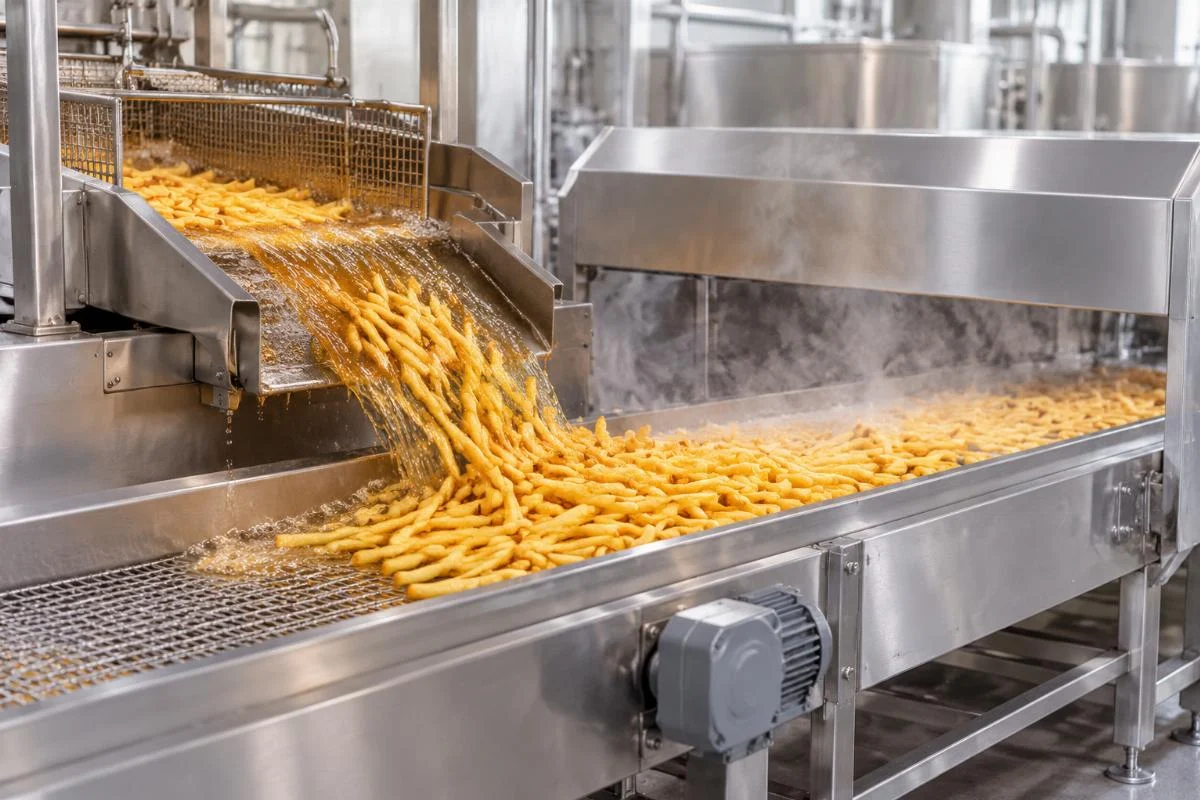
Integrating a fried snack cooling system into an existing frying setup requires more than just connecting a belt. It demands a holistic view of the thermal and physical workflow. The transition from the fryer to the deoiling section must be smooth to prevent product breakage.
Turnkey Engineering and Hygiene Standards
This is where comprehensive line design becomes indispensable. Meiteng provides turnkey frying chips line solutions that integrate the frying, deoiling, and cooling stages into a single, cohesive workflow. Instead of piecing together mismatched components from different vendors, a unified system ensures that the thermal output of the fryer perfectly matches the cooling capacity of the downstream equipment.
Furthermore, food safety is non-negotiable. Meiteng constructs these integrated systems using food-grade 304 stainless steel, ensuring compliance with strict international hygiene standards. This material choice prevents cross-contamination and withstands the rigorous cleaning protocols required in snack food production.
A startup in the Middle East initially tried to source a fryer and a cooling line separately. The integration gaps caused oil pooling at the transfer points, creating a severe slip hazard and hygiene issue. Switching to a unified turnkey approach eliminated these transfer gaps, ensuring a continuous, hygienic flow from the fryer oil bath to the final packaging infeed.
Conclusion
Selecting Deoiling and Cooling Conveyors requires a holistic focus on thermal dynamics, airflow precision, and line synchronization rather than isolated component specs.
Preventing moisture condensation and oil retention demands matching mesh speeds to extruder output and tuning VFD airflow to protect product integrity. Ultimately, a turnkey integrated approach ensures seamless thermal transitions and strict food-grade compliance, safeguarding both product shelf-life and operational efficiency.
Equipment Mentioned in This Article
 frying chips machine
100-2000L Tank Deep Fryer Commercial Chips Frying Machine
100-2000L Tank Deep Fryer for Snack Pellets and Chips — handles continuous deep frying and de-oiling for potato, cassava, and… View Machine Details frying chips machine
Continuous Frying Machine for Potato Chips and Snacks
Continuous Frying Machine for Potato Chips and Snacks — industrial deep fryer for continuous snack processing with precise temperature control… View Machine Details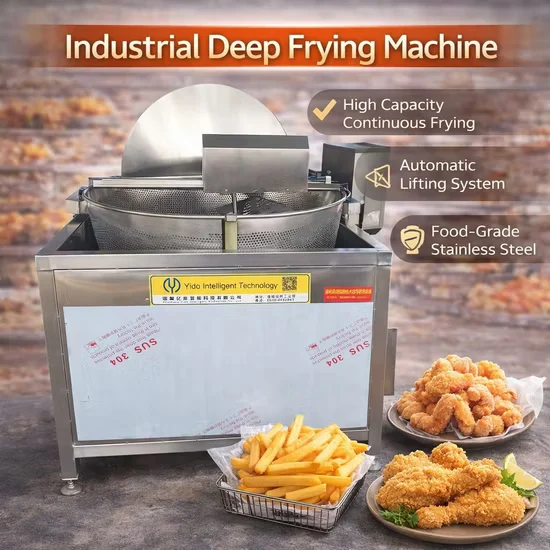 frying chips machine
Potato Chips Frying Machine Manufacturer Electric Gas Deep Fryer
Potato Chips Frying Machine for Uniform Heating and Oil Filtration — deep frying with automatic basket lifting ensures consistent product… View Machine Details frying chips machine
Potato Chips French Fries Batch Fryer Electric Gas Deep Frying Machine
Potato Chips and French Fries Batch Fryer for consistent deep frying of snacks and pellets. Built with food-grade SUS304 stainless… View Machine DetailsRelated Applications

Engineering Perspective
An In-House R&D Team Behind Every Line
Jinan MT Machinery develops its process technology in-house. The team concentrates on the four areas that decide pellet shape, expansion and line stability.
- Expansion technology
- Twin-screw extrusion
- Die design
- PLC/MCC automation
Related Articles
 Nov 16, 2026 · Product & Series Guides
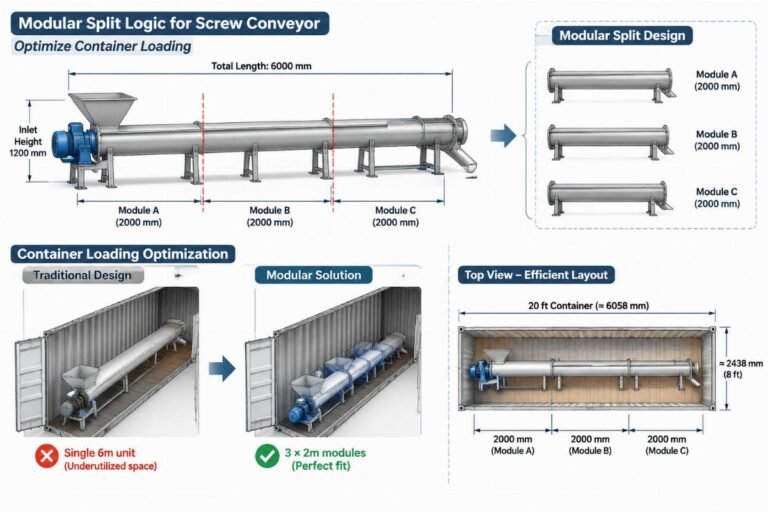
DS Series Snack Pellet Line Mixer & Screw Conveyor Manufacturer
Selecting the right DS Series Snack Pellet Line Mixer & Screw Conveyor Manufacturer prevents material degradation and motor burnout caused by oversized equipment. Match… Read This Article Nov 16, 2026 · Product & Series Guides
Meiteng Extruded Corn Chips Frying Line Manufacturer for Sale
Optimizing an Extruded Corn Chips Frying Line requires treating it as a complete thermal management system to precisely control final oil content and moisture.… Read This Article Nov 16, 2026 · Product & Series Guides
DS135 Twin-Screw Extruder Manufacturer for Large Output Pellet Plants
Scaling up with a DS135 Twin-Screw Extruder fails when producers rely solely on nameplate capacity instead of matching screw configurations to specific recipes. Real… Read This ArticleFree Process Check
Send Your Recipe for a Process Check
Jinan MT Machinery engineers review your recipe and return a free process plan within 24 hours. Tell us the product, output, raw material, local voltage and heat source.
Send Your Recipe on WhatsApp