
DS135 Twin-Screw Extruder Manufacturer for Large Output Pellet Plants
- By Jinan MT Machinery
Relying solely on nameplate capacity to scale up your pellet plant is a guaranteed way to trigger downstream bottlenecks and massive product waste.
Selecting a DS135 Twin-Screw Extruder for large-scale operations requires matching specific screw configurations and thermal profiles to your exact recipe, rather than just trusting the motor power rating. True output validation comes from balancing Specific Mechanical Energy limits with the physical properties of your raw materials.
Standing inside a pet food facility in Monterrey, Mexico, I watched the DS135 Twin-Screw Extruder fire up for the first time. The moment the main motor hit operational speed, the puffing rate dropped noticeably, and the pellet forming rate was unacceptably low. The entire line had to shut down for two full days. I had just flown in from the manufacturing workshops in Jinan to oversee this Latin American deployment, and staring directly at the die head while sweat dripped down my face, I knew the nameplate capacity meant nothing if the internal mechanics didn’t respect the recipe. We eventually dismantled the barrel, rearranged the screw elements, and微调 (fine-tuned) the thermal zones, which finally pulled the capacity back to a stable two-and-a-half-ton range. Working in this industry teaches you quickly that large pellet plant extruder选型 (selection) cannot rely on spec sheets alone; the screw combination must be relentlessly matched to the formula, or the downstream drying and coating systems will suffer the consequences.
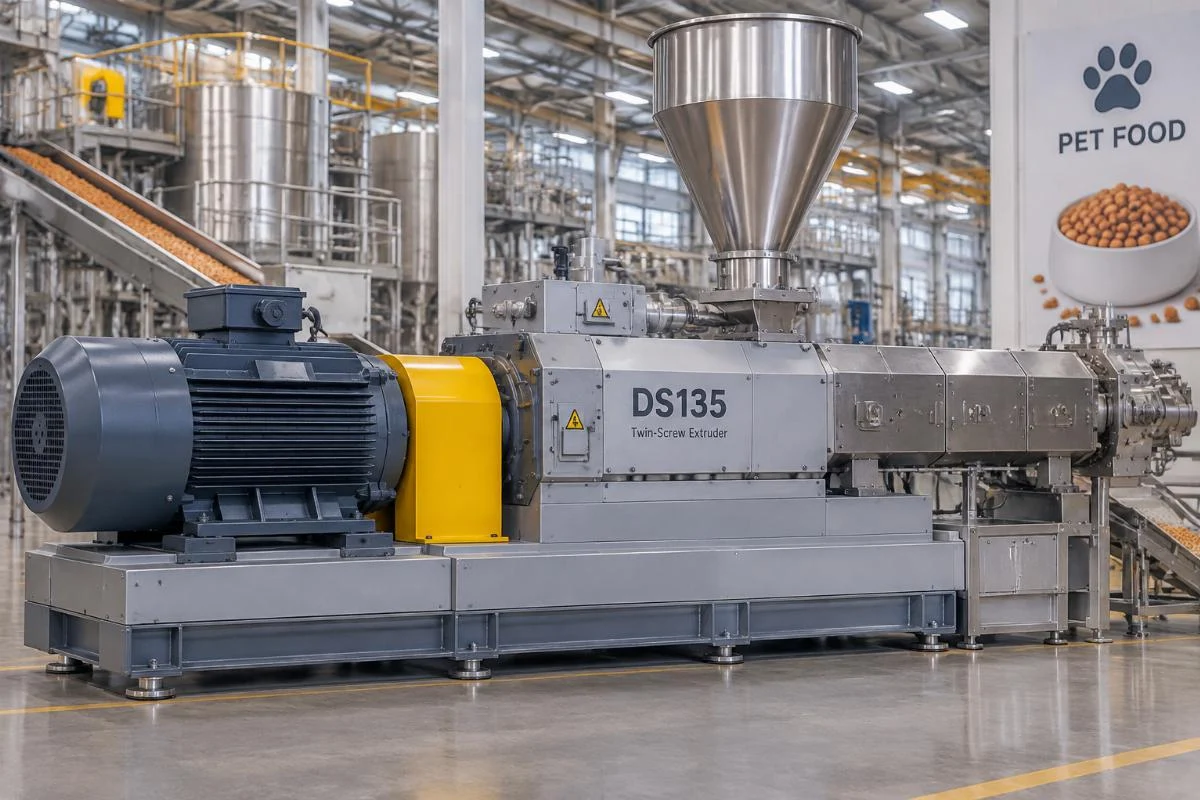
Scaling up from a pilot line to a commercial high capacity twin screw extruder setup reveals hidden variables that simple power ratings ignore.
Why Nameplate Capacity Fails in Large Pellet Plants?
Nameplate capacity is essentially a theoretical maximum achieved under highly specific, often unrealistic, laboratory conditions, not a reflection of real-world recipe shear and thermal dynamics.
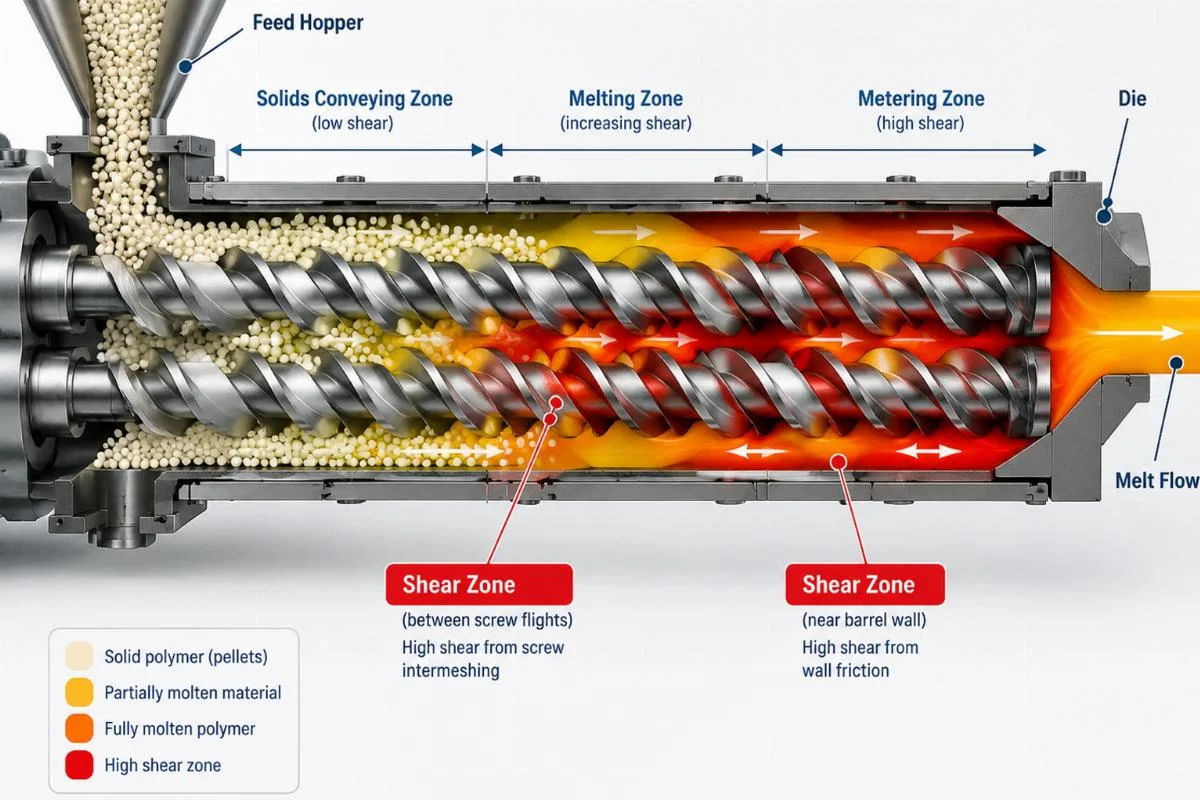
When producers evaluate a DS135 pet food extruder, they often fixate on the kilowatt rating of the main drive. However, actual output depends entirely on how the material behaves under shear stress inside the barrel. If the recipe contains high levels of fresh meat or specific starch blends, the friction generated can exceed the thermal limits of the barrel zones, causing the material to burn or slip, effectively killing the output.
During the Monterrey incident, the initial setup assumed the DS135 Twin-Screw Extruder could handle the high-meat formula at maximum revolutions per minute. Instead, the excessive shear caused the protein matrix to degrade before it reached the die. The result was a massive drop in expansion. We had to reduce the screw speed and increase the barrel temperature in the final metering zone to allow the material to expand properly without burning. This adjustment restored the forming rate and prevented the downstream dryer from being overwhelmed by wet, unexpanded product.
DS135 vs. Smaller Models: Spec Matrix for Scale-up
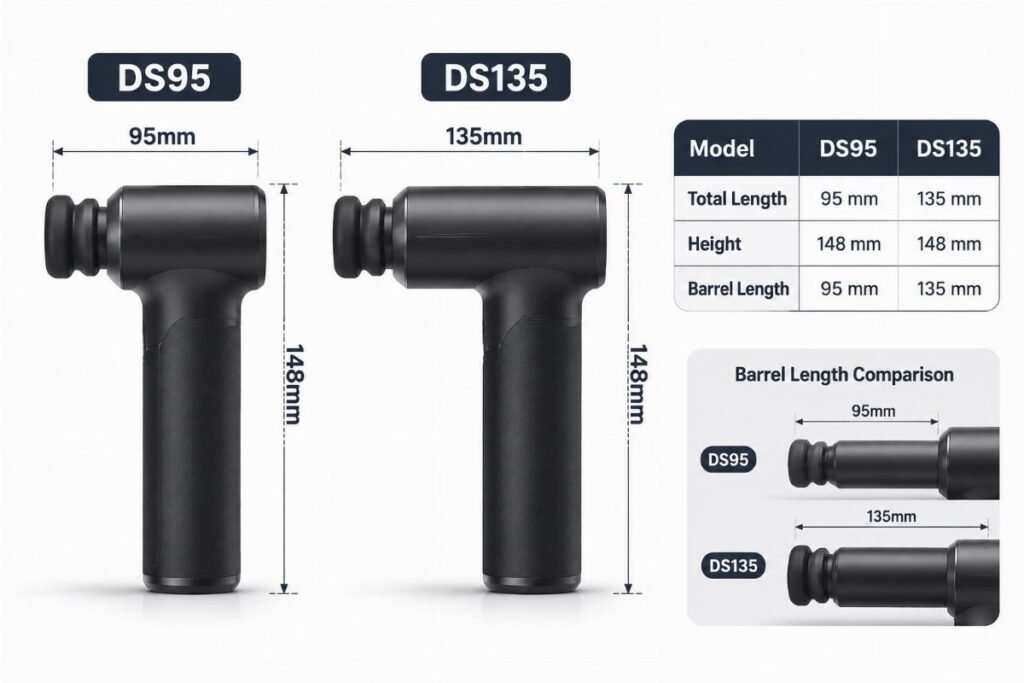
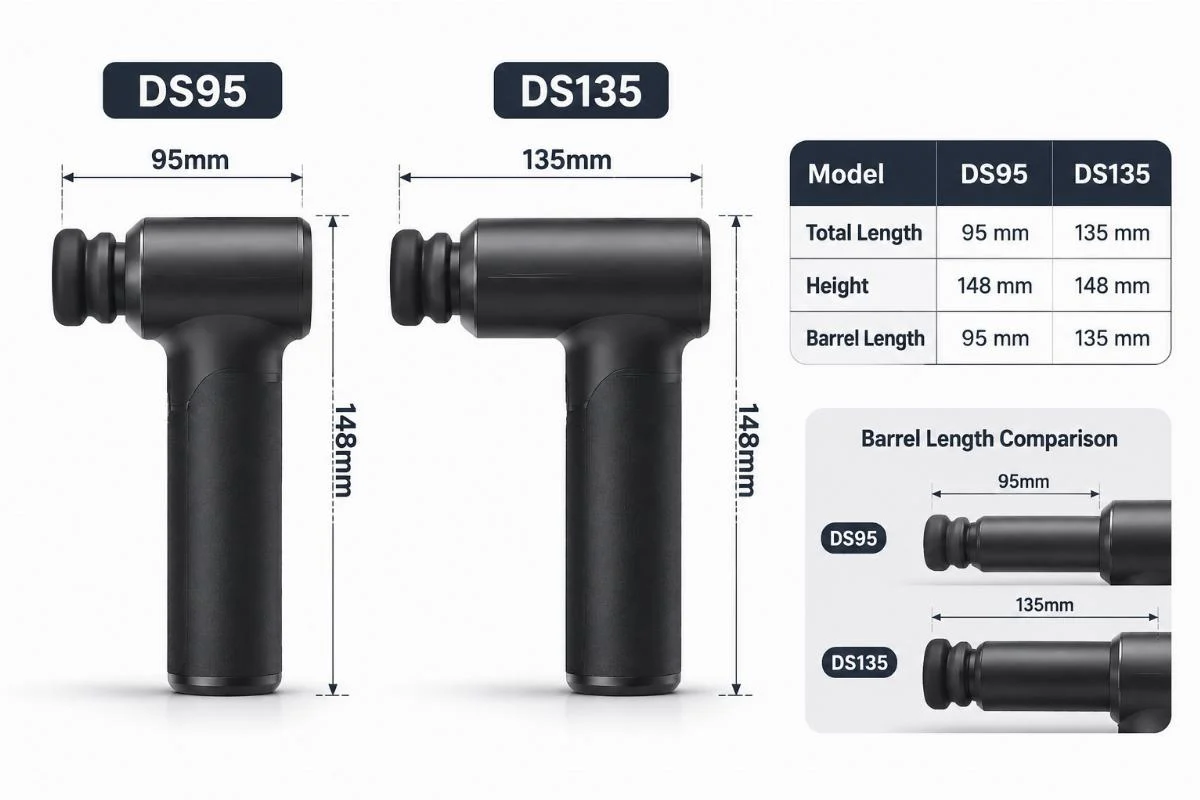
Upgrading to a DS135 Twin-Screw Extruder requires understanding how torque density and length-to-diameter ratios shift the processing window compared to smaller models like the DS95.
When scaling up, producers often assume that doubling the model size simply doubles the output. In reality, the internal geometry changes how the material is conveyed, compressed, and cooked. The DS135 offers a substantially longer effective cooking length and higher torque capacity, which is essential for dense, high-moisture recipes. However, this also means the material spends more time inside the barrel, requiring precise thermal management to avoid overcooking.
| Processing Factor | DS95 Model | DS135 Twin-Screw Extruder | Scale-up Impact |
|---|---|---|---|
| Torque Density | Standard | Robust | Handles denser, high-meat recipes without stalling |
| Length-to-Diameter Ratio | Moderate | Substantially Extended | Requires finer thermal zone control to prevent overcooking |
| Shear Management | Basic | Controlled | Reduces protein degradation in sensitive formulas |
| Downstream Load | Manageable | High | Demands synchronized dryer and coater capacity |
A South American aquaculture producer once upgraded from a smaller model to a DS135 Twin-Screw Extruder for a high-starch floating fish feed recipe. They kept the same temperature profile as the smaller machine. Because the DS135 has a substantially extended length-to-diameter ratio, the starch gelatinized too early and blocked the die. By adjusting the thermal profiling zones and utilizing custom screw elements, we achieved a stable floating rate and eliminated the die blockages.
Screw Configuration: The Real Key to Large Output
The screw profile is the actual engine of the DS135 Twin-Screw Extruder; without custom element arrangement tailored to your specific recipe, maximum capacity remains unreachable.
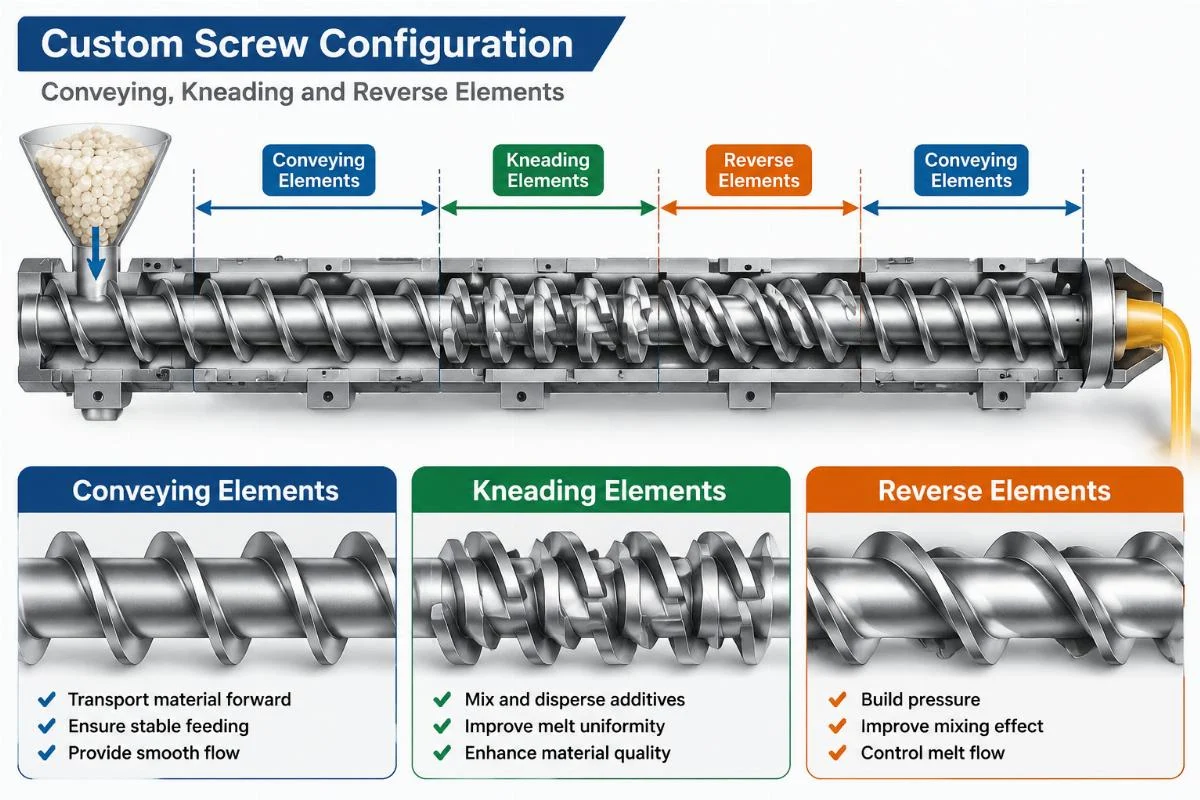
A large output pellet plant extruder relies on the precise arrangement of conveying, kneading, and reverse elements to build pressure and control residence time. Off-the-shelf screw configurations are designed for generic corn-based recipes. When you introduce alternative proteins, high-fiber ingredients, or elevated fat levels, the standard profile will fail to generate the necessary pressure at the die, leading to poor pellet forming rates.
To optimize the DS135 pet food extruder for a high-meat recipe, we had to increase the number of kneading blocks in the compression zone to ensure proper protein denaturation, while adding reverse elements near the discharge to build up the required pressure for a dense, sinking aquaculture pellet. This custom profiling ensures that the Specific Mechanical Energy is distributed evenly, preventing localized hot spots that cause product scorching.
The process involves:
- Analyzing the raw material particle size and moisture content.
- Selecting the appropriate pitch for the feed section to ensure consistent volumetric filling.
- Adjusting the width and angle of kneading discs to control shear intensity.
- Positioning reverse elements to regulate the fill degree and pressure buildup before the die.
Troubleshooting Field Failures in Large Lines
Field failures in large-scale extrusion are rarely caused by the main motor; they are almost always the result of mismatched thermal profiles and incorrect screw configurations causing downstream chaos.
When the DS135 Twin-Screw Extruder in Monterrey failed to produce acceptable puffing rates, the immediate reaction from the plant manager was to increase the feeder speed. This is a critical mistake. Pushing more material into a barrel that cannot properly cook and expand it simply floods the system, drops the internal temperature, and results in a massive amount of unformed, dense waste.
The correct troubleshooting approach requires a systematic evaluation of the extrusion mechanics:
- Low Puffing Rate: Check the temperature in the final metering zone. If it is too low, the material will not expand upon exiting the die. Alternatively, the screw profile may lack sufficient reverse elements to build the necessary pressure for expansion.
- Low Pellet Forming Rate: This usually indicates inadequate pressure at the die face. The screw configuration may be too aggressive in the conveying sections, failing to compress the material properly. Adjusting the kneading block arrangement can resolve this.
- Downstream Bottlenecks: If the extruder is producing wet, unexpanded product, the dryer and coater will be instantly overwhelmed. In the Monterrey case, the two-day downtime was primarily spent clearing the dryer of unexpanded, sticky product that had hardened inside the ducts. Synchronizing the extruder output with the dryer capacity is non-negotiable.
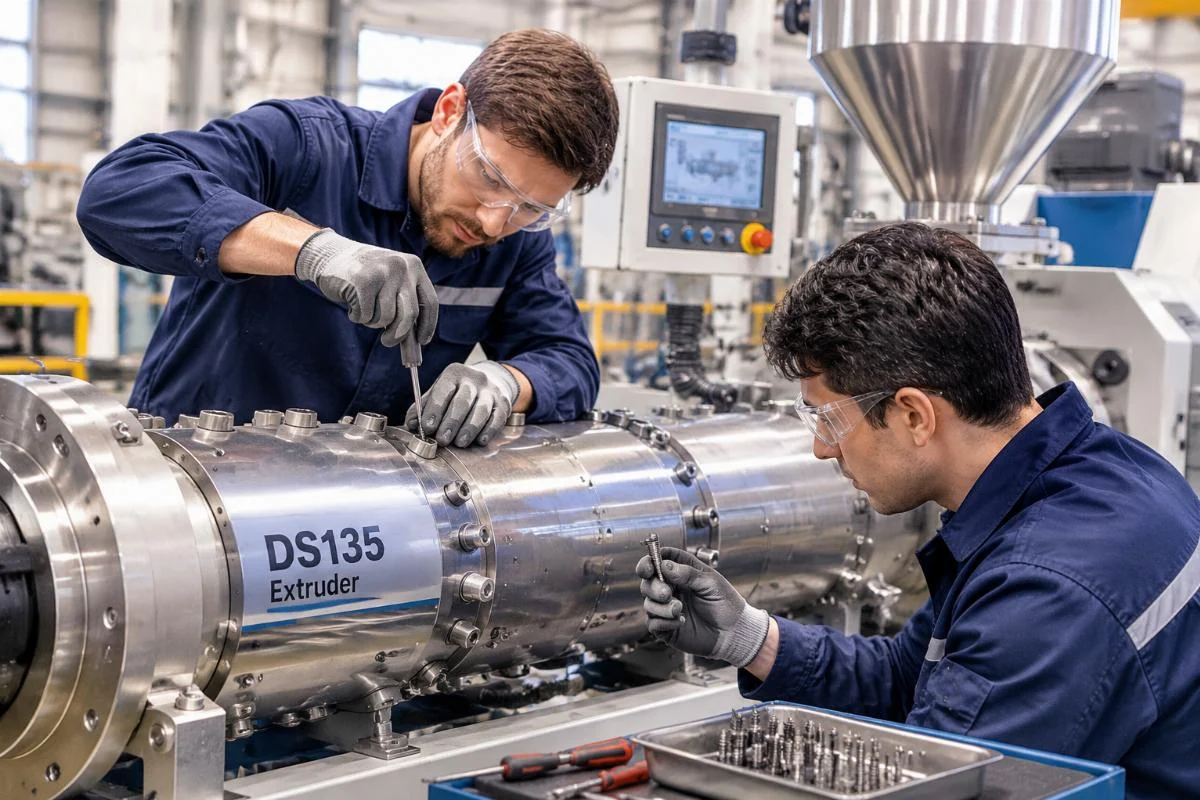
By dismantling the barrel and reprofiling the screws, we shifted the shear zone further back, allowing the final section to focus purely on pressure building and temperature stabilization. This simple mechanical adjustment restored the DS135 Twin-Screw Extruder to its designed capacity, proving that the solution lies in the barrel, not the control panel.
Conclusion
Scaling up pellet production demands a fundamental shift from trusting nameplate ratings to mastering recipe-specific mechanical dynamics. Selecting and operating a DS135 Twin-Screw Extruder successfully requires custom screw profiling and precise thermal management to ensure stable output and protect downstream equipment. When these mechanical variables are aligned with your specific formula, large-scale extrusion becomes a predictable, highly efficient process.
Equipment Mentioned in This Article
 3D papad machine
3D Snack Pellet Production Line Fried Extruder Machine
3D Snack Pellet Production Line for Starch-Based Snacks — twin-screw extrusion processes potato, cassava, and corn starch into diverse shapes.… View Machine Details 3D papad machine
Fully Automatic 3D Snack Pellets Extruder Making Machine for Chips
Chips 3D Snack Pellet Extruder Line for 2D/3D Shapes — co-rotating twin-screw extrusion processes potato and cassava starches into papad,… View Machine Details 3D papad machine
Automatic 3D Pellet Extruded Corn Puffed Snack Food Production Line
3D Pellet Extruded Snack Food Production Line for Starch Pellets — processes potato, corn, and cassava starch into papad and… View Machine Details 3D papad machine
2D 3D Snack Pellet Production Line Manufacturer
2D 3D Snack Pellet Production Line for Diverse Shapes from Starches — twin-screw extrusion handles wheat, corn, and cassava. The… View Machine DetailsRelated Applications

Engineering Perspective
An In-House R&D Team Behind Every Line
Jinan MT Machinery develops its process technology in-house. The team concentrates on the four areas that decide pellet shape, expansion and line stability.
- Expansion technology
- Twin-screw extrusion
- Die design
- PLC/MCC automation
Related Articles
 Nov 16, 2026 · Product & Series Guides
DS Series Snack Pellet Line Mixer & Screw Conveyor Manufacturer
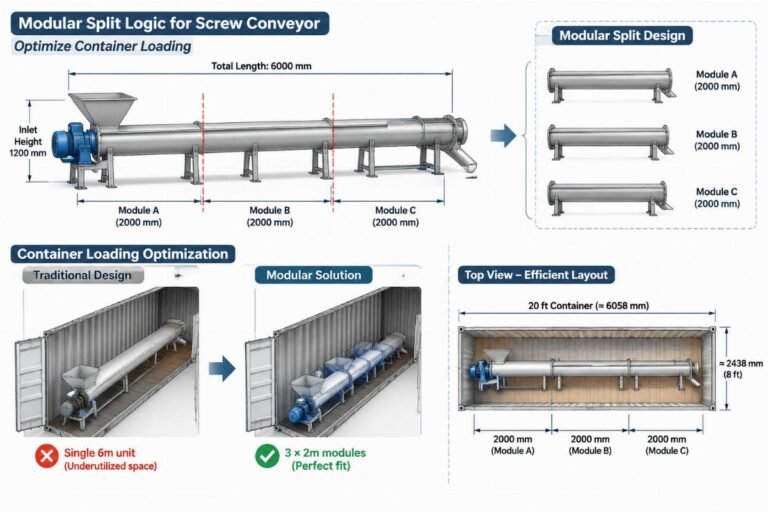
Selecting the right DS Series Snack Pellet Line Mixer & Screw Conveyor Manufacturer prevents material degradation and motor burnout caused by oversized equipment. Match… Read This Article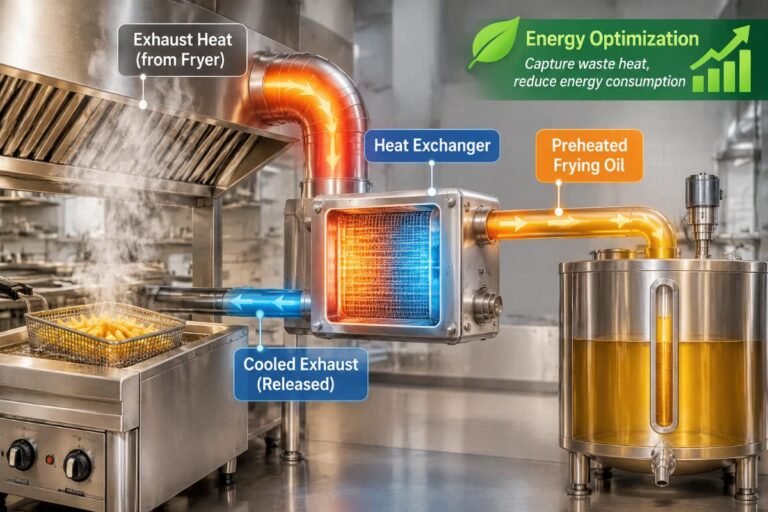 Nov 16, 2026 · Product & Series Guides
Meiteng Extruded Corn Chips Frying Line Manufacturer for Sale
Optimizing an Extruded Corn Chips Frying Line requires treating it as a complete thermal management system to precisely control final oil content and moisture.… Read This Article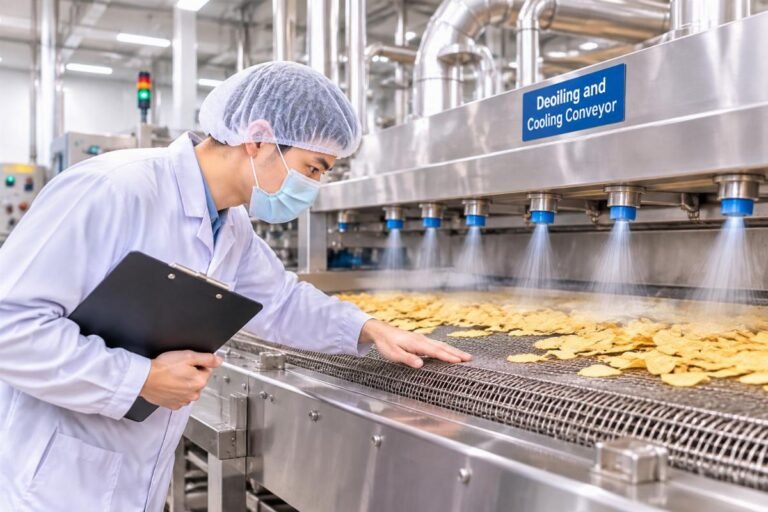 Nov 16, 2026 · Product & Series Guides
Meiteng Deoiling & Cooling Conveyors for Frying Chips Line Manufacturer
Properly matching Deoiling and Cooling Conveyors prevents moisture condensation and oil retention that ruin fried chips after packaging. Synchronizing mesh speed with extruder output… Read This ArticleFree Process Check
Send Your Recipe for a Process Check
Jinan MT Machinery engineers review your recipe and return a free process plan within 24 hours. Tell us the product, output, raw material, local voltage and heat source.
Send Your Recipe on WhatsApp