
Meiteng Extruded Corn Chips Frying Line Manufacturer for Sale
- By Jinan MT Machinery
A fryer is never just a hot oil tank; it is a complex thermal management engine where de-oiling and heat recovery dictate your final product’s shelf life.
The core answer to scaling snack production lies in treating the Extruded Corn Chips Frying Line as a complete thermal profile system rather than a standalone heating vessel. Controlling the final oil content and moisture requires precise thermal dynamics, continuous heat distribution, and integrated de-oiling modules that work in tandem with the twin-screw extruder.
I still remember the exact moment my perspective shifted permanently. Years ago, I was standing on the busy floor of a major trade show in Chicago, right after leaving the QC lab to step into equipment sales. A seasoned US buyer cornered me to discuss our corn chip processing capabilities. Confident in my technical specs, I started pitching the dimensions and heating capacity of the fryer tank itself. He stopped me mid-sentence, pointed at my brochure, and asked about the oil turnover rate and the thermal recovery setup. When I admitted we were quoting the tank in isolation, he shook his head. He explained that my proposed configuration would push the final oil content well past acceptable thresholds, effectively killing the deal before it even started. That wake-up call completely rewired how I view snack manufacturing. I realized that a frying line isn’t merely about submerging dough in hot oil; it is about engineering the entire thermal profile from the moment the dough exits the barrel to the final flavor coating.
To truly understand what separates a basic setup from a profitable production facility, we have to look at the engineering reality behind the steel.
What Defines a Modern Corn Chips Frying Line?
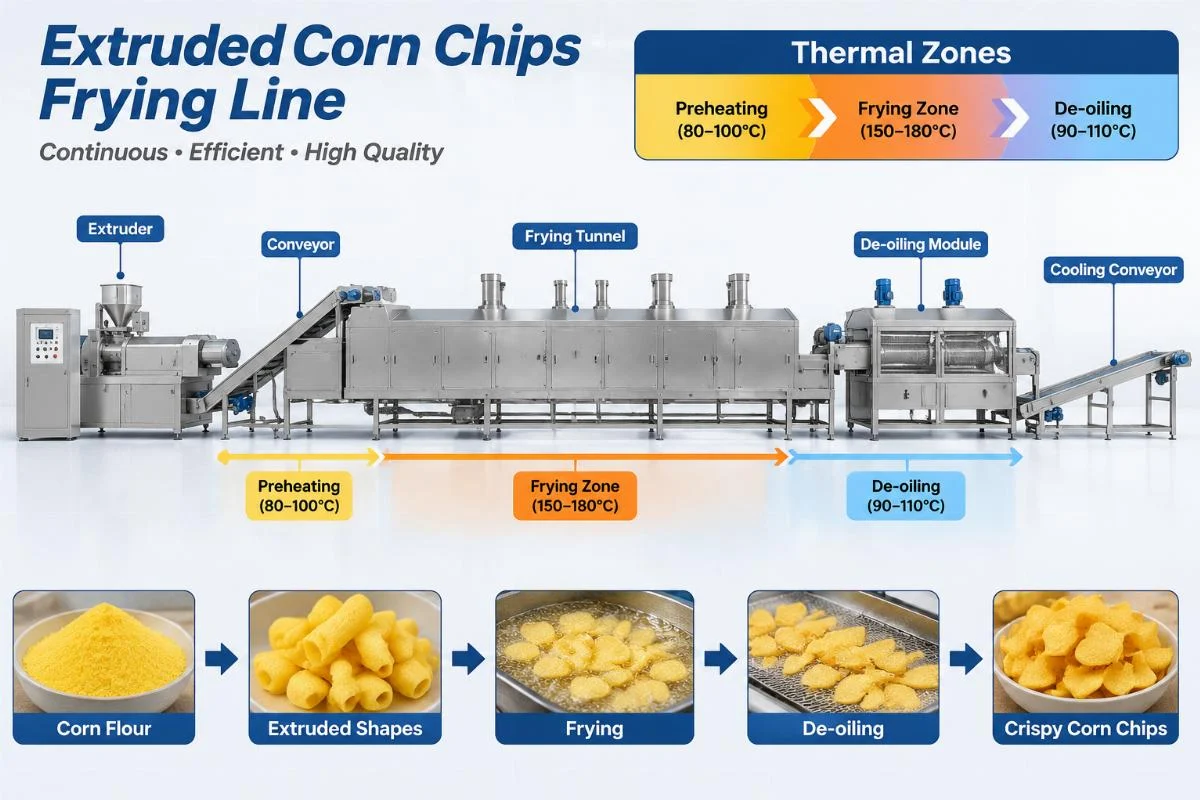
A modern Extruded Corn Chips Frying Line is defined by its ability to maintain a consistent thermal profile across continuous production runs, ensuring uniform moisture evaporation and structural expansion.
Most people entering the snack business focus heavily on the twin-screw extruder, assuming the frying stage is just a simple holding tank. This is a fundamental misunderstanding of continuous frying system for snacks engineering. The real challenge lies in thermal dynamics and continuous heat distribution. When the extruded corn dough hits the oil, rapid moisture evaporation occurs. If the thermal profile is uneven, you get localized burning in some zones and undercooked, moisture-trapped centers in others.
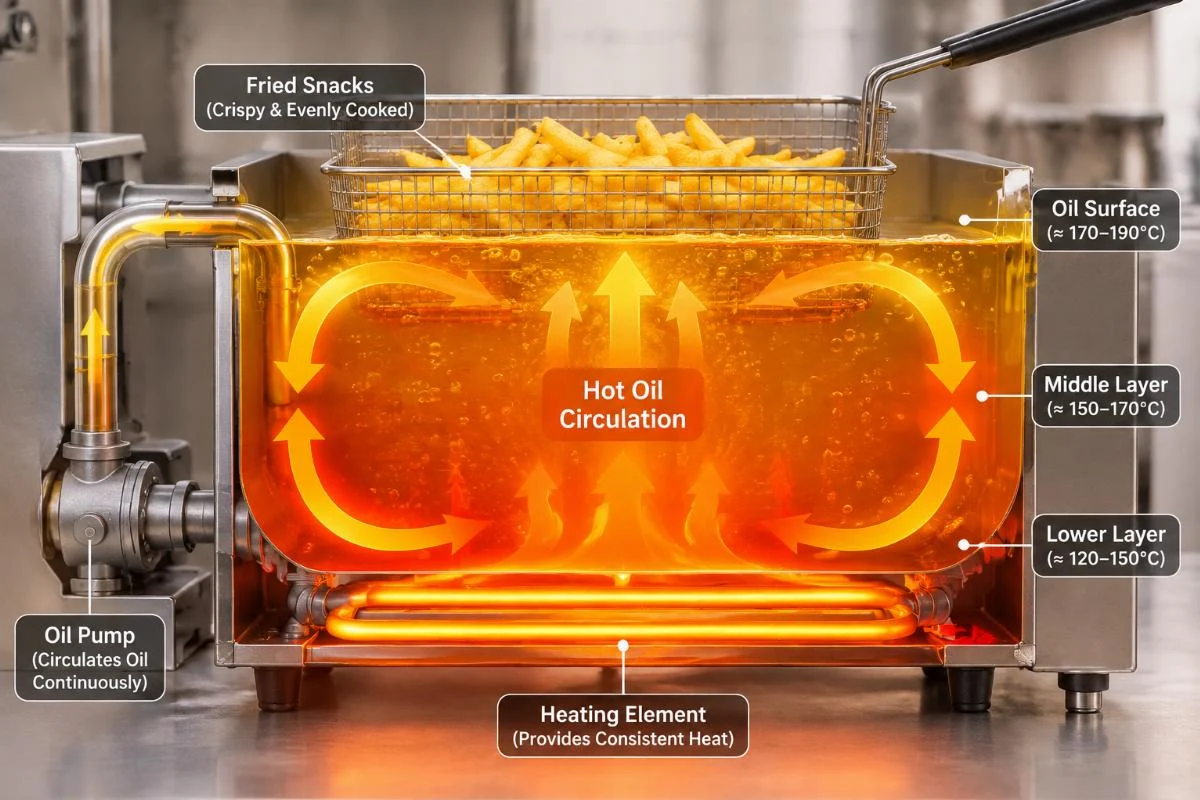
In my early days of consulting for startup food businesses, I visited a facility where the operators were constantly adjusting the burner to compensate for temperature drops. They didn’t realize their oil circulation was inadequate. A proper Extruded Corn Chips Frying Line utilizes advanced oil circulation to ensure that the temperature at the product inlet matches the outlet. This continuous heat distribution prevents the oil from degrading prematurely and ensures every single corn chip experiences the exact same thermal shock. It is this precise thermal management that creates the signature airy crunch, rather than a dense, oily bite.
How Does the De-oiling System Control Final Oil Content?
Effective de-oiling and immediate cooling are mandatory downstream processes to halt oil absorption, lock in texture, and guarantee the final product meets strict moisture and oil content targets.
The frying process does not actually stop when the product leaves the oil bath; it continues to absorb oil as long as it remains hot and porous. This is where the de-oiling system becomes the most critical component of the entire Extruded Corn Chips Frying Line. If you neglect this stage, your oil content will skyrocket, leading to a greasy mouthfeel and a drastically reduced shelf life due to lipid oxidation.
I once worked with a client who was facing a quality control failure. Their corn chips were testing consistently high in oil, and the bags were showing signs of rancidity within weeks. They blamed the fryer temperature. However, upon inspecting the line, I found their de-oiling vibration mechanism was poorly calibrated, and the cooling conveyor was too short. The chips were entering the flavoring drum while still holding excess surface oil. By upgrading the de-oiling and cooling modules, we managed to bring the oil content down to the target range and significantly extended the product’s stability.
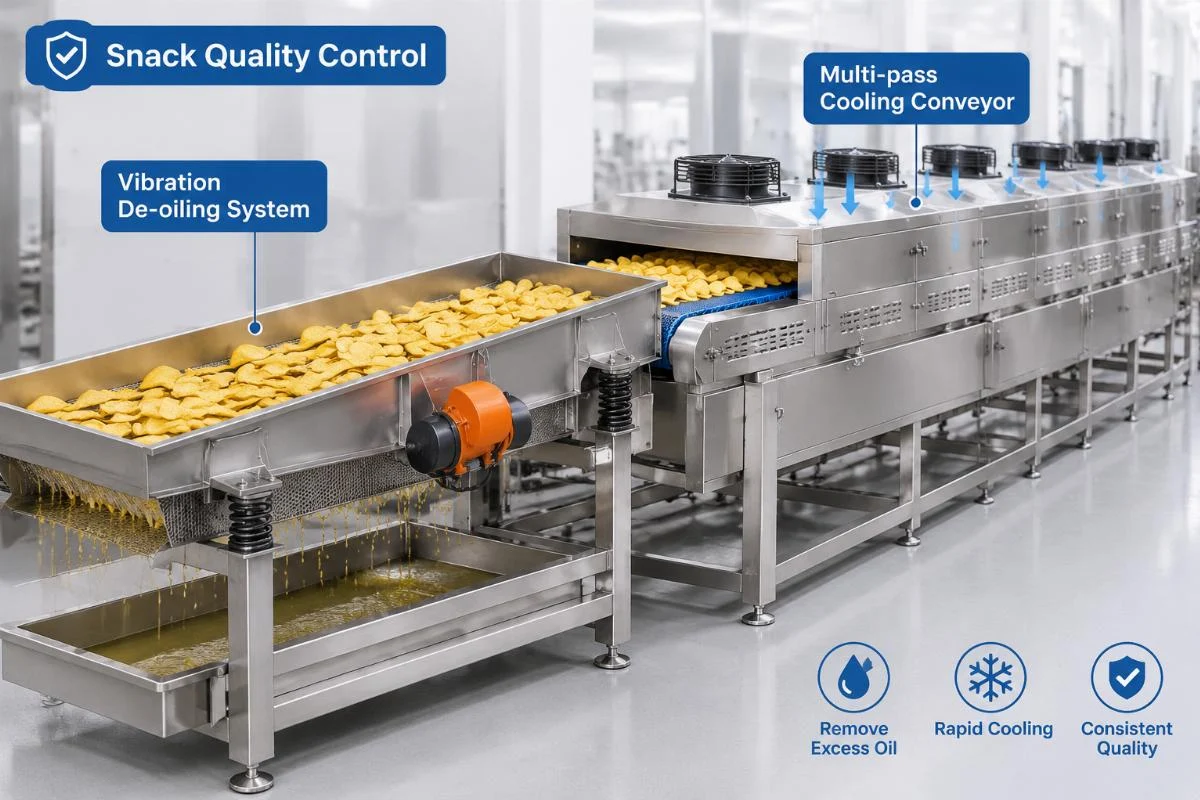
The vibration de-oiling mechanism must be tuned to the specific density of the extruded corn chip. Too aggressive, and you shatter the fragile structure; too gentle, and the surface oil remains. Following this, a multi-pass cooling conveyor rapidly drops the product temperature, effectively sealing the cellular structure and preventing any further oil migration.
Why is Heat Recovery Crucial for Frying Line ROI?
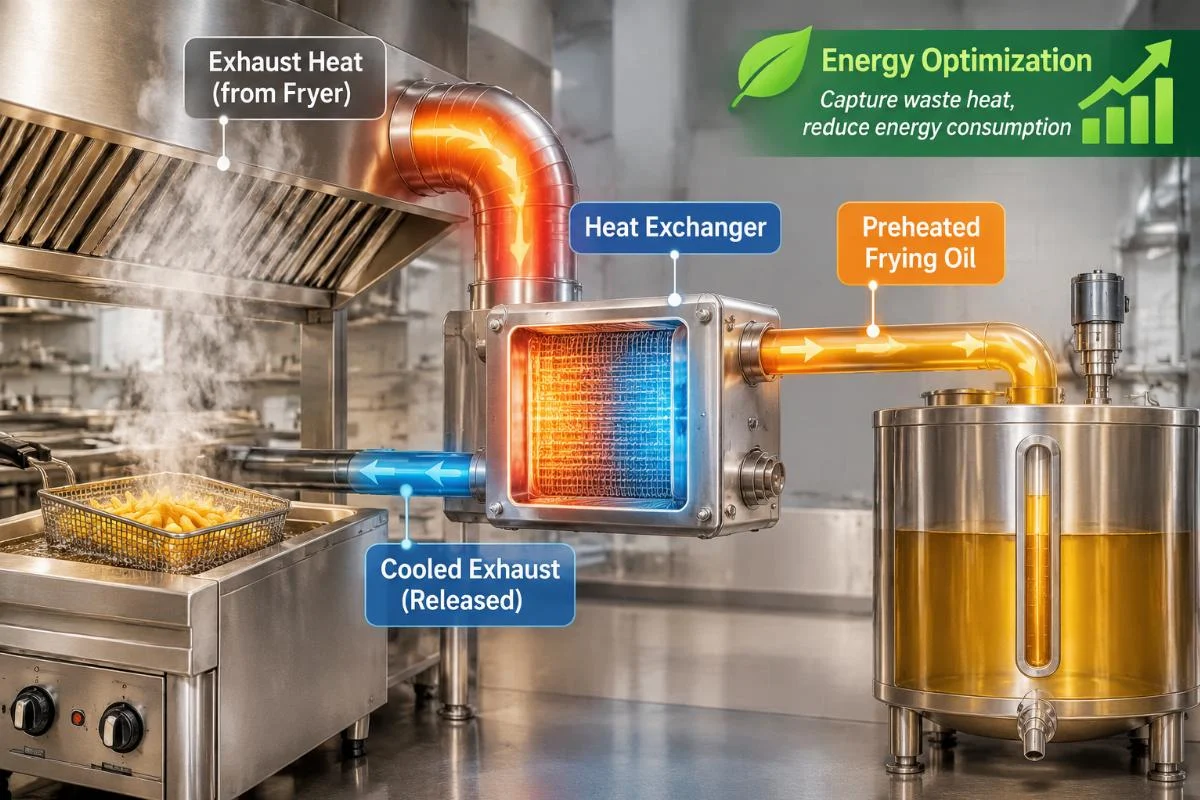
Integrating a heat recovery system to capture exhaust energy and preheat incoming oil drastically reduces operational energy costs, directly impacting the long-term profitability of the continuous frying system for snacks.
Energy consumption is often the hidden killer of profit margins in snack manufacturing. Running a twin-screw extruder frying line requires massive amounts of thermal energy to maintain oil temperatures and evaporate moisture. Without a heat recovery system, that energy simply vanishes into the factory atmosphere through exhaust stacks.
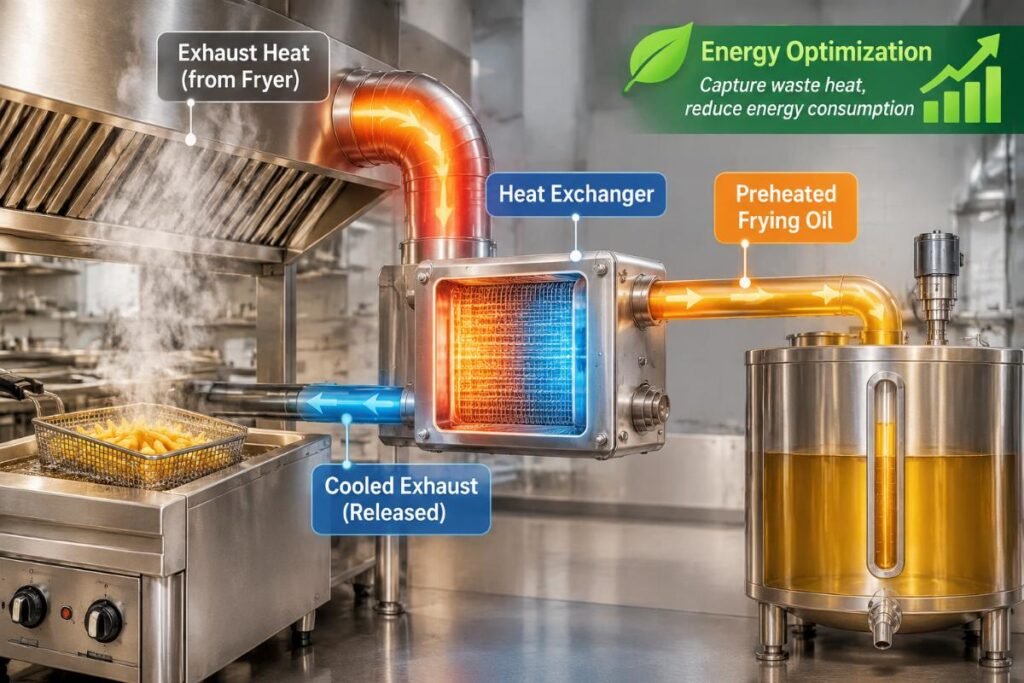
A modern Extruded Corn Chips Frying Line treats waste heat as a valuable resource. By installing heat exchangers on the exhaust ducts, we can capture the hot, moist air leaving the fryer and use it to preheat the raw oil being pumped into the system.
I recall a project in a region where industrial energy costs were exceptionally high. The startup owners were struggling to keep their operational expenses within budget. We integrated a specialized heat recovery loop into their line. The preheated oil entering the fryer required significantly less burner output to reach the target frying temperature. Over the course of a year, the energy savings were substantial enough to pay for the recovery module’s installation. It transforms the Extruded Corn Chips Frying Line from a massive energy drain into a highly optimized, cost-effective thermal engine.
How to Integrate the Frying Line with Extrusion and Packaging?
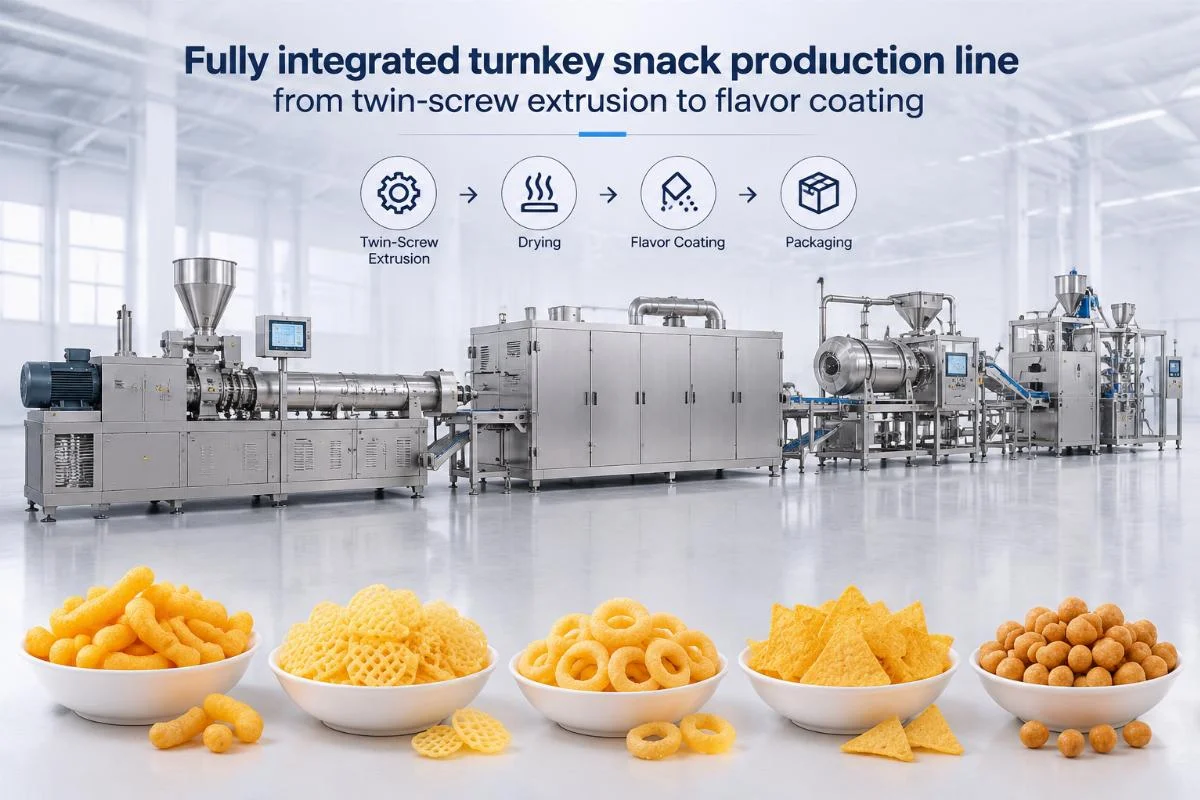
Seamless integration from the twin-screw extruder through the frying, de-oiling, and flavor coating stages ensures consistent product quality and maximizes overall line efficiency.
The final piece of the puzzle is how all these modules communicate and physically connect. A fragmented line with manual transfers between the fryer and the flavoring drum introduces contamination risks and temperature fluctuations. The Extruded Corn Chips Frying Line must operate as a single, synchronized organism.
This is where the engineering philosophy of Meiteng truly shines for startup food businesses. We design turnkey corn puff lines that bridge the gap between raw material intake and final packaging. The integration starts right at the discharge of the twin-screw extruder, where the multi-form dough is gently conveyed into the fryer without breaking the delicate pre-gelatinized structure.
Following the thermal and de-oiling stages, the product moves directly into an automated flavor coating system. The coating drum is synchronized with the fryer’s output speed, ensuring an even distribution of seasoning without clumping. Throughout this entire journey, the equipment is constructed from food-grade stainless steel, adhering to strict sanitary standards.
For new entrepreneurs entering the snack market, the complexity of matching the extruder’s output to the fryer’s thermal capacity can be daunting. That is why comprehensive formula development support and on-site installation with operator training are non-negotiable. We don’t just hand over a list of machines; we engineer the entire thermal profile, ensuring that the transition from a raw corn blend to a perfectly seasoned, crispy snack is seamless, repeatable, and certified for global food safety standards.
Conclusion
Mastering snack production requires viewing the frying process as a holistic thermal management challenge rather than a simple heating step. By prioritizing continuous heat distribution, aggressive de-oiling, and intelligent heat recovery, manufacturers can control oil content, reduce energy costs, and guarantee a superior crunch. A fully integrated Extruded Corn Chips Frying Line transforms raw ingredients into a consistent, high-quality product, securing both operational efficiency and long-term market success.
Equipment Mentioned in This Article
 3D papad machine
2D 3D Snack Pellet Production Line Manufacturer
2D 3D Snack Pellet Production Line for Diverse Shapes from Starches — twin-screw extrusion handles wheat, corn, and cassava. The… View Machine Details frying chips machine
Industrial Deep Fryer Machine Manufacturer Banana Potato Chips French Fries
Industrial Deep Fryer Machine for banana and potato chips features automatic basket lifting and oil filtration. The electric heating system… View Machine Details frying chips machine
100-2000L Tank Deep Fryer Commercial Chips Frying Machine
100-2000L Tank Deep Fryer for Snack Pellets and Chips — handles continuous deep frying and de-oiling for potato, cassava, and… View Machine Details frying chips machine
Electric Batch Frying Machine for French Fries Fast Food Chicken Wing
Industrial Batch Fryer for Fried Snacks and French Fries — features electric or gas heating with automatic basket lifting for… View Machine DetailsRelated Applications

Engineering Perspective
An In-House R&D Team Behind Every Line
Jinan MT Machinery develops its process technology in-house. The team concentrates on the four areas that decide pellet shape, expansion and line stability.
- Expansion technology
- Twin-screw extrusion
- Die design
- PLC/MCC automation
Related Articles
 Nov 16, 2026 · Product & Series Guides
DS Series Snack Pellet Line Mixer & Screw Conveyor Manufacturer
Selecting the right DS Series Snack Pellet Line Mixer & Screw Conveyor Manufacturer prevents material degradation and motor burnout caused by oversized equipment. Match… Read This Article Nov 16, 2026 · Product & Series Guides
DS135 Twin-Screw Extruder Manufacturer for Large Output Pellet Plants
Scaling up with a DS135 Twin-Screw Extruder fails when producers rely solely on nameplate capacity instead of matching screw configurations to specific recipes. Real… Read This Article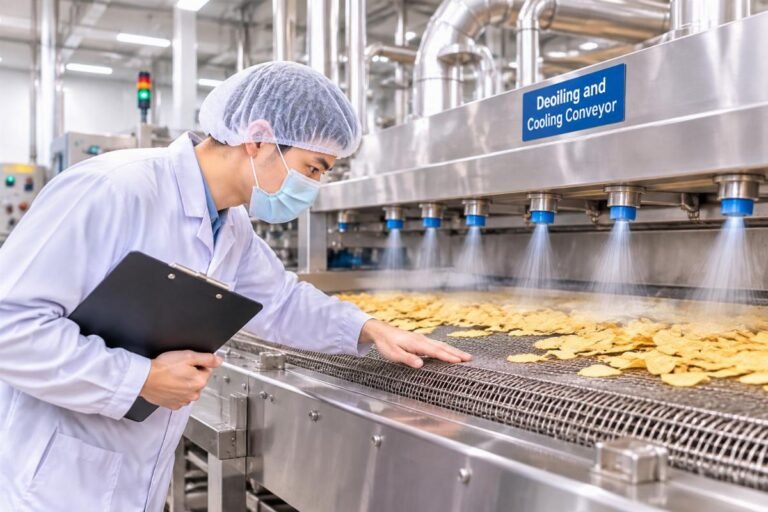 Nov 16, 2026 · Product & Series Guides
Meiteng Deoiling & Cooling Conveyors for Frying Chips Line Manufacturer
Properly matching Deoiling and Cooling Conveyors prevents moisture condensation and oil retention that ruin fried chips after packaging. Synchronizing mesh speed with extruder output… Read This ArticleFree Process Check
Send Your Recipe for a Process Check
Jinan MT Machinery engineers review your recipe and return a free process plan within 24 hours. Tell us the product, output, raw material, local voltage and heat source.
Send Your Recipe on WhatsApp