
Meiteng DS65 Twin-Screw vs SLG-90 Single-Screw for 2D Pellets Manufacturer
- By Jinan MT Machinery

Most buyers assume a simpler machine means lower total cost, but complex 2D pellet recipes often make the twin-screw option the more economical choice over time.
Choosing between the DS65 twin-screw and the SLG-90 single-screw extruder for 2D pellets depends entirely on your raw material complexity, required shear force, and production scale, rather than just the initial equipment price.
Walking through a pet food startup facility in Southeast Asia last year, I watched their production team struggle with uneven gelatinization in their new 2D treat line. They had initially opted for a simpler friction-based setup to save on upfront capital, but the resulting waste and frequent die clogs erased those savings within months. When we evaluated their throughput and energy consumption per ton, the operational reality became clear: the DS65 twin-screw vs SLG-90 single-screw debate is not about which machine is universally better, but which mechanical action aligns with your specific formulation constraints.
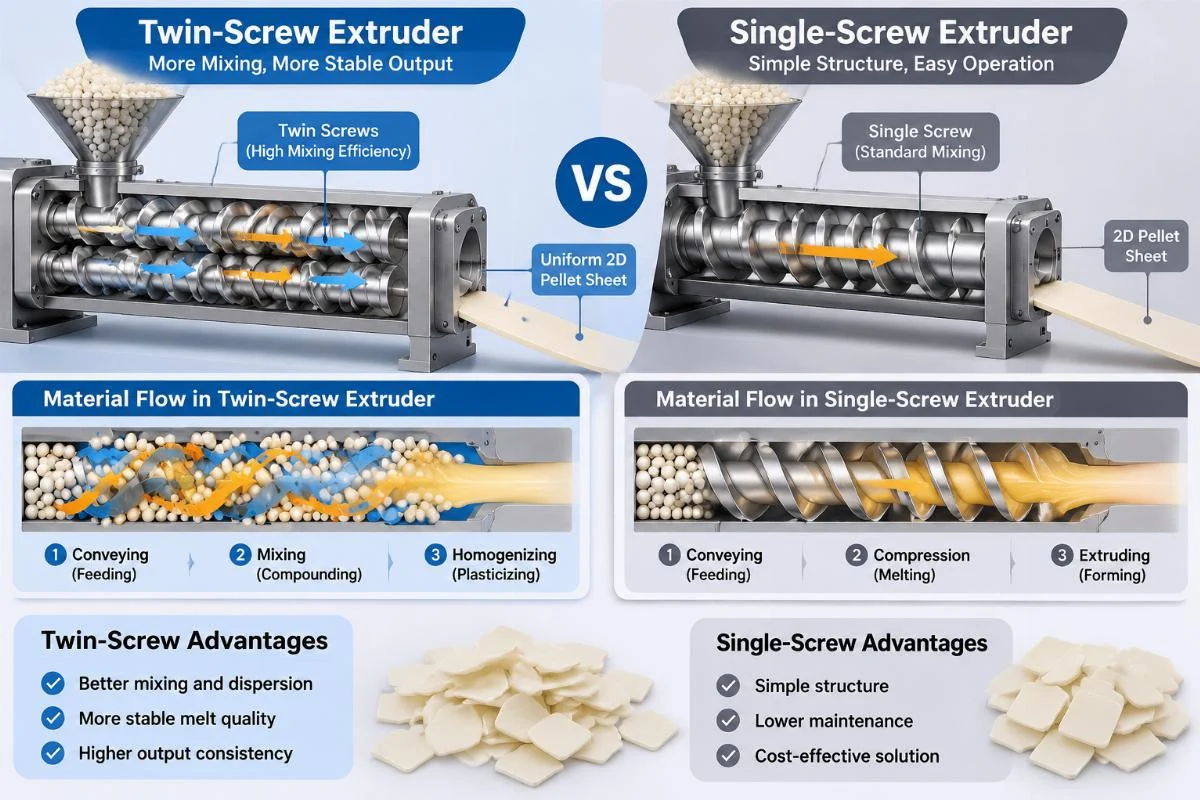
This brings us to the fundamental mechanics that dictate how each machine handles your specific 2D pellet geometry.
What Are the Core Mechanical Differences Between DS65 and SLG-90?
The DS65 utilizes co-rotating screws that provide intense self-cleaning and controlled shear, whereas the SLG-90 relies on barrel friction and a simpler pressure build-up profile.
When evaluating the DS65 twin-screw vs SLG-90 single-screw extruder for 2D pellets, the internal mechanics dictate everything from starch gelatinization to protein texturization. The twin-screw design forces materials to interact with each other and the barrel walls in a highly controlled, positive conveying manner. This self-wiping action prevents material stagnation, which is critical when dealing with sticky or high-moisture 2D pellet recipes. Conversely, the single-screw design depends heavily on the friction coefficient between the material and the barrel. If your recipe lacks sufficient natural lubricants or standard starches, the material can slip, leading to pressure drops and inconsistent pellet shapes.
| Mechanical Feature | DS65 Twin-Screw | SLG-90 Single-Screw |
|---|---|---|
| Conveying Mechanism | Positive, self-cleaning | Friction-dependent |
| Shear Force Control | Highly adjustable via screw profile | Fixed by barrel and screw geometry |
| Material Stagnation Risk | Noticeably reduced | Vulnerable to slip zones |
| Recipe Flexibility | Robust | Basic |
A contract manufacturer handling multi-formulation pet treats once faced severe cross-contamination issues. Their single-screw setup required full screw withdrawal for cleaning, taking hours of downtime. By switching to a modular twin-screw barrel system, they could quickly open the barrel and clean the exposed screws, drastically reducing changeover time. This flexibility is a hallmark of Meiteng’s turnkey line design, ensuring your facility can pivot between recipes without sacrificing hygiene standards.
Ultimately, the mechanical choice defines your operational ceiling. If your process requires precise shear manipulation, the twin-screw architecture is non-negotiable.
How Do They Perform Specifically for 2D Pellet Forming?
The DS65 ensures uniform gelatinization for complex, multi-ingredient 2D shapes, while the SLG-90 remains optimal for standard, high-starch 2D pellets with simple geometries.
The true test of the DS65 twin-screw vs SLG-90 single-screw extruder for 2D pellets happens at the die face. Creating a 2D pellet—such as a flat bone or a layered treat—requires the material to exit the die with uniform viscosity and structural integrity. The intense mixing and controlled specific mechanical energy (SME) input of the twin-screw extruder guarantee that even heat-sensitive nutrients are evenly distributed without localized burning.
| 2D Pellet Forming Aspect | DS65 Twin-Screw | SLG-90 Single-Screw |
|---|---|---|
| Gelatinization Uniformity | Controlled and thorough | Dependent on recipe starch content |
| Die Face Pressure Stability | Substantially extended stability | Noticeably reduced with complex dies |
| Heat-Sensitive Nutrient Retention | Robust protection | Vulnerable to localized overheating |
| Shape Definition Clarity | High precision | Standard definition |
Consider an aquaculture feed producer switching to a new 2D sinking pellet recipe rich in alternative proteins. Their initial trials on a friction-based machine resulted in severe die wear and inconsistent pellet density due to uneven material flow. By transitioning to a system with precise L/D ratio management and adjustable shear, they stabilized their die pressure and extended their maintenance cycles significantly. Meiteng’s formula development support plays a crucial role here, helping producers tweak their recipes to maximize the extruder’s inherent strengths.
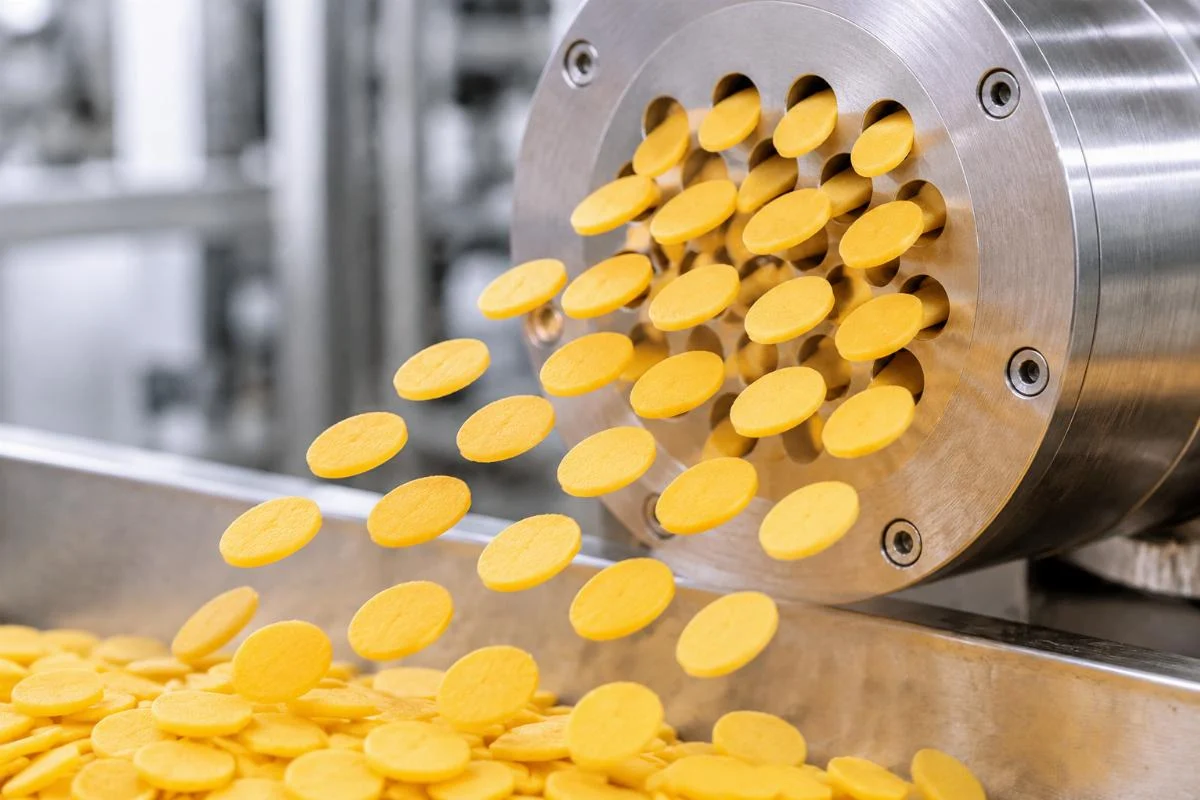
For simple, high-starch shapes, the single-screw is perfectly adequate. But for intricate 2D designs requiring precise density and nutrient retention, the twin-screw’s mixing capability is the deciding factor.
Which Extruder Delivers Better ROI for Your Production Scale?
The SLG-90 wins for single-recipe, high-volume runs, while the DS65 pays off rapidly in multi-recipe flexibility, waste reduction, and long-term operational stability.
Calculating the return on investment requires looking beyond the purchase price. When analyzing the DS65 twin-screw vs SLG-90 single-screw extruder for 2D pellets, startups often fixate on the initial capital expenditure. However, the total cost of ownership tells a different story. A single-screw machine might cost less upfront, but if your business model relies on frequent recipe changes or premium ingredients, the waste generated during startup and changeover can result in a mid-six-figure loss over a few years.
| ROI Factor | DS65 Twin-Screw | SLG-90 Single-Screw |
|---|---|---|
| Initial Capital Expenditure | Higher investment | Lower entry cost |
| Multi-Recipe Flexibility | Full batch-level adaptability | Sample-level limitations |
| Startup Waste Generation | Noticeably reduced | Uncontrolled during transitions |
| Long-Term Downtime Costs | Substantially extended uptime | Vulnerable to recipe complexity |
A pet food startup scaling up their treat line initially hesitated at the higher investment of a twin-screw system. However, after running a pilot batch with complex, multi-ingredient 2D shapes, they realized the single-screw alternative would have required constant manual adjustments and generated unacceptable levels of off-spec product. By investing in the DS65, backed by Meiteng’s on-site operator training, they ensured their team could maximize the machine’s efficiency from day one, turning a potential operational bottleneck into a competitive advantage.

If your strategy involves a single, high-volume SKU, the single-screw is a solid choice. But for brands building a diverse portfolio of 2D pellets, the twin-screw’s flexibility secures a much healthier margin.
What Are the Maintenance and Operational Costs?
Twin-screw barrels are modular for easy, targeted part replacement, whereas single-screw setups often require full screw withdrawal and more intensive barrel cleaning.
Maintenance is where the theoretical advantages of the DS65 twin-screw vs SLG-90 single-screw extruder for 2D pellets become tangible financial realities. The modular barrel design of the twin-screw extruder allows maintenance teams to open specific zones, inspect the screw elements, and replace worn segments without dismantling the entire assembly. This is particularly important when processing abrasive 2D pellet formulations that accelerate wear in specific high-shear zones.
| Maintenance Aspect | DS65 Twin-Screw | SLG-90 Single-Screw |
|---|---|---|
| Barrel Access | Modular, section-by-section | Full length assembly |
| Screw Replacement | Targeted element replacement | Full screw withdrawal required |
| Cleaning Efficiency | Self-cleaning action aids process | Manual, intensive scraping needed |
| Abrasive Wear Management | Isolated zone replacement | Generalized barrel wear |
An aquaculture feed producer dealing with high-mineral 2D sinking pellets noticed increased vibration and energy draw on their older single-screw line. Diagnosing the issue required pulling the entire screw assembly, a process that halted production for an extended period. In contrast, facilities utilizing the DS65 can simply unbolt the affected barrel section, swap the worn screw elements, and resume production rapidly. Meiteng’s commitment to CE and ISO certified food-grade construction ensures that all modular components meet strict sanitary standards, making the maintenance process both efficient and compliant.
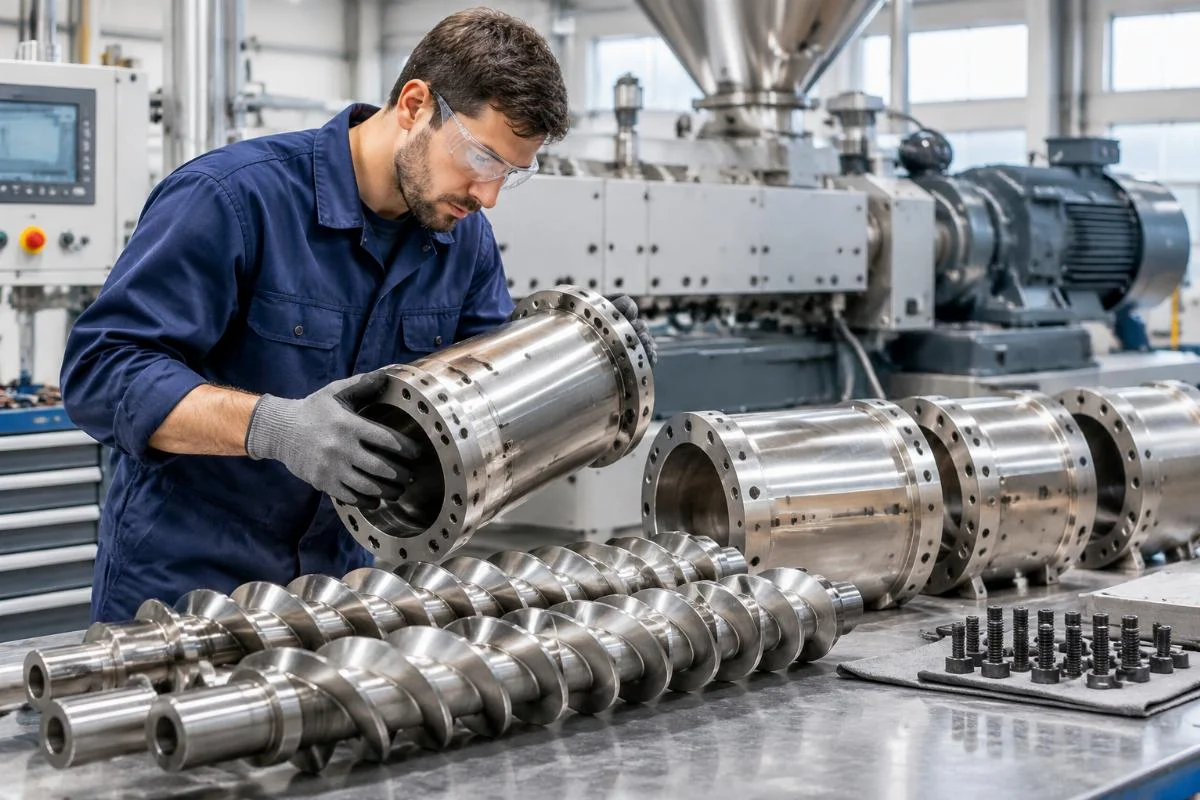
Routine maintenance on a twin-screw system is inherently more predictable and less disruptive. The ability to address wear locally prevents minor issues from escalating into major production halts.
Conclusion
The choice between these extruders hinges on your recipe complexity and production agility, not just the initial price tag.
While the SLG-90 serves high-volume, simple starch-based 2D pellets efficiently, the DS65 twin-screw extruder provides the shear control, modularity, and flexibility required for complex, multi-ingredient formulations. Evaluating the DS65 twin-screw vs SLG-90 single-screw extruder for 2D pellets ultimately comes down to aligning your mechanical capabilities with your long-term product strategy and waste reduction goals.
Equipment Mentioned in This Article
 3D papad machine
2D 3D Snack Pellet Production Line Manufacturer
2D 3D Snack Pellet Production Line for Diverse Shapes from Starches — twin-screw extrusion handles wheat, corn, and cassava. The… View Machine Details 3D papad machine
3D Snack Pellet Production Line Fried Extruder Machine
3D Snack Pellet Production Line for Starch-Based Snacks — twin-screw extrusion processes potato, cassava, and corn starch into diverse shapes.… View Machine Details 3D papad machine
Fully Automatic 3D Snack Pellets Extruder Making Machine for Chips
Chips 3D Snack Pellet Extruder Line for 2D/3D Shapes — co-rotating twin-screw extrusion processes potato and cassava starches into papad,… View Machine Details 3D papad machine
Automatic 3D Pellet Extruded Corn Puffed Snack Food Production Line
3D Pellet Extruded Snack Food Production Line for Starch Pellets — processes potato, corn, and cassava starch into papad and… View Machine DetailsRelated Applications

Engineering Perspective
An In-House R&D Team Behind Every Line
Jinan MT Machinery develops its process technology in-house. The team concentrates on the four areas that decide pellet shape, expansion and line stability.
- Expansion technology
- Twin-screw extrusion
- Die design
- PLC/MCC automation
Related Articles
 Nov 12, 2026 · Brands & Alternatives
Bühler vs Wenger vs Clextral Snack Extruder Wholesale Supplier
Evaluating snack extruder options reveals that premium European brands often cause costly downtime due to long spare parts lead times and rigid designs for… Read This Article Nov 12, 2026 · Brands & Alternatives
Semi-Auto vs Fully Auto Pellet Chips Lines Manufacturer
Choosing between semi-automatic and fully automatic pellet chips lines depends on matching local power capacity, labor costs, and factory space rather than just production… Read This Article Nov 12, 2026 · Brands & Alternatives
Low-Fat Snack Air Popping Lines: Wholesale Supplier for Pellet Fryer Alternatives
Transitioning to an Air popping line for low-fat snacks often causes blockages and severe screw wear due to poor shear control. Twin-screw extruders with… Read This ArticleFree Process Check
Send Your Recipe for a Process Check
Jinan MT Machinery engineers review your recipe and return a free process plan within 24 hours. Tell us the product, output, raw material, local voltage and heat source.
Send Your Recipe on WhatsApp