
Meiteng Multi-Layer Belt Dryer for Snack Pellets Manufacturer
- By Jinan MT Machinery

More layers and higher temperatures do not guarantee better drying; they often seal the surface and trap internal moisture.
Selecting the right Multi-Layer Belt Dryer for Snack Pellets requires matching layer count, airflow, and temperature to the specific initial moisture and density of the extruded product, rather than just focusing on throughput capacity.
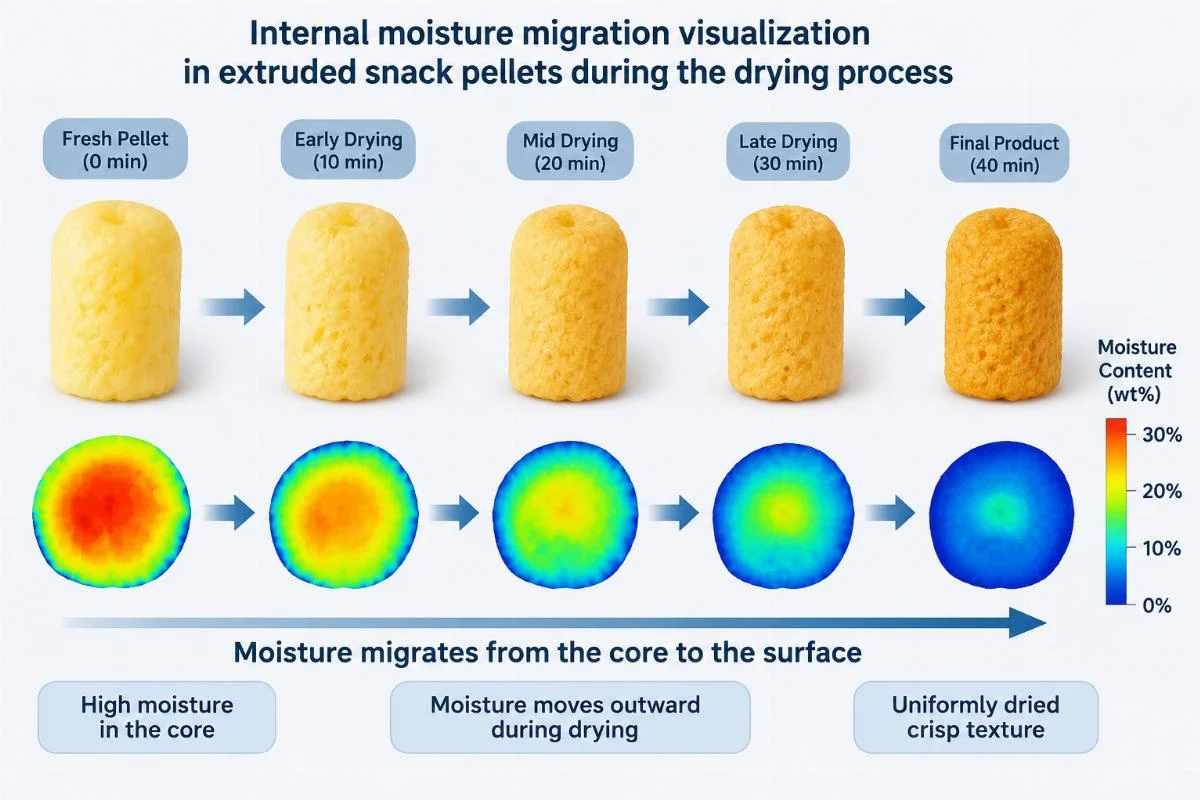
I learned this the hard way during a commissioning trip to an extrusion plant in São Paulo, Brazil. We were processing high-moisture corn puffs, and I set up a standard three-layer configuration with aggressive initial temperatures and maximum airflow. The result was a disaster: the snack pellets looked perfectly dry on the outside, but when we bit into them, the cores were completely raw and doughy. The client was ready to reject the entire line. That failure forced me to stop treating the Multi-Layer Belt Dryer for Snack Pellets as a simple conveyor oven and start treating it as a complex thermodynamic system. I had to learn how to map initial versus final moisture content and calculate airflow penetration rates instead of just reading a basic spec sheet. Now, when I design a drying solution, I focus entirely on the physical characteristics of the extruded matrix.
Understanding these principles is the first step toward optimizing your production line.
What Are the Core Specs of a Snack Pellet Belt Dryer?
The true performance of a Multi-Layer Belt Dryer for Snack Pellets is defined by its thermal zoning and airflow penetration, not just its physical footprint.
When buyers first look at snack pellet drying machine specs, they usually focus on belt width and total length. While these dictate throughput, they tell you nothing about drying efficiency. The critical specifications revolve around how the machine manages heat and humidity across different zones.
A properly engineered machine divides the drying tunnel into independent temperature and airflow zones. This allows the operator to apply gentle heat in the initial stages to prevent surface sealing, followed by higher heat in the middle stages for rapid moisture evaporation, and finally, a cooling or tempering zone to equalize the core moisture.
Another vital spec is the internal air velocity. If the air moves too fast, it cools the product surface and creates a crust. If it moves too slowly, the humid air saturates the boundary layer around the pellet, halting evaporation. The ideal setup requires variable frequency drives on the exhaust fans to adjust the penetration rate based on the product’s porosity.
When evaluating options, you must also verify the construction materials. Food-grade 304 stainless steel is non-negotiable for snack applications to prevent cross-contamination and ensure compliance with international food safety standards.

How Do You Match Dryer Options to Your Snack Density?
Matching multi-layer belt dryer options to your specific snack density prevents case hardening and ensures uniform core drying.
A common misconception is that a five-layer machine is inherently better than a three-layer machine. In reality, mismatched layer counts and airflow settings are the primary culprits behind case hardening—the phenomenon where the outer shell dries too quickly, trapping moisture inside.
To illustrate this, let us compare how different extruded matrices require entirely different configurations within a Multi-Layer Belt Dryer for Snack Pellets.
| Snack Matrix Type | Layer Configuration | Initial Zone Strategy | Airflow Direction |
|---|---|---|---|
| High-Moisture Corn Puffs | Three-Layer Setup | Moderate heat, high exhaust frequency | Cross-flow to prevent surface crust |
| Dense Protein Pellets | Five-Layer Setup | Lower initial temperature, extended retention | Down-flow penetration for core drying |
| Fragile Expanded Rings | Three-Layer Setup | Gentle heat, low velocity | Low-velocity circulation to avoid breakage |
For high-moisture corn puffs, a three-layer setup is sufficient, provided the exhaust fan frequency is tuned to pull moisture away rapidly without baking the surface. The goal is to achieve a steady moisture reduction per layer without shocking the product.
Conversely, dense protein snack pellets behave like tiny insulated bricks. If you hit them with high heat immediately, the surface seals instantly. A five-layer configuration with a lower initial zone temperature allows the heat* matrix. The extended retention time across five layers ensures the core moisture migrates to the surface at the same rate it evaporates.
For fragile expanded rings, the physical transfer between layers can cause product breakage. Here, the multi-layer belt dryer options must include gentle airflow settings and specialized transfer mechanisms to maintain product integrity.

Why Is Exhaust Airflow More Critical Than Heating Power?
Exhaust airflow dictates the actual drying rate, whereas excessive heating power merely wastes energy and damages product texture.
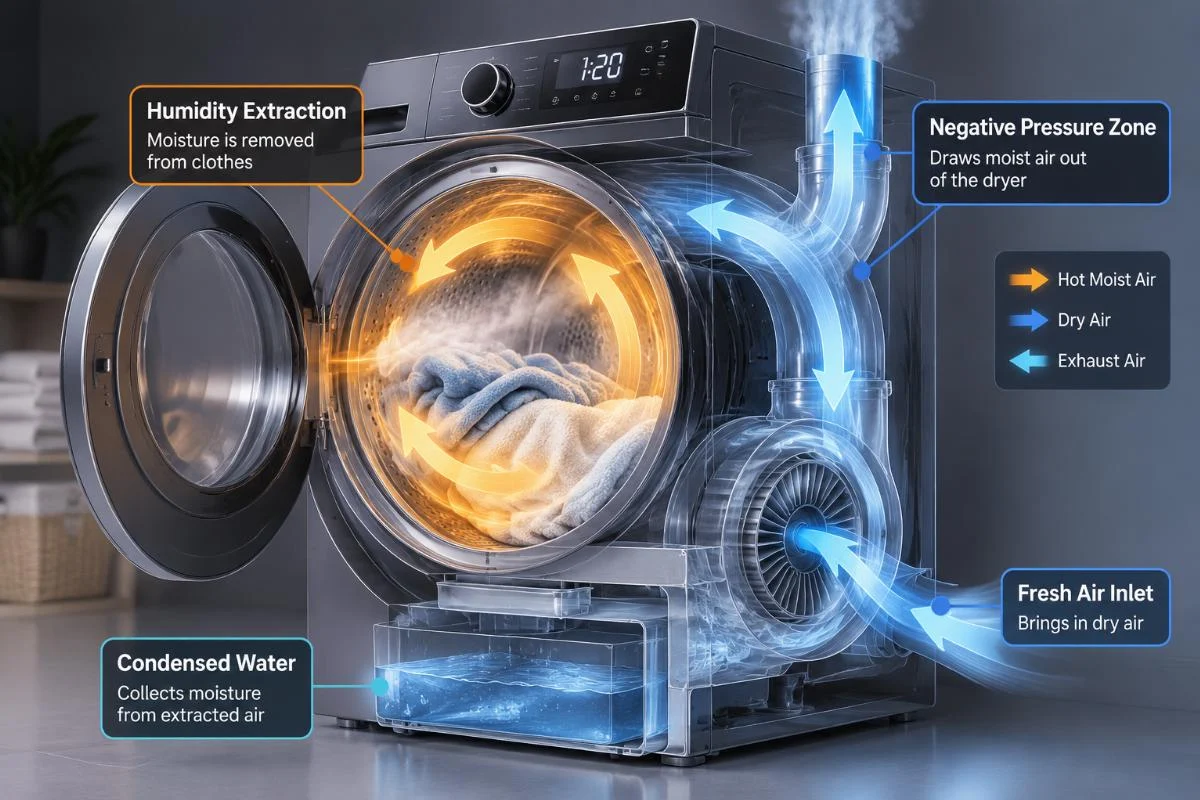
Many startup owners assume that upgrading the heating elements will speed up production. This is a costly mistake. In a Multi-Layer Belt Dryer for Snack Pellets, the heating elements only provide the potential for evaporation; the exhaust airflow does the actual work of removing the moisture.
If the exhaust system is undersized, the humidity inside the drying tunnel spikes. The air becomes saturated, and evaporation stops, regardless of how hot the elements are. The product simply sits in a hot, wet sauna. This leads to extended dwell times, increased specific heat consumption, and a sticky, uneven final product.
Furthermore, improper airflow direction causes physical damage. High-velocity air blowing directly upward through the bottom belt can blow lightweight expanded snacks off the belt or cause them to tumble violently, resulting in broken pieces and fines.
The solution lies in balancing the fresh air intake with the exhaust output. By utilizing advanced multi-layer belt dryer options that feature independent exhaust controls for each zone, operators can create a negative pressure gradient. This ensures that moist air is continuously pulled out of the high-humidity zones and replaced with dry, heated air, maintaining a high driving force for evaporation throughout the entire tunnel.
How to Verify Dryer Performance Before Purchase?
Never finalize a purchase without conducting a factory trial using your exact raw materials and extrusion parameters.
Theoretical calculations can only take you so far. The true test of any industrial snack dryer manufacturer is their willingness to validate performance through physical trials. Before committing to a Multi-Layer Belt Dryer for Snack Pellets, you must demand a test run that mimics your actual production conditions.
During the trial, the manufacturer should process your specific formulation through their pilot equipment. You need to monitor several critical data points: the initial moisture content of the extruded pellets, the final moisture content after drying, the exact dwell time required, and the sensory qualities of the final snack, including color, texture, and structural integrity.
A reputable partner will provide a detailed report mapping the moisture reduction curve across each layer of the machine. They will demonstrate how their customizable configurations—whether it is a three-layer setup for light snacks or a five-layer setup for dense proteins—handle your specific product.
Additionally, verify the construction quality. The machine must be fabricated from food-grade 304 stainless steel, with smooth welds and sanitary design features that allow for easy cleaning. An industrial snack dryer manufacturer that cuts corners on material quality will cost you dearly in maintenance and food safety compliance down the line.

Conclusion
Successful snack pellet drying relies on thermodynamic balance, not just raw heating capacity.
Selecting the right Multi-Layer Belt Dryer for Snack Pellets requires a deep understanding of your product’s density, initial moisture, and structural fragility. By prioritizing exhaust airflow management, independent thermal zoning, and rigorous material testing, you can eliminate case hardening and achieve uniform moisture reduction. Partnering with an experienced manufacturer who validates these parameters through physical trials ensures your extrusion line operates at peak efficiency and delivers a perfect final product.
Equipment Mentioned in This Article
 3D papad machine
2D 3D Snack Pellet Production Line Manufacturer
2D 3D Snack Pellet Production Line for Diverse Shapes from Starches — twin-screw extrusion handles wheat, corn, and cassava. The… View Machine Details 3D papad machine
3D Snack Pellet Production Line Fried Extruder Machine
3D Snack Pellet Production Line for Starch-Based Snacks — twin-screw extrusion processes potato, cassava, and corn starch into diverse shapes.… View Machine Details 3D papad machine
Fully Automatic 3D Snack Pellets Extruder Making Machine for Chips
Chips 3D Snack Pellet Extruder Line for 2D/3D Shapes — co-rotating twin-screw extrusion processes potato and cassava starches into papad,… View Machine Details 3D papad machine
Automatic 3D Pellet Extruded Corn Puffed Snack Food Production Line
3D Pellet Extruded Snack Food Production Line for Starch Pellets — processes potato, corn, and cassava starch into papad and… View Machine DetailsRelated Applications

Engineering Perspective
An In-House R&D Team Behind Every Line
Jinan MT Machinery develops its process technology in-house. The team concentrates on the four areas that decide pellet shape, expansion and line stability.
- Expansion technology
- Twin-screw extrusion
- Die design
- PLC/MCC automation
Related Articles
 Nov 16, 2026 · Product & Series Guides
DS Line Rotary Cutter for 2D Snack Pellets Manufacturer
Optimizing Rotary Cutter Options for 2D Snack Pellets eliminates edge burrs and reduces scrap rates by synchronizing cutter speed with extruder screw speed. Selecting… Read This Article Nov 16, 2026 · Product & Series Guides
2D Pellet Die Set for Wheels, Squares, Shells & Tubes Wholesale Supplier
Selecting the right 2D pellet die set requires matching specific shapes with the correct compression ratio to prevent screw jamming and transit corrosion. Discover… Read This Article Nov 16, 2026 · Product & Series Guides
DS85 vs DS95 Pellet Chips Extruder Manufacturer for Sale
Choosing the right DS85 vs DS95 extruder prevents barrel blockage when processing high-meat pellet chip formulas. The DS85 delivers energy efficiency for standard recipes,… Read This ArticleFree Process Check
Send Your Recipe for a Process Check
Jinan MT Machinery engineers review your recipe and return a free process plan within 24 hours. Tell us the product, output, raw material, local voltage and heat source.
Send Your Recipe on WhatsApp