
Pellet Chips Line for Morocco & Algeria: Meiteng Manufacturer
- By Jinan MT Machinery
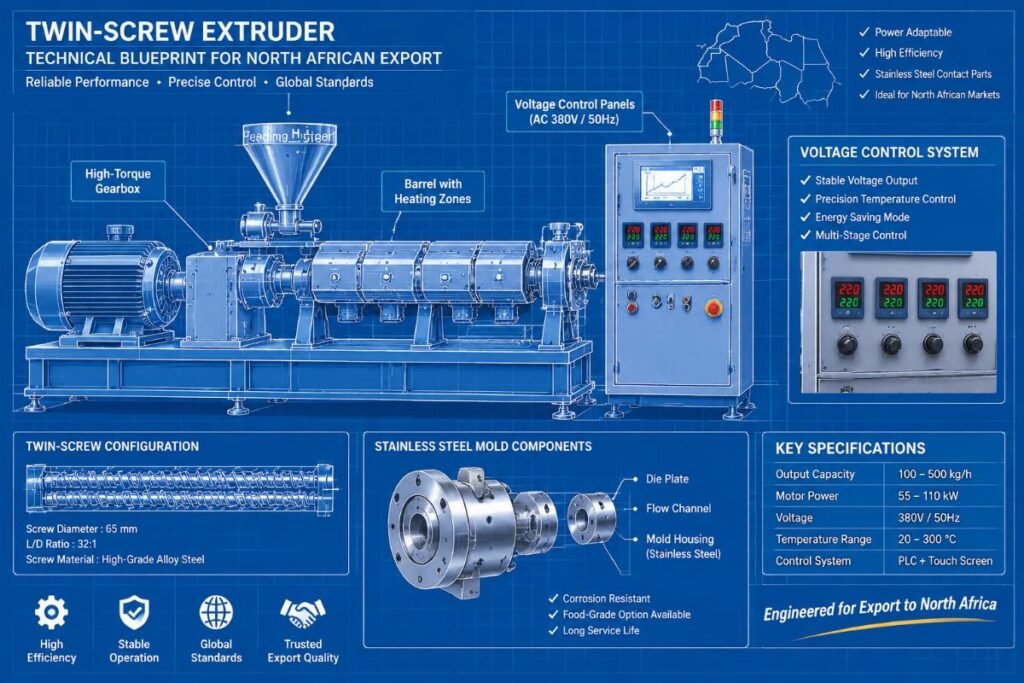
Most buyers obsess over extruder screw speed, yet local power grid compatibility and customs documentation dictate whether a pellet chips line shipping Morocco Algeria project succeeds or fails at the port.
To ensure a successful pellet chips line shipping Morocco Algeria operation, the extrusion equipment must be strictly customized to the local 380V/50Hz power standard, upgraded with marine-grade alloys to withstand high heat and humidity, and accompanied by complete CE certification to bypass North African customs detention.
Standing at our booth in Hannover years ago, an Algerian buyer pointed at our extrusion line blueprints and shook his head. He complained that the voltage specifications were wrong and the mold materials could not survive the North African heat and humidity. Back then, working as a quality inspector in the workshop, I only cared about screw rotation speeds and puffing ratios. It was not until I transitioned to international trade that I realized merely understanding machine parameters is never enough to secure orders in North Africa. I had to dig deep into the local 380V/50Hz electrical standards and CE customs clearance details to make this pellet chips line shipping Morocco Algeria turnkey solution actually work. Selecting a production line means calculating the local electricity, climate, and customs regulations into the total cost.

Let us break down the exact requirements and field realities you must navigate before finalizing your order.
What are the critical voltage and power requirements for Algeria and Morocco?
Motors and control panels must be strictly customized to 380V/50Hz to prevent immediate burnout upon first startup.
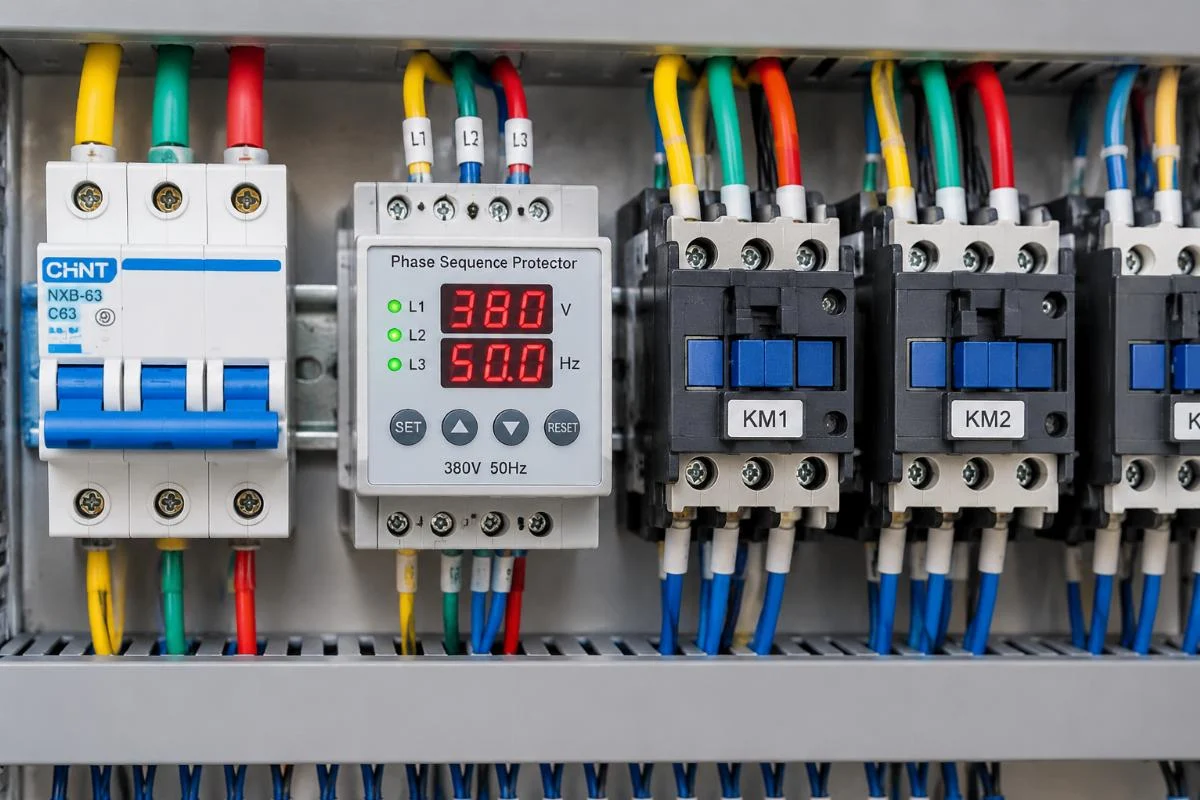
When arranging a pellet chips line shipping Morocco Algeria, the most common and catastrophic mistake is assuming standard Chinese or European motor configurations will work out of the box. The industrial power grid in both Algeria and Morocco operates strictly on a 380V/50Hz three-phase system. If your twin-screw extruder arrives with motors wired for a different frequency or voltage, the thermal overload relays will trip instantly, and the insulation on the motor windings will degrade rapidly under the wrong magnetic flux.
A snack food startup in Algiers once received a standard extrusion setup from an overseas supplier. The main drive motor was rated for a different frequency baseline. When they attempted to run the pellet chips line, the motor overheated within hours, causing a complete production halt. Rewiring the entire control panel and replacing the main drive motors cost them several times the initial savings they thought they had made on the base machine price.
To avoid this, every electrical component, from the main extruder drive to the cutting motors and the drying oven blowers, must be specified for 380V/50Hz. The control panels need to be equipped with phase sequence protectors and voltage fluctuation compensators, as local grid stability can sometimes vary.
Risk Checklist for Power Mismatch:
- Motor insulation breakdown due to incorrect frequency flux.
- Inverter and VFD (Variable Frequency Drive) failure from voltage spikes.
- Heating element burnout in the barrel zones due to unregulated current.
- Complete voiding of the equipment warranty by local electricians.
How does the North African climate affect mold and barrel lifespan?
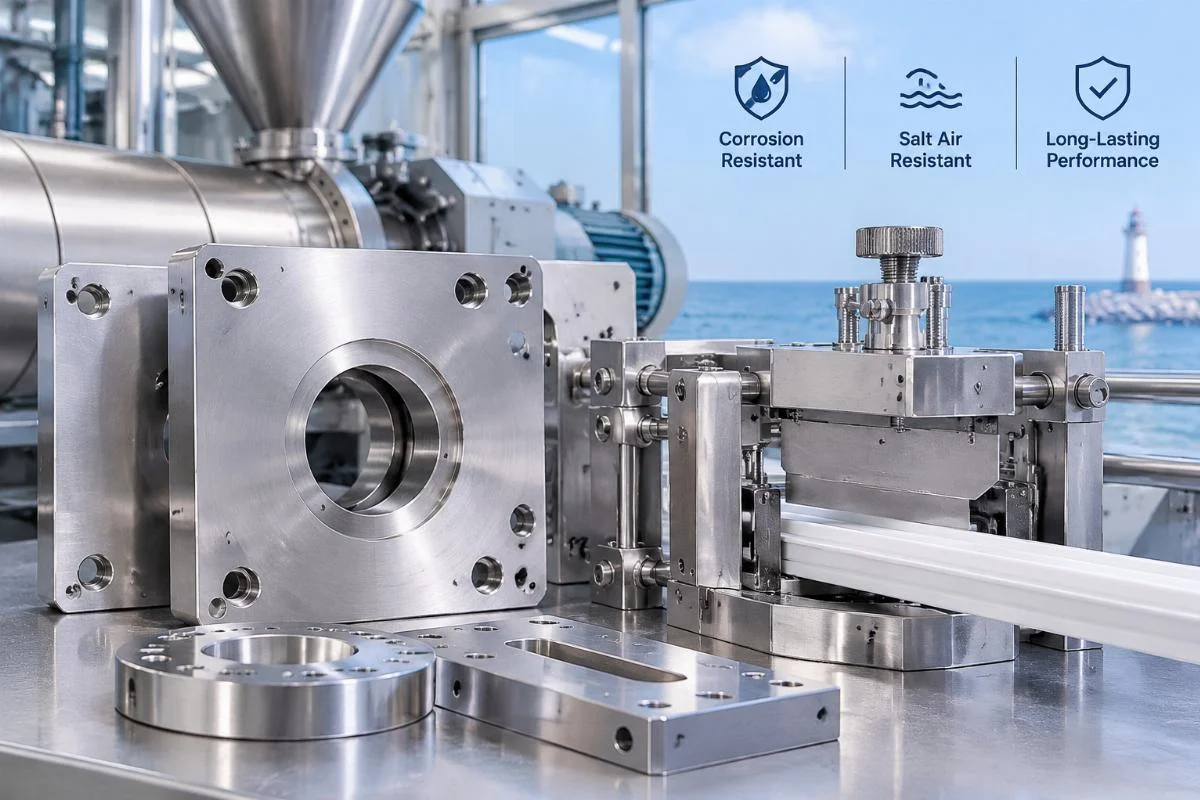
High heat and humidity require upgraded alloy molds and enhanced cooling systems to prevent rapid corrosion and product deformation.
The coastal cities of Morocco and Algeria experience intense summer heat combined with high maritime humidity. Standard carbon steel or basic alloy molds used in temperate climates will corrode rapidly in this environment. When executing a pellet chips line shipping Morocco Algeria, the extrusion dies and barrel sleeves must be upgraded to food-grade 304 or 316 stainless steel.
During a site visit to a facility near Casablanca, I observed a standard alloy mold that had been in use for only a few months. The high humidity had caused microscopic pitting on the die face. This pitting not only ruined the surface finish of the extruded pellet chips but also caused uneven material flow, leading to inconsistent puffing densities. The manufacturer had to halt production to polish and eventually replace the mold, losing significant revenue.
Furthermore, the ambient temperature affects the cooling efficiency of the production line. The multi-layer drying ovens and cooling conveyors must be oversized or equipped with enhanced airflow systems to compensate for the hot, humid intake air. If the cooling section cannot drop the moisture content of the pellet chips rapidly enough, the final product will become soggy and prone to mold growth during storage.
Climate Adaptation Requirements:
- Die plates and cutter blades manufactured from marine-grade stainless alloys.
- Barrel sections treated for enhanced thermal and moisture resistance.
- Drying and cooling systems with increased air exchange capacity.
- Electrical cabinets sealed with industrial-grade desiccant systems.
Which CE and customs documents are mandatory for smooth clearance?
Complete CE certification and specific export documentation prevent port detention and ensure legal compliance.
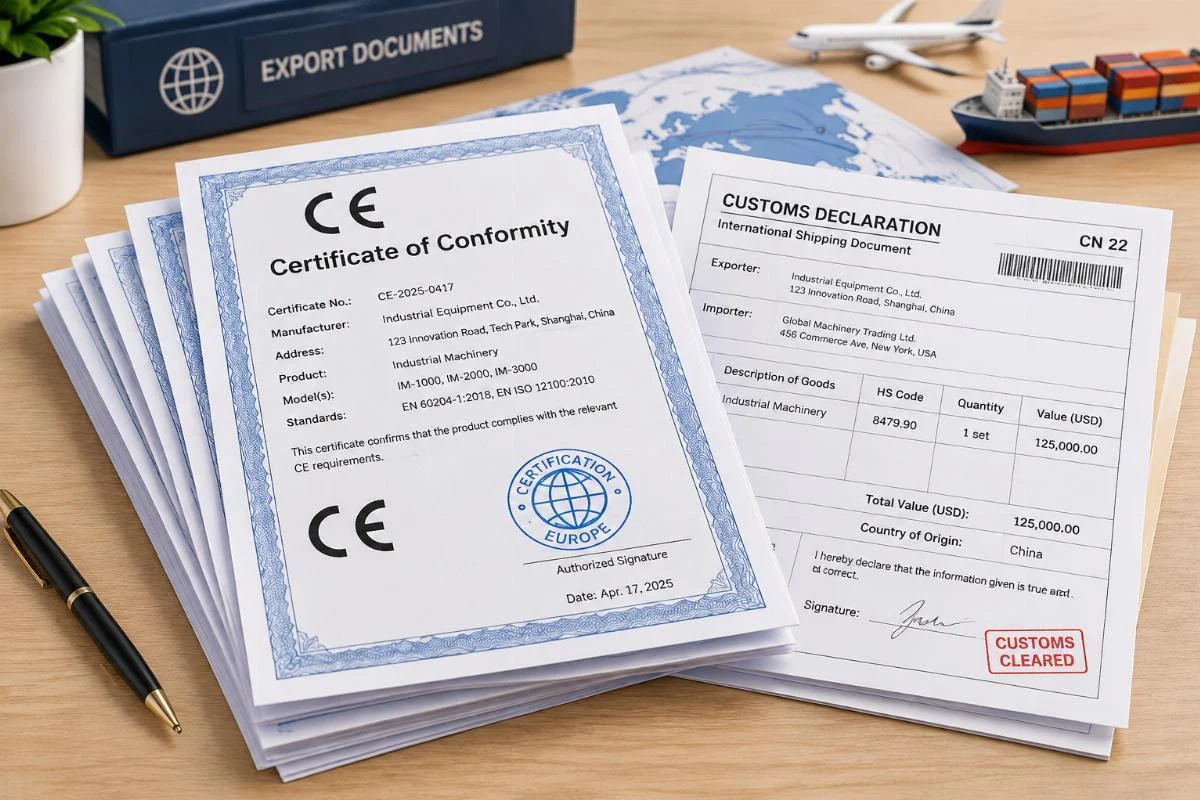
North African customs authorities have become increasingly strict regarding industrial machinery imports. For a seamless pellet chips line shipping Morocco Algeria, the CE mark is not just a quality badge; it is a mandatory legal requirement for customs clearance. Without the full CE technical file, including the Declaration of Conformity, risk assessments, and electrical schematics, your equipment will be held at the port, accruing massive demurrage charges daily.
I recall a case where a buyer in Tangier imported a snack food line without verifying the supplier’s CE documentation. The local customs inspectors requested the specific test reports for the emergency stop circuits and the material safety certificates for the food-contact surfaces. The supplier could only provide a generic certificate that did not match the specific machine serial numbers. The cargo was detained for weeks, and the buyer had to pay exorbitant storage fees while flying in a third-party inspection agency to verify the machine retroactively.
To guarantee smooth clearance, the manufacturer must provide a comprehensive dossier. This includes the CE Certificate of Conformity, ISO quality management certificates, detailed commercial invoices with accurate HS codes for each component, and a packed list that matches the physical container loading perfectly. Any discrepancy between the paperwork and the physical goods will trigger a full container inspection.
Mandatory Documentation Checklist:
- CE Declaration of Conformity specific to the machine serial numbers.
- ISO certification for the manufacturing facility.
- Detailed electrical and mechanical schematics for local safety inspectors.
- Accurate HS codes and material safety certificates for food-contact parts.
How to ensure a smooth turnkey installation post-shipping?
On-site commissioning and operator training are vital for local team handover and long-term stability.
The physical arrival of the equipment is only the beginning. The true value of a pellet chips line shipping Morocco Algeria is realized only when it is correctly installed, calibrated, and operated by the local team. Turnkey design means the supplier must provide on-site installation, commissioning, and comprehensive operator training.
A common pitfall is assuming that local mechanics can figure out the twin-screw extruder configuration on their own. The interaction between feed rate, screw speed, barrel temperature, and moisture content is highly complex. Without proper training, operators will either burn the product or produce under-puffed, dense pellets that are unsellable.
When we deploy engineers for a turnkey project in North Africa, they do not just bolt the machines together. They spend weeks on-site, running test batches with the buyer’s raw materials. They adjust the ring die and pellet forming parameters, calibrate the flavor-coating systems, and teach the local team how to perform daily maintenance, such as cleaning the extruder screws and checking the belt tensions. This hands-on knowledge transfer ensures that the production line runs efficiently long after the engineers have departed.
Turnkey Installation Essentials:
- Factory acceptance testing before container loading.
- On-site mechanical assembly and electrical wiring by supplier engineers.
- Trial runs using local raw materials to finalize product recipes.
- Comprehensive training for local operators and maintenance staff.

Conclusion
Success in North Africa demands adapting to local power, climate, and customs, not just buying machinery.
A pellet chips line shipping Morocco Algeria requires strict adherence to 380V/50Hz electrical standards, marine-grade material upgrades for high humidity, and flawless CE documentation to avoid port delays. By prioritizing these regional specifics and securing comprehensive on-site turnkey support, buyers can transform a complex import process into a stable, profitable production operation.
Equipment Mentioned in This Article
 3D papad machine
Fully Automatic 3D Snack Pellets Extruder Making Machine for Chips
Chips 3D Snack Pellet Extruder Line for 2D/3D Shapes — co-rotating twin-screw extrusion processes potato and cassava starches into papad,… View Machine Details frying chips machine
Industrial Deep Fryer Machine Manufacturer Banana Potato Chips French Fries
Industrial Deep Fryer Machine for banana and potato chips features automatic basket lifting and oil filtration. The electric heating system… View Machine Details frying chips machine
100-2000L Tank Deep Fryer Commercial Chips Frying Machine
100-2000L Tank Deep Fryer for Snack Pellets and Chips — handles continuous deep frying and de-oiling for potato, cassava, and… View Machine Details frying chips machine
Electric Batch Frying Machine for French Fries Fast Food Chicken Wing
Industrial Batch Fryer for Fried Snacks and French Fries — features electric or gas heating with automatic basket lifting for… View Machine DetailsRelated Applications

Engineering Perspective
An In-House R&D Team Behind Every Line
Jinan MT Machinery develops its process technology in-house. The team concentrates on the four areas that decide pellet shape, expansion and line stability.
- Expansion technology
- Twin-screw extrusion
- Die design
- PLC/MCC automation
Related Articles
 Nov 10, 2026 · Procurement & Trade FAQs
Snack Pellet Line for UAE: Twin-Screw Extruder Manufacturer & Turnkey Service
Buying a snack pellet line UAE requires engineering systems that survive extreme heat and voltage fluctuations, not just finding the lowest price. You must… Read This Article Nov 10, 2026 · Procurement & Trade FAQs
Fast Replacement Pellet Dies from China Manufacturer Meiteng
Minimize extruder downtime by understanding that replacement pellet die delivery time relies on precise formula matching and custom compression ratios rather than just express… Read This Article Nov 10, 2026 · Procurement & Trade FAQs
Snack Pellet Line for Poland & EU: Meiteng Twin-Screw Extruder Manufacturer
Importing a snack pellet line into Poland and the EU requires navigating strict CE machinery directives, EORI customs registration, and adapting equipment to local… Read This ArticleFree Process Check
Send Your Recipe for a Process Check
Jinan MT Machinery engineers review your recipe and return a free process plan within 24 hours. Tell us the product, output, raw material, local voltage and heat source.
Send Your Recipe on WhatsApp