
Pellet Snack Line for Egypt: DS70/DS85 Extruder Manufacturer
- By Jinan MT Machinery
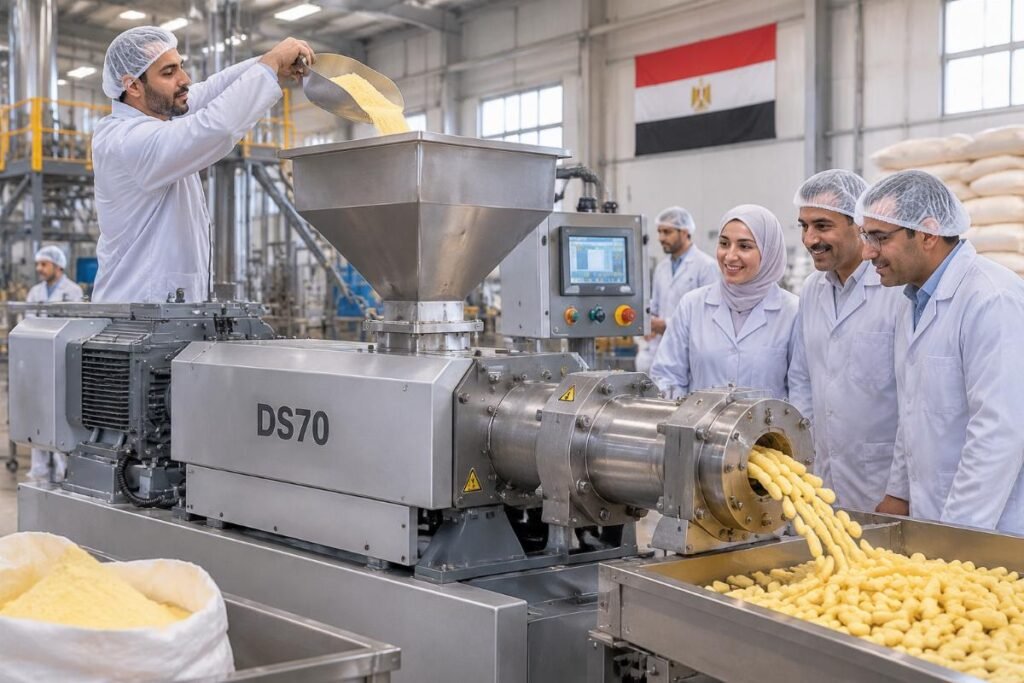
Standard machinery does not work globally; local corn gluten and voltage dictate success.
Importing a pellet snack line to Egypt requires adapting to local voltage and corn flour properties, not just buying standard machinery. The real bottlenecks are formula adjustments and on-site conditions, not the hardware itself.
I still remember sleeping on the floor of a snack factory on the outskirts of Cairo a few years ago. We had just fired up a twin-screw extruder to produce corn puff pellets, and the client was furious. The pellet debris rate was over half. The local power grid was fluctuating wildly, and the Egyptian corn flour had a completely different gluten profile than what we tested in Jinan. That night, I realized that selling a pellet snack line is not about selling a piece of iron; the formula and the actual workshop conditions are the real lifelines.

If you are planning to import a pellet snack line to Egypt or the broader North African market, you must look beyond the brochure specs. Here is how we tackle the real-world challenges on the ground.
How to adapt DS70 extruders for Egypt’s unstable voltage?
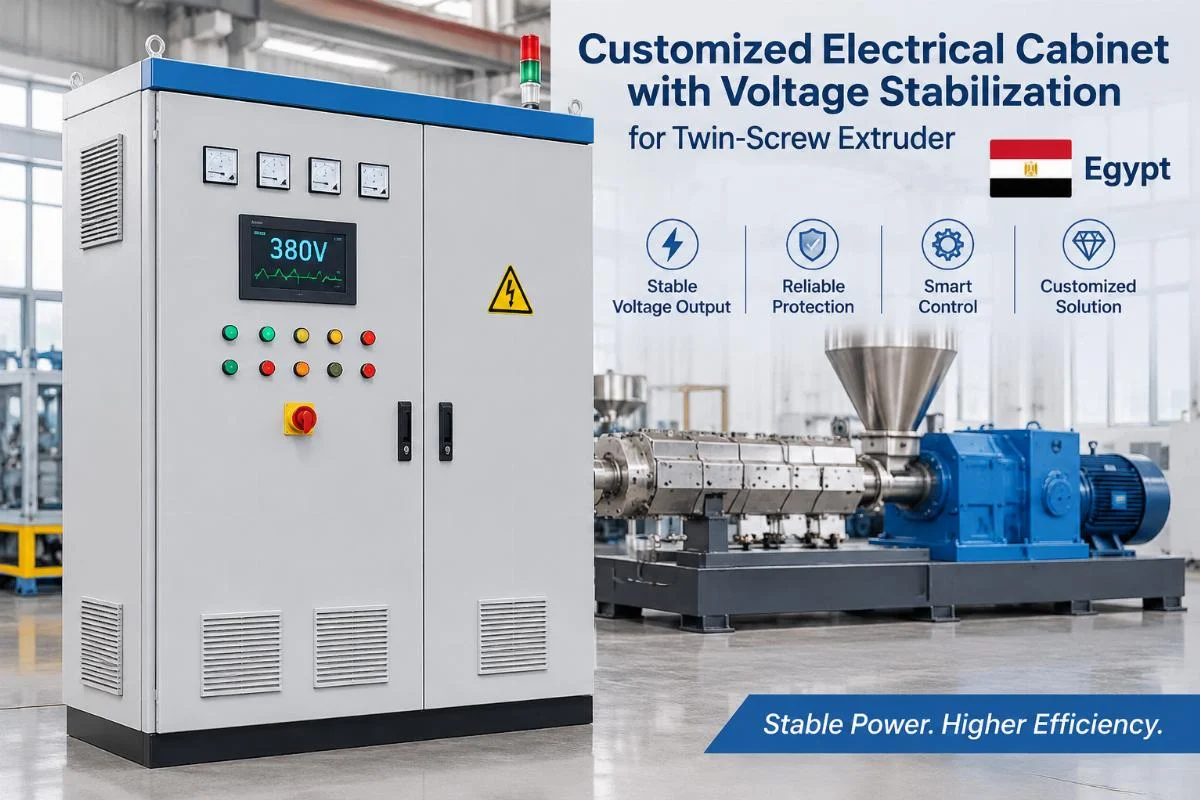
Custom motor and electrical cabinet upgrades are mandatory for regions with fluctuating power grids.
When importing a pellet snack line to Egypt, the first shock is often the power supply. Industrial zones on the outskirts of Cairo or Alexandria frequently experience voltage drops and phase imbalances. A standard electrical cabinet will trip constantly, or worse, burn out the main motor during peak extrusion loads.
To solve this, the DS70 twin-screw extruder requires specific electrical adaptations. We do not just ship a standard panel. The main drive motors must be upgraded to handle wider voltage tolerances, and the electrical cabinet needs integrated voltage stabilization modules and soft starters.
A Middle East snack startup once bought a standard line without consulting us about their local grid. Within a week, their main motor overheated, and the inverter board fried. They had to halt production, costing them weeks of delays. When we stepped in to retrofit their pellet snack line, we installed heavy-duty transformers and customized the control logic to gracefully shut down during severe sags rather than tripping the whole system.
For a twin-screw extruder Egypt buyers rely on, the electrical cabinet must be built with CE-certified components, specifically rated for harsh, dusty, and hot environments. The goal is to ensure the DS70 runs smoothly at its designed capacity of 200-300kg/h, regardless of what the local grid is doing.
Why does Egyptian corn flour cause high pellet debris?
Local gluten differences require specific screw reconfiguration to reduce pellet debris.
Hardware is only half the battle. The raw material is the other half, and Egyptian corn flour is notoriously different from the corn we use in our R&D center in Shandong. The protein and gluten content varies, which directly affects the dough rheology inside the barrel.
When we first ran local corn flour through the DS70, the shear force was insufficient to fully gelatinize the starch, resulting in weak pellets that shattered into dust during the drying and cooling phases. The debris rate was unacceptable.
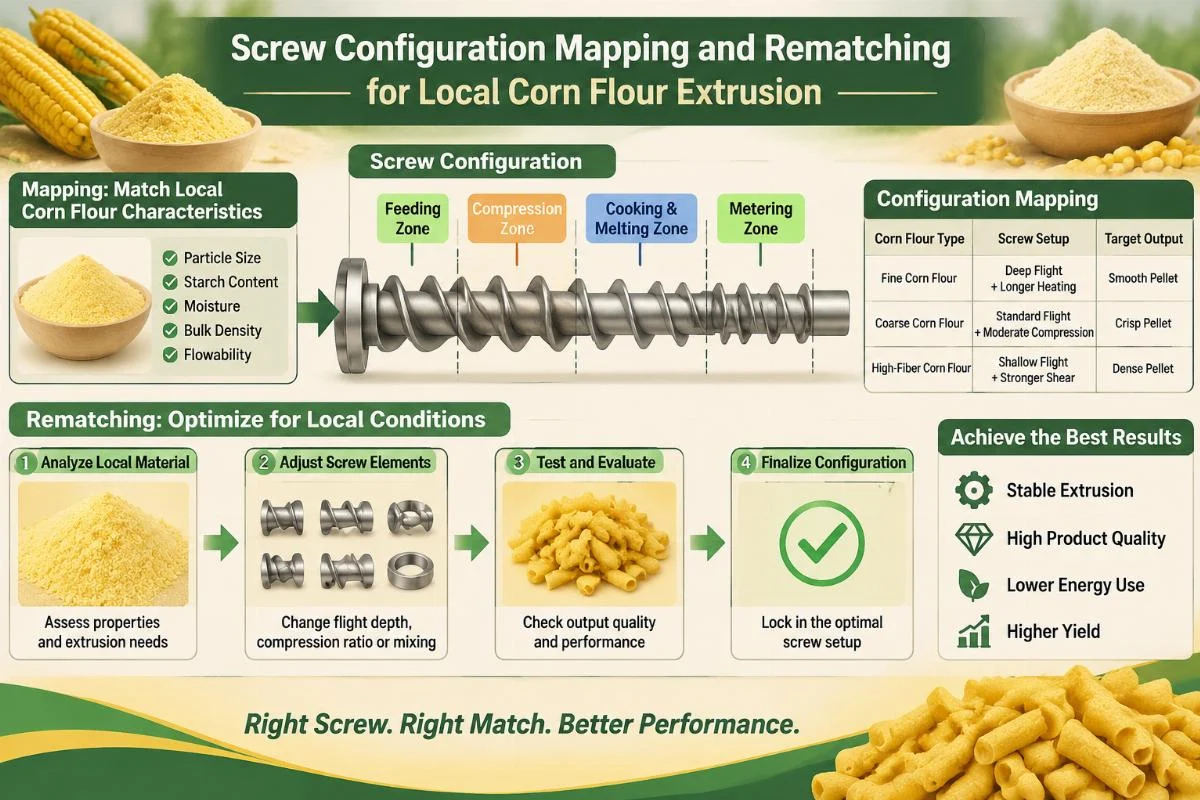
The solution lies in screw configuration mapping. We had to rematch the screw elements inside the DS70 barrel. By adjusting the arrangement of the kneading blocks and conveying elements, we increased the specific mechanical energy and improved the mixing intensity. This specific screw combination ensures that the local corn flour is properly sheared and gelatinized.
After rematching the screws for a corn puff line North Africa project, the debris rate was cut by half. The pellets came out of the die with a smooth, uniform surface, ready for the flavor coating system without generating excessive dust.
What moisture level ensures 90%+ forming rate?
Feed moisture must be strictly adjusted below 14% for optimal forming.
Moisture control is the most critical parameter in extrusion, yet it is often misunderstood by new operators. For Egyptian corn flour, the standard moisture settings simply do not apply. The ambient humidity and the inherent moisture content of the local grain require a different approach.
During that initial trial in Cairo, the feed moisture was set at the standard 14%. The result was a sticky, uneven dough that clogged the die and produced misshapen pellets. I spent days in the车间, tweaking the feed moisture from 14% downwards, monitoring the amperage and the extrusion torque.
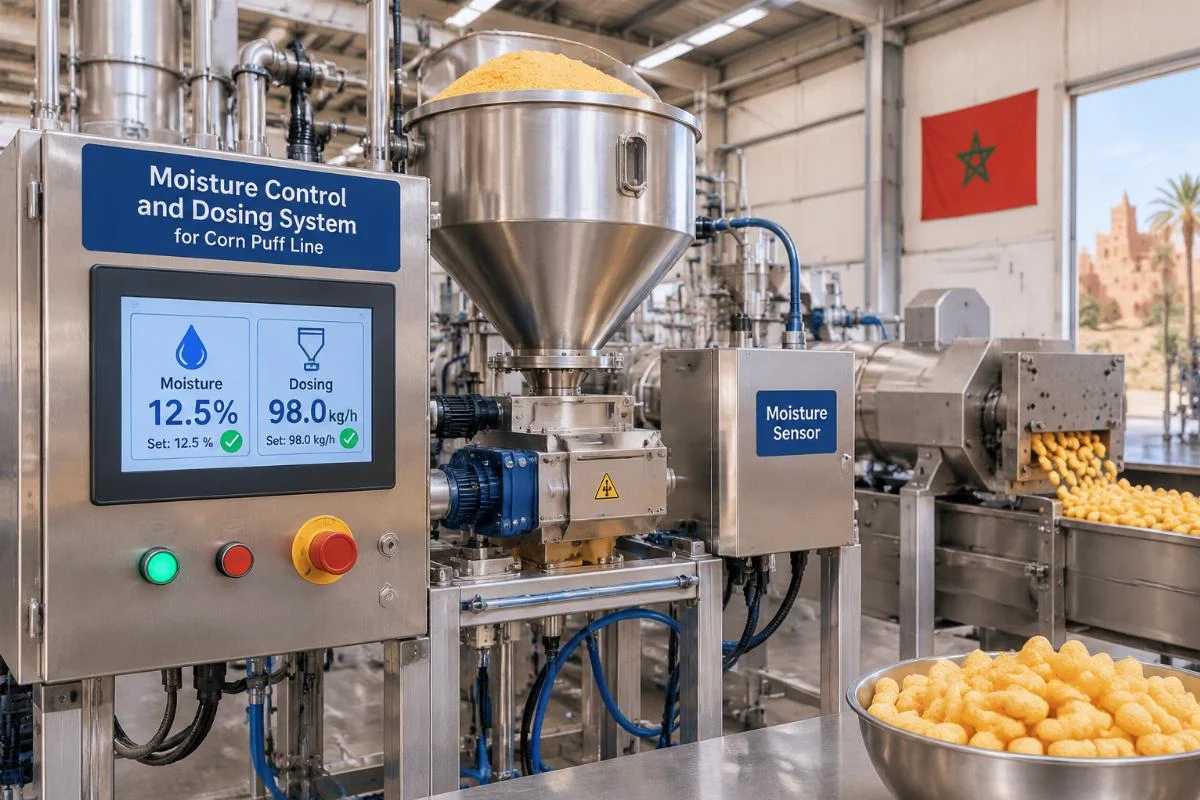
By dropping the moisture level slightly below 14%, the dough viscosity stabilized. The forming rate climbed back to over 90%. The pellets maintained their shape through the multi-pass dryer and retained their structural integrity during the flavor coating process.
This is where a snack machinery supplier must provide more than just equipment; they must provide the moisture adjustment curves and formula R&D support. A turnkey pellet snack line includes not just the DS70 extruder, but the precise dosing systems and the proprietary formulas tailored to your specific raw materials.
How to ensure smooth import and turnkey installation?
Rely on CE-certified suppliers offering formula and on-site training to guarantee success.
Importing a pellet snack line to Egypt involves complex logistics, customs clearance, and, most importantly, on-site commissioning. You cannot simply buy a machine, plug it in, and expect perfect snacks.
A true turnkey solution means the supplier handles everything from raw material intake to packaging. For Meiteng, this means our engineers fly to your facility in Egypt or anywhere in North Africa. We do not just bolt the DS70 or DS85 to the floor; we commission the entire line, including the multi-pass dryer, the cooling system, and the flavoring drum.
More importantly, we provide on-site operator training and formula development support. We teach your local team how to adjust the moisture, how to read the amperage, and how to perform basic maintenance. We also help you develop the exact seasoning formulas that appeal to the local palate.
When a North African snack startup relies on a supplier who only ships the hardware, they are left guessing how to run the line. When they partner with a manufacturer who provides full turnkey line design, food-grade 304 stainless construction, and multi-language technical support, the transition from installation to commercial production is seamless.

Conclusion
Success in the North African snack market relies on adapting to local conditions, not just importing standard machinery.
Importing a pellet snack line to Egypt requires navigating voltage instability, reconfiguring screws for local corn gluten, and strictly controlling feed moisture. By focusing on formula R&D, customized electrical upgrades, and comprehensive on-site training, manufacturers can transform raw local ingredients into high-quality, profitable snack pellets.
Equipment Mentioned in This Article
 3D papad machine
3D Snack Pellet Production Line Fried Extruder Machine
3D Snack Pellet Production Line for Starch-Based Snacks — twin-screw extrusion processes potato, cassava, and corn starch into diverse shapes.… View Machine Details 3D papad machine
Automatic 3D Pellet Extruded Corn Puffed Snack Food Production Line
3D Pellet Extruded Snack Food Production Line for Starch Pellets — processes potato, corn, and cassava starch into papad and… View Machine Details 3D papad machine
2D 3D Snack Pellet Production Line Manufacturer
2D 3D Snack Pellet Production Line for Diverse Shapes from Starches — twin-screw extrusion handles wheat, corn, and cassava. The… View Machine Details 3D papad machine
Fully Automatic 3D Snack Pellets Extruder Making Machine for Chips
Chips 3D Snack Pellet Extruder Line for 2D/3D Shapes — co-rotating twin-screw extrusion processes potato and cassava starches into papad,… View Machine DetailsRelated Applications

Engineering Perspective
An In-House R&D Team Behind Every Line
Jinan MT Machinery develops its process technology in-house. The team concentrates on the four areas that decide pellet shape, expansion and line stability.
- Expansion technology
- Twin-screw extrusion
- Die design
- PLC/MCC automation
Related Articles
 Nov 10, 2026 · Procurement & Trade FAQs
Snack Pellet Line for UAE: Twin-Screw Extruder Manufacturer & Turnkey Service
Buying a snack pellet line UAE requires engineering systems that survive extreme heat and voltage fluctuations, not just finding the lowest price. You must… Read This Article Nov 10, 2026 · Procurement & Trade FAQs
Fast Replacement Pellet Dies from China Manufacturer Meiteng
Minimize extruder downtime by understanding that replacement pellet die delivery time relies on precise formula matching and custom compression ratios rather than just express… Read This Article Nov 10, 2026 · Procurement & Trade FAQs
Snack Pellet Line for Poland & EU: Meiteng Twin-Screw Extruder Manufacturer
Importing a snack pellet line into Poland and the EU requires navigating strict CE machinery directives, EORI customs registration, and adapting equipment to local… Read This ArticleFree Process Check
Send Your Recipe for a Process Check
Jinan MT Machinery engineers review your recipe and return a free process plan within 24 hours. Tell us the product, output, raw material, local voltage and heat source.
Send Your Recipe on WhatsApp