
Snack Pellet Dryer: Belt Layers, Length & Energy Use – Meiteng Manufacturer
- By Jinan MT Machinery

More belt layers do not guarantee better drying if airflow and heat distribution remain uncalculated.
For snack pellet dryer selection, a 3-layer belt suits low-moisture targets and compact spaces, while a 5-layer configuration is essential for high-initial-moisture extrudates. The ideal dryer length must match your extruder output to ensure adequate residence time without over-drying, and extended configurations require optimized airflow to prevent power spikes and reduce per-unit energy costs.
I started on the assembly floor before moving into technical sales, which means I learn best from broken machines. Years ago, I was commissioning a snack pellet line in Lagos. The client insisted on a cheap, short 3-layer dryer to save floor space. I warned him about the thermal dynamics, but he wouldn’t listen. When we ran the extruded pellets, they came out soggy because the residence time was simply too short. We had to retrofit a 5-layer belt, but the original blower couldn’t handle the extended length, and the local diesel generators kept tripping from the power spike. That sweltering night in the factory taught me that dryer length and belt layers aren’t just spec sheet numbers—they dictate your moisture content and your electricity bill. Now, I always calculate the thermal dynamics before quoting.
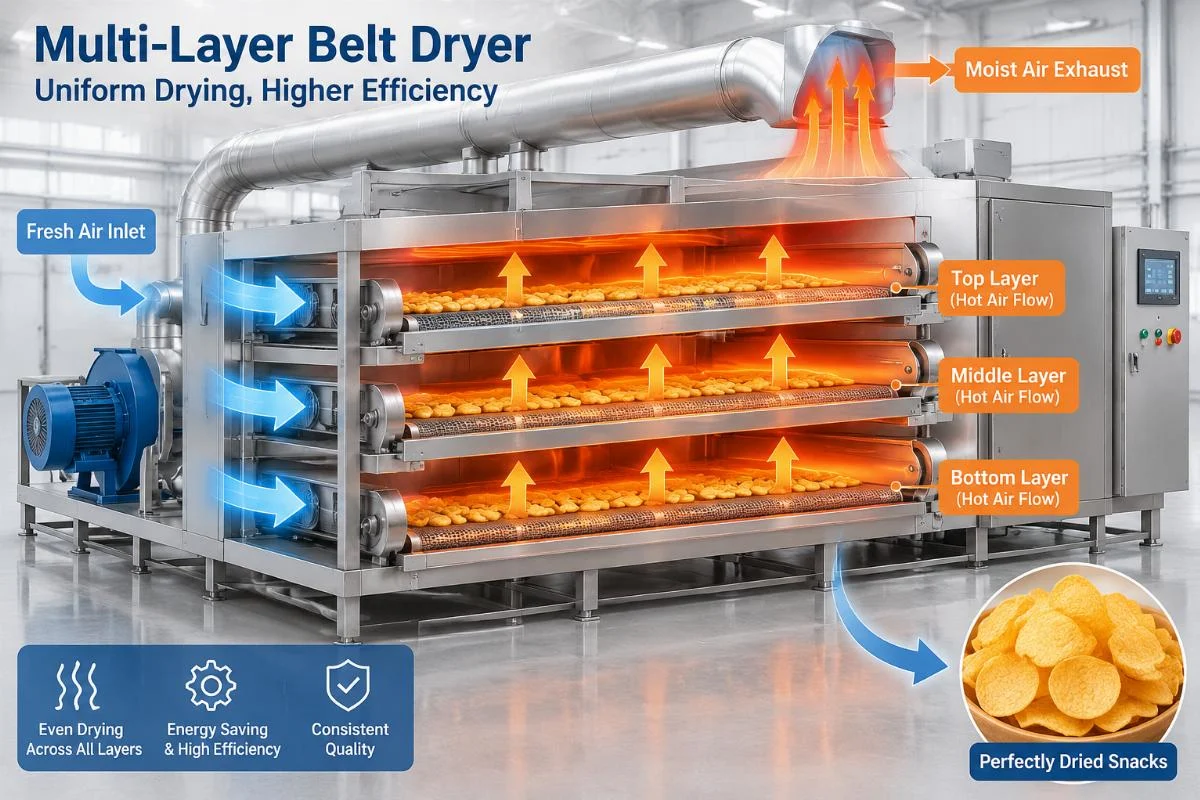
Understanding these variables prevents costly retrofits. Let us break down how belt layers, length, and thermal dynamics shape your snack extruder dryer energy consumption and final product quality.
How Do Belt Layers Impact Snack Pellet Moisture?
The number of belt layers directly dictates the vertical footprint and the available residence time for moisture evaporation.
When evaluating a multi-layer belt dryer for snacks, you are essentially balancing floor space against thermal exposure. The specific heat capacity of extruded dough requires sustained heat to drive internal moisture to the surface. If the residence time is too short, the exterior dries while the core remains soggy, leading to rapid staling and microbial growth post-packaging.
Consider the structural differences in a 3 vs 5 layer snack dryer setup:
| Configuration Parameter | 3-Layer Compact Setup | 5-Layer Extended Setup |
|---|---|---|
| Floor Space Footprint | Noticeably reduced | Standard industrial footprint |
| Residence Time Capacity | Limited | Substantially extended |
| Airflow Recirculation | Standard | Requires advanced zoning |
| Suitability for High-Moisture Dough | Vulnerable | Robust |
| Blower Motor Load | Standard | Noticeably increased |
A shorter dryer saves floor space but drastically increases energy cost per kg of water evaporated because the heat transfer rate must be aggressively spiked to compensate for the lack of time. Conversely, adding layers without recalculating the airflow velocity metrics leads to dead zones where humid air stagnates, halting evaporation.
A West African snack startup once ordered a 3-layer unit for a high-moisture corn puff recipe. The pellets emerged with uneven moisture gradients. By the time we retrofitted the system, the initial capital expenditure had nearly doubled. Always map your initial extrudate moisture to the required evaporation curve before locking in the layer count.

What is the Ideal Dryer Length for Your Capacity?
Dryer length must scale proportionally with extruder output to maintain a consistent residence time without creating thermal bottlenecks.
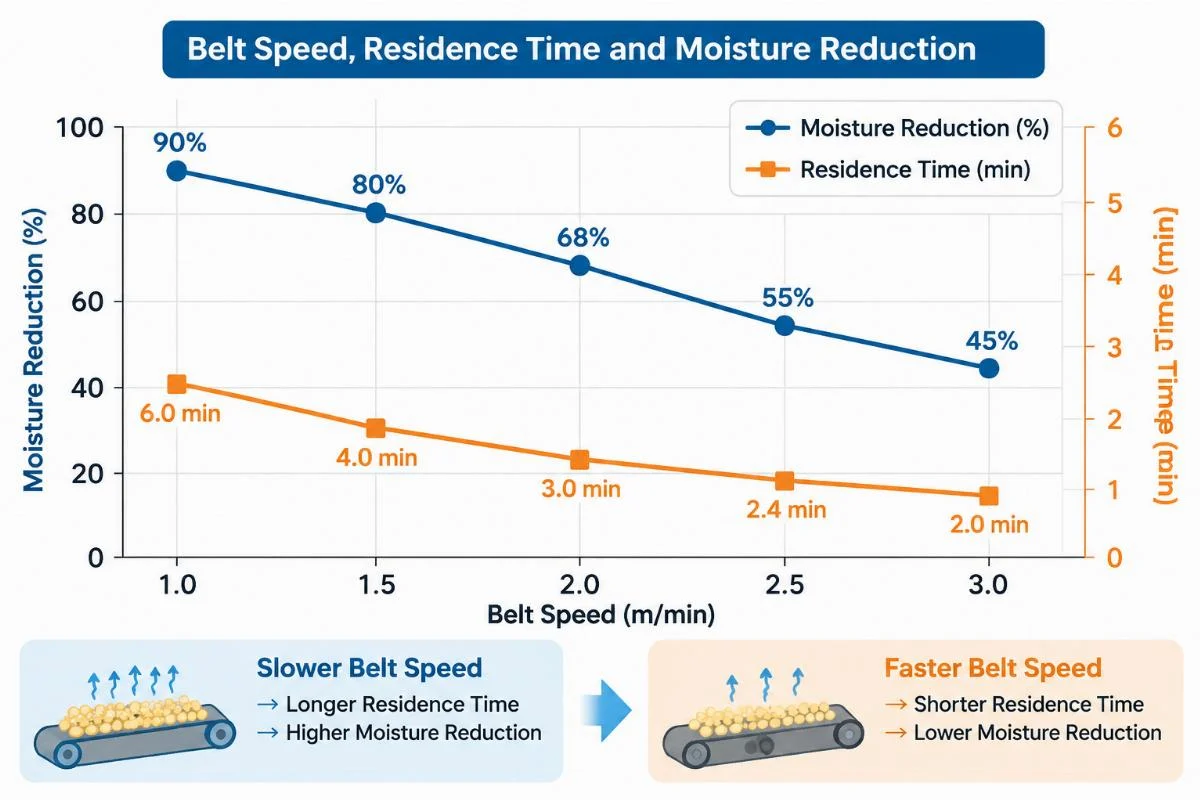
The residence time formula is non-negotiable in snack pellet dryer selection. If your twin-screw extruder pushes a high volume of raw material, a short dryer forces the belt speed to increase. High belt speed reduces the exposure time to the heating elements, resulting in a product that is scorched on the outside and raw on the inside.
Calculating the required length involves analyzing the heat transfer rate versus belt speed. For high-capacity lines, an undersized heating chamber creates a thermal mismatch. The dough surface seals too quickly, trapping internal steam and causing the pellets to crack or blister during the cooling phase.
A Middle East contract manufacturer scaled their puffed snack line from a pilot batch to full commercial output without extending the dryer length. The belt speed had to be maximized to keep up with the extruder. The result was a massive spike in reject rates due to fractured pellets. The physical stress of rapid moisture flash-off destroyed the product structure.
When sizing your line, remember that length is not just about physical distance; it is about the cumulative thermal energy delivered to the product bed. A properly sized dryer ensures that the evaporation front moves steadily from the core to the surface, preserving the delicate cellular structure of puffed snacks.
How Does Dryer Configuration Affect Energy Consumption?
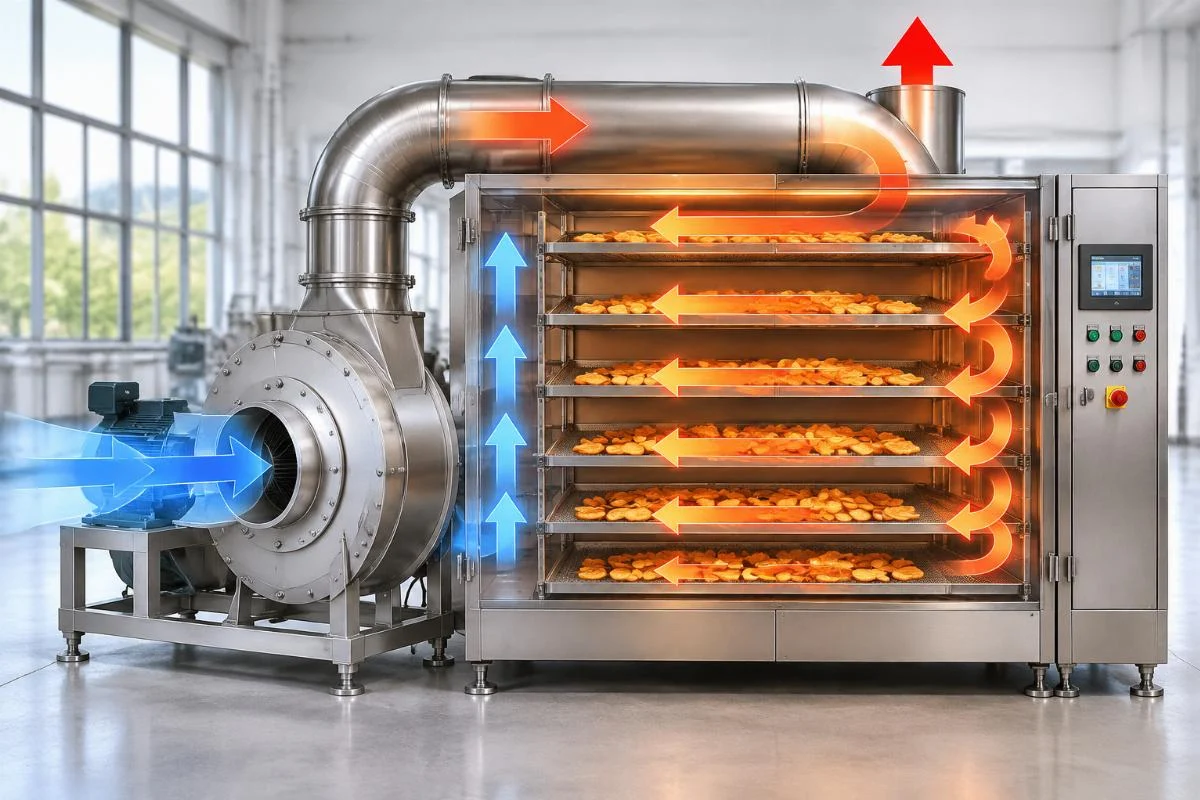
Extended dryer configurations demand precise airflow calibration; otherwise, snack extruder dryer energy consumption will skyrocket due to inefficient heat recovery and motor overload.
The most counter-intuitive trap in snack pellet dryer selection is assuming that a larger, longer dryer automatically improves efficiency. In reality, if the blower capacity and exhaust systems are not upgraded to match the extended thermal chamber, the system will fight itself.
During my time in Lagos, the retrofit from a 3-layer to a 5-layer belt meant the air had to travel through a much more complex path. The existing blower was pushed to its absolute limit, drawing massive amperage. The local diesel generators, already strained by the extruder and fryer, tripped repeatedly. The power spike failure halted production for days.
To optimize energy use, the dryer must utilize segmented heating zones with independent airflow velocity controls. This allows the system to apply high heat and high airflow in the initial constant-rate drying phase, and then reduce the energy input during the falling-rate phase where moisture is bound within the starch matrix.
| Energy Management Factor | Unoptimized Setup | Optimized Turnkey Setup |
|---|---|---|
| Blower Motor Sizing | Under-matched | Precisely calculated |
| Heat Recovery | Uncontrolled | Standard |
| Zoned Airflow | Uncontrolled | Controlled |
| Power Spike Risk | Vulnerable | Resistant |
| Per-Unit Energy Cost | Noticeably increased | Substantially reduced |
Without these controls, you are essentially paying to heat the factory floor rather than the product.
How to Calculate Thermal Dynamics Before Buying?
Always calculate heat load and airflow requirements based on your specific recipe and capacity to avoid mismatched specs.
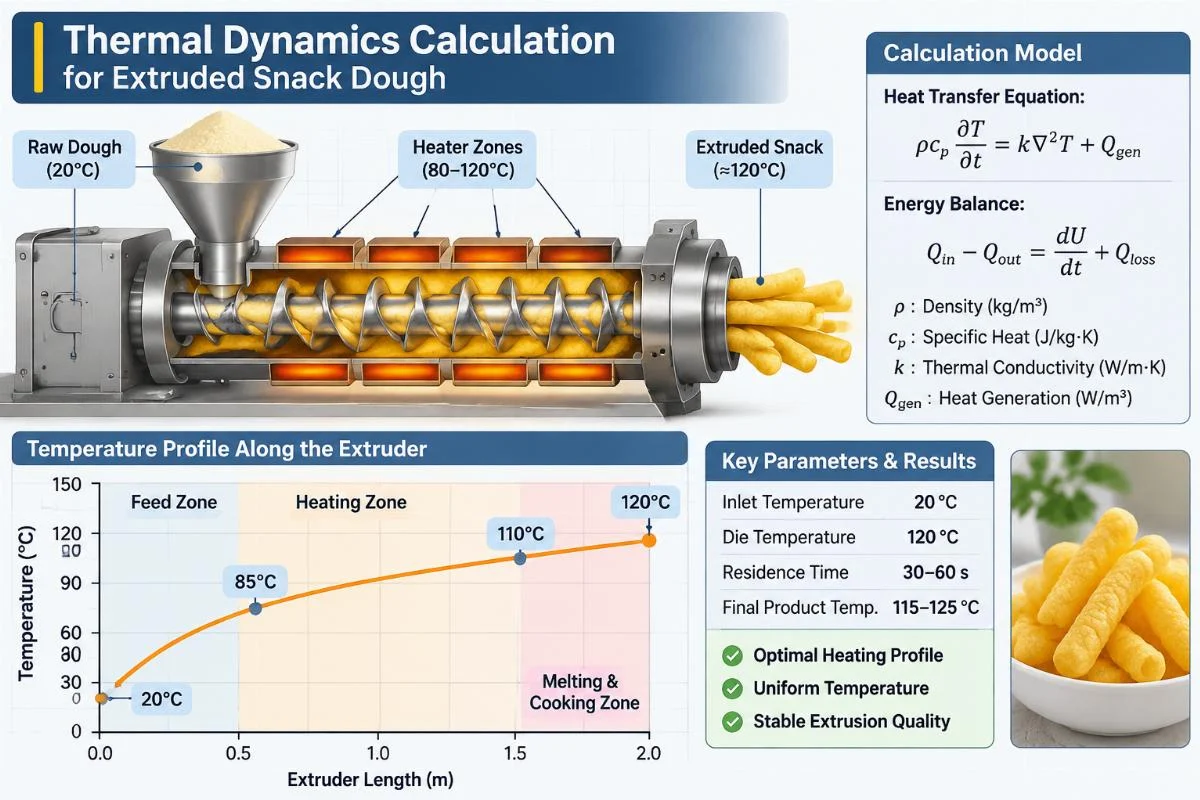
Thermal dynamics calculation is the bridge between a theoretical spec sheet and a profitable production run. It requires understanding the specific heat capacity of your extruded dough and the latent heat of vaporization for the moisture content you need to remove.
The methodology involves several critical steps:
- Determine Mass Flow Rate: Calculate the exact kilograms of wet pellets entering the dryer per hour based on your extruder’s maximum output.
- Calculate Moisture Removal Load: Subtract the target final moisture percentage from the initial extrudate moisture to find the total water mass that must be evaporated.
- Assess Heat Transfer Requirements: Factor in the sensible heat needed to raise the product temperature and the latent heat required to boil off the water.
- Size the Airflow Velocity: Ensure the air volume is sufficient to carry the evaporated moisture away from the belt surface without cooling the product bed too rapidly.
A European snack food startup attempted to bypass this calculation, relying on a generic catalog model for a novel lentil-based puff. The generic model assumed a standard wheat-corn matrix. The lentil dough had a different gelatinization profile and retained moisture differently. The dryer could not achieve the target crunch without burning the edges. We had to completely redesign the internal baffling and adjust the exhaust ratios.
This is where integrated engineering becomes critical. At Meiteng, we do not just sell a standalone drying box. Our integrated drying and cooling systems are designed holistically with the twin-screw extruders, such as the DS65 or DS70 series. We perform the pre-purchase thermal calculation to ensure the belt layers, length, and blower capacity perfectly match your recipe’s thermodynamic profile. This turnkey line design approach eliminates the guesswork and prevents the costly mismatches that plague startup food businesses.
Conclusion
Snack pellet dryer selection is a balancing act between residence time, airflow volume, and thermal efficiency. Choosing the correct belt layers and dryer length prevents soggy products and catastrophic power failures. By prioritizing rigorous thermal dynamics calculations over mere floor space savings, manufacturers ensure consistent moisture reduction and sustainable energy costs.
Equipment Mentioned in This Article
 3D papad machine
3D Snack Pellet Production Line Fried Extruder Machine
3D Snack Pellet Production Line for Starch-Based Snacks — twin-screw extrusion processes potato, cassava, and corn starch into diverse shapes.… View Machine Details 3D papad machine
Fully Automatic 3D Snack Pellets Extruder Making Machine for Chips
Chips 3D Snack Pellet Extruder Line for 2D/3D Shapes — co-rotating twin-screw extrusion processes potato and cassava starches into papad,… View Machine Details 3D papad machine
2D 3D Snack Pellet Production Line Manufacturer
2D 3D Snack Pellet Production Line for Diverse Shapes from Starches — twin-screw extrusion handles wheat, corn, and cassava. The… View Machine Details 3D papad machine
Automatic 3D Pellet Extruded Corn Puffed Snack Food Production Line
3D Pellet Extruded Snack Food Production Line for Starch Pellets — processes potato, corn, and cassava starch into papad and… View Machine DetailsRelated Applications

Engineering Perspective
An In-House R&D Team Behind Every Line
Jinan MT Machinery develops its process technology in-house. The team concentrates on the four areas that decide pellet shape, expansion and line stability.
- Expansion technology
- Twin-screw extrusion
- Die design
- PLC/MCC automation
Related Articles
 Nov 7, 2026 · Buying Guide
Energy Efficient Snack Pellet Extruder Line Manufacturer for Sale
Evaluating an energy efficiency snack pellet production line requires looking beyond single motor ratings to total system power and heat recovery to eliminate hidden… Read This Article Nov 7, 2026 · Buying Guide
De-Oiling Machine for Pellet Chips Fryer Line | Meiteng OEM Manufacturer
A properly matched de-oiling machine for pellet chips controls residual surface oil to extend shelf life and ensure seasoning adhesion without shattering fragile snacks.… Read This Article Nov 7, 2026 · Buying Guide
Twin-Screw Extruder for Snack Food: Wholesale Manufacturer
Selecting a twin-screw extruder for snack food requires matching machine specifications with local factory conditions and raw material intake rather than merely comparing price… Read This ArticleFree Process Check
Send Your Recipe for a Process Check
Jinan MT Machinery engineers review your recipe and return a free process plan within 24 hours. Tell us the product, output, raw material, local voltage and heat source.
Send Your Recipe on WhatsApp