
Snack Pellet Extruder Screw & Barrel Options: OEM Manufacturer for Sale
- By Jinan MT Machinery

Standard carbon steel barrels are a silent killer for snack food safety.
When selecting Snack Pellet Extruder Screw and Barrel Options, the optimal configuration requires matching bimetallic alloy grades to ingredient abrasiveness and balancing nitriding depth to prevent core brittleness, ensuring zero metal contamination and extended wear life.
I still cringe thinking about the ProPak exhibition in Chicago a few years back. A US pet food startup bought a twin-screw extruder from a competitor, opting for standard carbon steel barrels to cut initial capital costs. Within three months of processing high-ash bone meal snacks, the screws wore down severely, contaminating the batch with metal shavings and forcing a total line shutdown. That disaster taught me a hard lesson: in snack pellet extrusion, the Snack Pellet Extruder Screw and Barrel Options aren’t just about price; they dictate your product’s safety and your machine’s lifespan. When buyers ask me for OEM options today, I don’t just quote them; I walk them through the metallurgical realities needed for their specific recipe, because I’ve seen what happens when you compromise on the core wear parts.

Transitioning from a factory floor QC inspector to international trade means I look at these components through a metallurgist’s eyes. Let’s break down the technical realities of selecting the right Snack Pellet Extruder Screw and Barrel Options for your production line.
Why Standard Carbon Steel Fails in Snack Extrusion?
High-ash recipes accelerate wear exponentially, turning cheap barrels into contamination hazards.
Many startup manufacturers look at the initial procurement sheet and choose standard carbon steel to save money. This is a fundamental misunderstanding of tribology in food extrusion. When you process recipes with high mineral content, such as bone meal for pet treats or fortified cereal blends for baby food, the abrasive nature of the ash acts like sandpaper against the barrel内壁.
Standard carbon steel lacks the necessary surface hardness to resist this micro-cutting action. As the material removes itself from the barrel wall, it introduces ferrous metal shavings directly into the food stream. This isn’t just a maintenance issue; it is a critical food safety violation. International food safety standards strictly regulate metallic contamination limits, and a single batch recall due to metal shavings will cost several times the savings you initially gained from buying cheaper barrels.
Furthermore, the wear pattern is rarely uniform. The clearance between the screw flight and the barrel wall increases unevenly, leading to poor mixing, inconsistent product texture, and severe pressure drops. You end up replacing the entire Screw and Barrel Options set prematurely, negating any upfront savings.

How to Choose the Right Alloy Grade for Your Recipe?
Matching the bimetallic liner composition to ingredient acidity and abrasiveness is non-negotiable.
The Snack Pellet Extruder Screw and Barrel Options you request must align with your specific formulation chemistry. If you are extruding acidic snacks, such as tomato-based puffs or citrus-flavored pet treats, standard nitriding is insufficient. Acidic environments can cause corrosion pitting, which then accelerates abrasive wear.
For corrosive ingredients, you must specify a bimetallic barrel for snack extrusion. These barrels feature an inner liner alloyed with elements that resist both chemical attack and mechanical abrasion. The alloy composition is carefully balanced to provide a robust defense against acidic degradation while maintaining the structural integrity of the barrel under high extrusion pressures.
Conversely, for highly abrasive but non-corrosive recipes, like high-fiber plant-based proteins or mineral-dense aquaculture feed, the focus shifts to maximizing surface hardness. However, here lies a counter-intuitive trap: maximum hardness causes brittleness. If you push the surface hardness too high without proper core toughness, the barrel becomes susceptible to micro-cracking under the immense torque and thermal cycling of the extruder. Balanced metallurgy prevents cracking and ensures the barrel survives the mechanical shocks of startup and shutdown cycles.
| Alloy Grade Category | Abrasion Resistance | Corrosion Resistance | Core Toughness | Ideal Application |
|---|---|---|---|---|
| Standard Nitrided Steel | Basic | Vulnerable | Standard | Low-ash, neutral pH cereals |
| Tool Steel Alloy | Robust | Resistant | High | High-fiber, abrasive plant proteins |
| Bimetallic Liner | Substantially Extended | Highly Resistant | Controlled | Acidic snacks, high-mineral pet food |

What Nitriding Depth Ensures Maximum Lifespan?
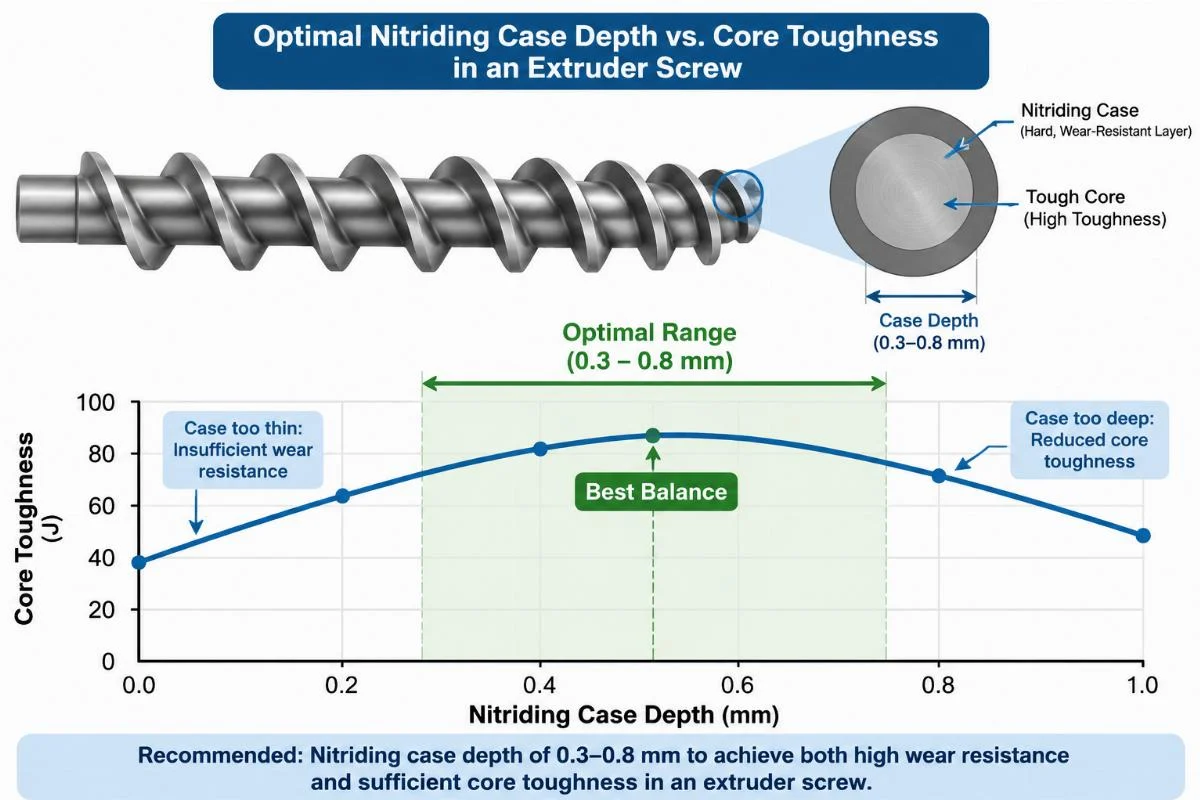
Optimal nitriding depth balances surface hardness and core toughness, preventing premature spalling.
When evaluating Snack Pellet Extruder Screw and Barrel Options, the nitriding depth is a critical parameter that is often misunderstood. Nitriding is a thermochemical heat treatment process that diffuses nitrogen into the surface of the steel to create an extremely hard wear layer.
Some buyers assume that a deeper nitriding layer is always better. This is incorrect. If the nitriding depth is too shallow, the hard layer will wear through quickly under high-ash conditions, exposing the softer core material and leading to rapid failure. On the other hand, if the nitriding depth is excessively deep, it can compromise the core toughness of the screw or barrel, making it brittle and prone to catastrophic fracture under high torsional loads.
The ideal nitriding depth for food extruder screws provides a hard, wear-resistant surface while maintaining a tough, ductile core that absorbs mechanical stress. This controlled nitrogen infusion ensures that the component can withstand the rigorous demands of continuous snack extrusion without flaking or cracking. For twin screw extruder barrel material, achieving this precise metallurgical balance is what separates a component that lasts for extended service life from one that fails in a single production season.
How to Verify Supplier Claims Before Ordering?
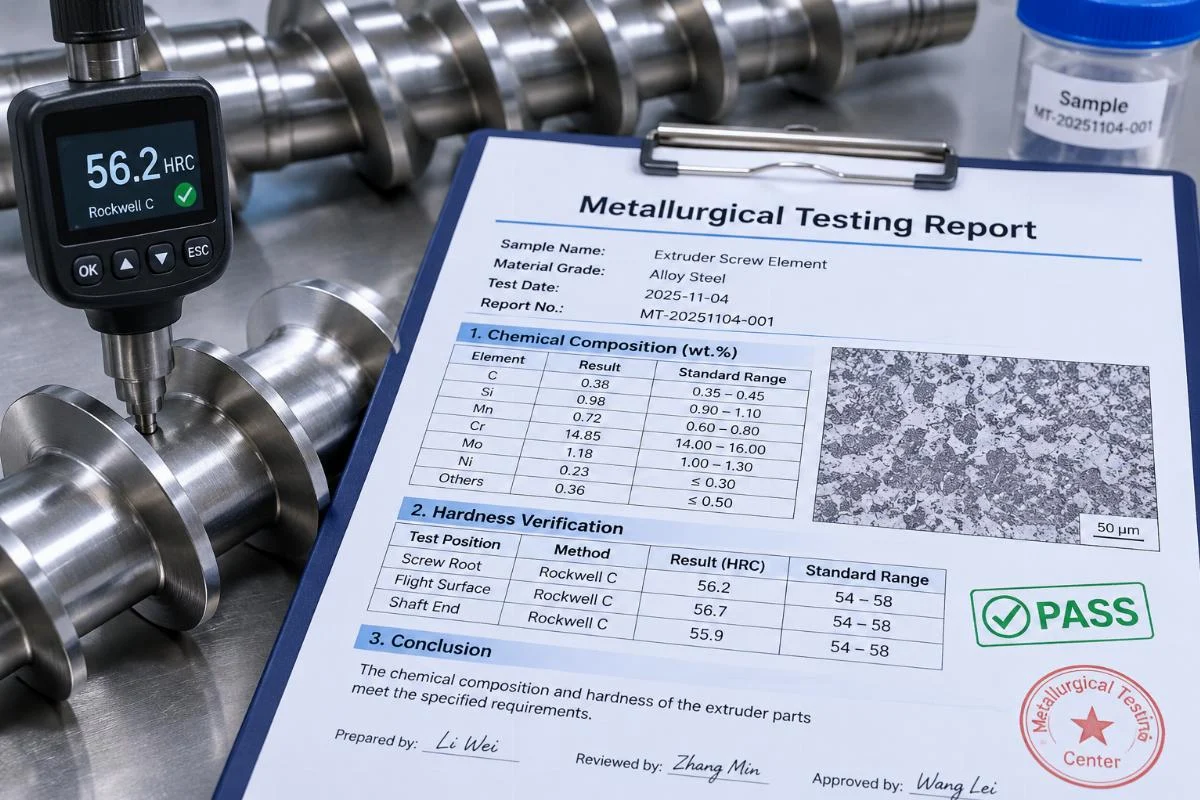
Requesting verifiable metallurgical reports is the only way to ensure your Snack Pellet Extruder Screw and Barrel Options meet food safety standards.
The market is flooded with suppliers claiming to offer premium wear parts, but verbal promises do not stop metal contamination. Before placing an order, you must demand comprehensive metallurgical reports and third-party testing certificates. These documents should detail the exact alloy composition, the achieved surface hardness, and the verified nitriding depth.
This is where partnering with a verified manufacturer makes a tangible difference. At Meiteng, we understand that snack extrusion requires uncompromising hygiene and durability. That is why our food-grade 304/316 stainless construction for contact parts ensures compliance with strict sanitary standards, while our customized nitriding treatments are tailored to your specific recipe’s abrasiveness. We don’t just supply machines; we provide turnkey production line design and formula development support, ensuring that the metallurgy of your wear parts perfectly matches your product goals.
When you review a supplier’s proposal, look for transparency. If they cannot provide batch-level material certificates or hide behind vague terms like “high-quality steel,” walk away. The cost of verifying these claims is negligible compared to the financial and reputational damage of a contamination shutdown.
Conclusion
Selecting the right Snack Pellet Extruder Screw and Barrel Options is a metallurgical decision, not just a purchasing one.
Matching bimetallic alloys to your recipe’s chemistry and balancing nitriding depth ensures food safety and maximizes equipment lifespan. Always demand verifiable material certifications to protect your production line from costly contamination and premature wear.
Equipment Mentioned in This Article
 3D papad machine
3D Snack Pellet Production Line Fried Extruder Machine
3D Snack Pellet Production Line for Starch-Based Snacks — twin-screw extrusion processes potato, cassava, and corn starch into diverse shapes.… View Machine Details 3D papad machine
Fully Automatic 3D Snack Pellets Extruder Making Machine for Chips
Chips 3D Snack Pellet Extruder Line for 2D/3D Shapes — co-rotating twin-screw extrusion processes potato and cassava starches into papad,… View Machine Details 3D papad machine
2D 3D Snack Pellet Production Line Manufacturer
2D 3D Snack Pellet Production Line for Diverse Shapes from Starches — twin-screw extrusion handles wheat, corn, and cassava. The… View Machine Details 3D papad machine
Automatic 3D Pellet Extruded Corn Puffed Snack Food Production Line
3D Pellet Extruded Snack Food Production Line for Starch Pellets — processes potato, corn, and cassava starch into papad and… View Machine DetailsRelated Applications

Engineering Perspective
An In-House R&D Team Behind Every Line
Jinan MT Machinery develops its process technology in-house. The team concentrates on the four areas that decide pellet shape, expansion and line stability.
- Expansion technology
- Twin-screw extrusion
- Die design
- PLC/MCC automation
Related Articles
 Nov 7, 2026 · Buying Guide
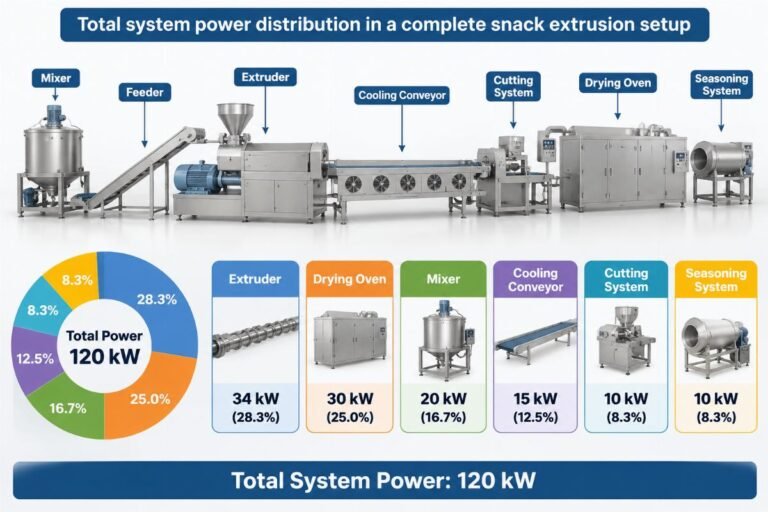
Energy Efficient Snack Pellet Extruder Line Manufacturer for Sale
Evaluating an energy efficiency snack pellet production line requires looking beyond single motor ratings to total system power and heat recovery to eliminate hidden… Read This Article Nov 7, 2026 · Buying Guide
De-Oiling Machine for Pellet Chips Fryer Line | Meiteng OEM Manufacturer
A properly matched de-oiling machine for pellet chips controls residual surface oil to extend shelf life and ensure seasoning adhesion without shattering fragile snacks.… Read This Article Nov 7, 2026 · Buying Guide
Twin-Screw Extruder for Snack Food: Wholesale Manufacturer
Selecting a twin-screw extruder for snack food requires matching machine specifications with local factory conditions and raw material intake rather than merely comparing price… Read This ArticleFree Process Check
Send Your Recipe for a Process Check
Jinan MT Machinery engineers review your recipe and return a free process plan within 24 hours. Tell us the product, output, raw material, local voltage and heat source.
Send Your Recipe on WhatsApp