
Snack Pellet Extrusion Line Manufacturer for Indonesia & Philippines Buyers
- By Jinan MT Machinery

The extruder is rarely the point of failure in tropical snack manufacturing; the drying system is.
Successful Snack Pellet Line Procurement in high-humidity regions demands a turnkey solution encompassing multi-stage drying, local formula adaptation, and on-site operator training, rather than just purchasing standalone machinery.
Back when I was on the buying side, I configured a twin-screw extruder snack line Indonesia for a client. I focused entirely on negotiating the price of the main extruder barrel and screws, completely miscalculating the drying and flavoring配套设施 required for the local high-humidity environment. The result? The extruded corn puffs turned soft and molded within days, and the entire setup was nearly scrapped. After transitioning to the supply side and spending years at trade shows in Hanover and Chicago, I realized Southeast Asian buyers had been burned by similar mistakes. Now, when a buyer from Manila inquires about a puff snack manufacturing machine Philippines, their very first question is inevitably about whether the supplier includes formula debugging and on-site training. I understand this pain intimately; buying equipment is not about acquiring heavy iron, but about securing a turnkey system that produces合格 goods from day one.
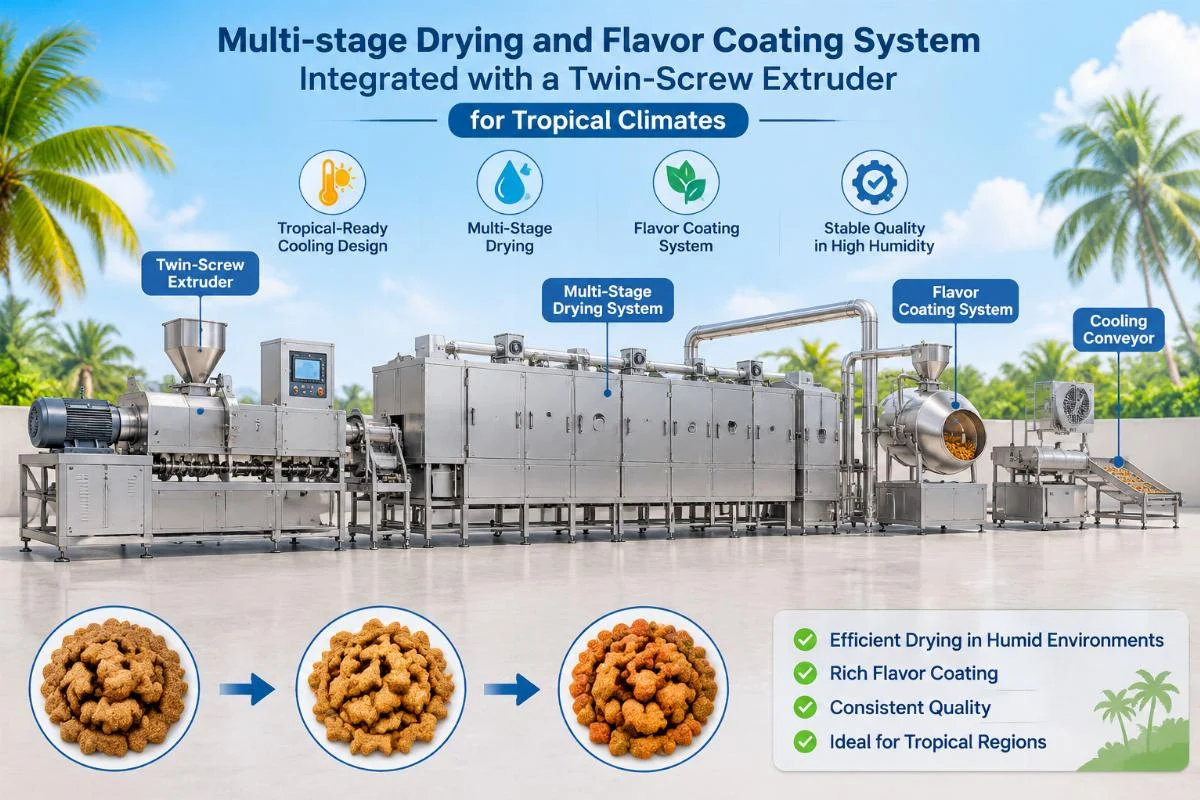
Navigating these regional challenges requires shifting the focus from mere equipment specs to comprehensive process engineering, which brings us to the core technical requirements for this market.
What are the critical drying requirements for snack lines in tropical climates?
Multi-stage drying is mandatory to prevent molding and ensure structural integrity in high-humidity environments.
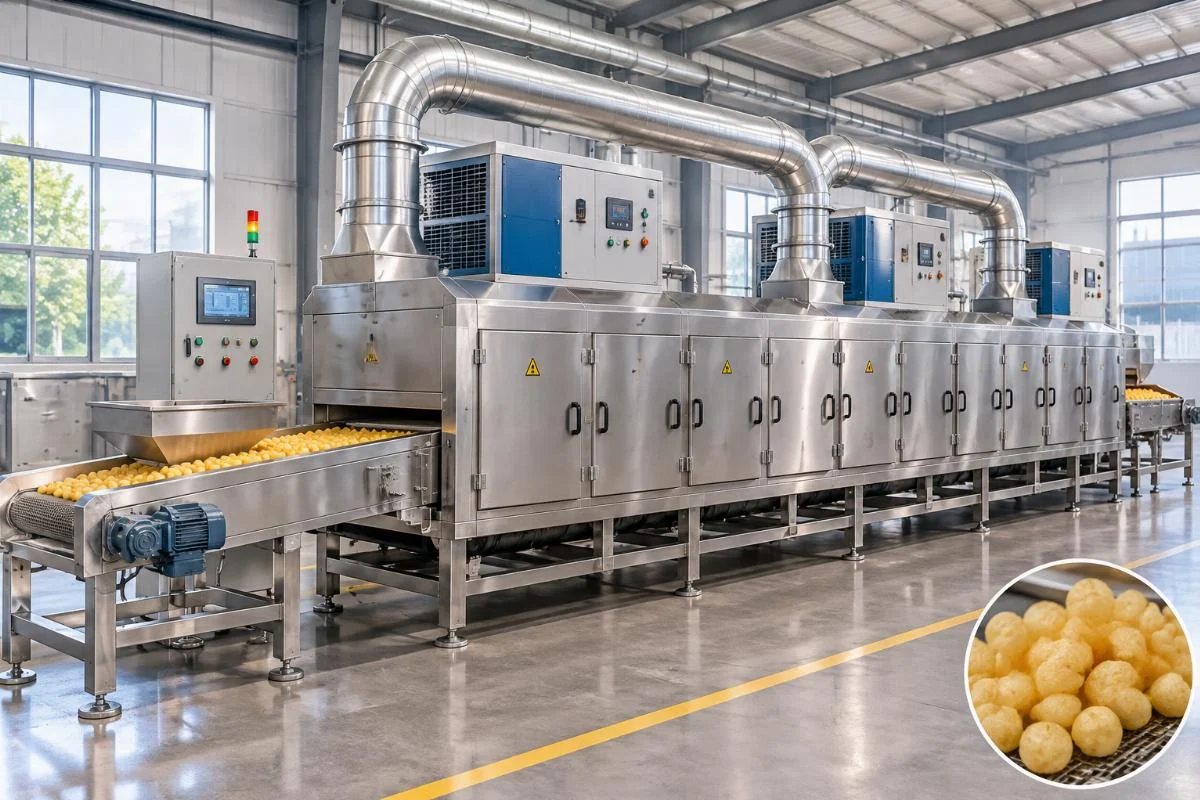
When executing Snack Pellet Line Procurement, buyers often assume a single-pass dryer is sufficient. In tropical climates, ambient moisture levels severely disrupt the moisture reduction rate. A single drying stage frequently leaves internal moisture pockets, leading to product deformation and rapid microbial growth.
A Southeast Asian startup once invested heavily in a high-capacity extruder but used a basic single-pass dryer. During the monsoon season, the ambient humidity saturated the drying chamber’s exhaust, rendering the system ineffective. The products emerged with a leathery texture instead of a crisp bite. By upgrading to a multi-stage drying system with precise temperature curves and dehumidified air circulation, the moisture reduction rate stabilized, and the shelf life extended substantially.
Risk Checklist for Drying Systems:
- Inadequate exhaust dehumidification causing moisture re-absorption.
- Single-zone temperature profiles leading to case hardening (dry exterior, wet interior).
- Lack of automated moisture sensors resulting in inconsistent batch drying.
How to ensure flavor coating adhesion in high-moisture environments?
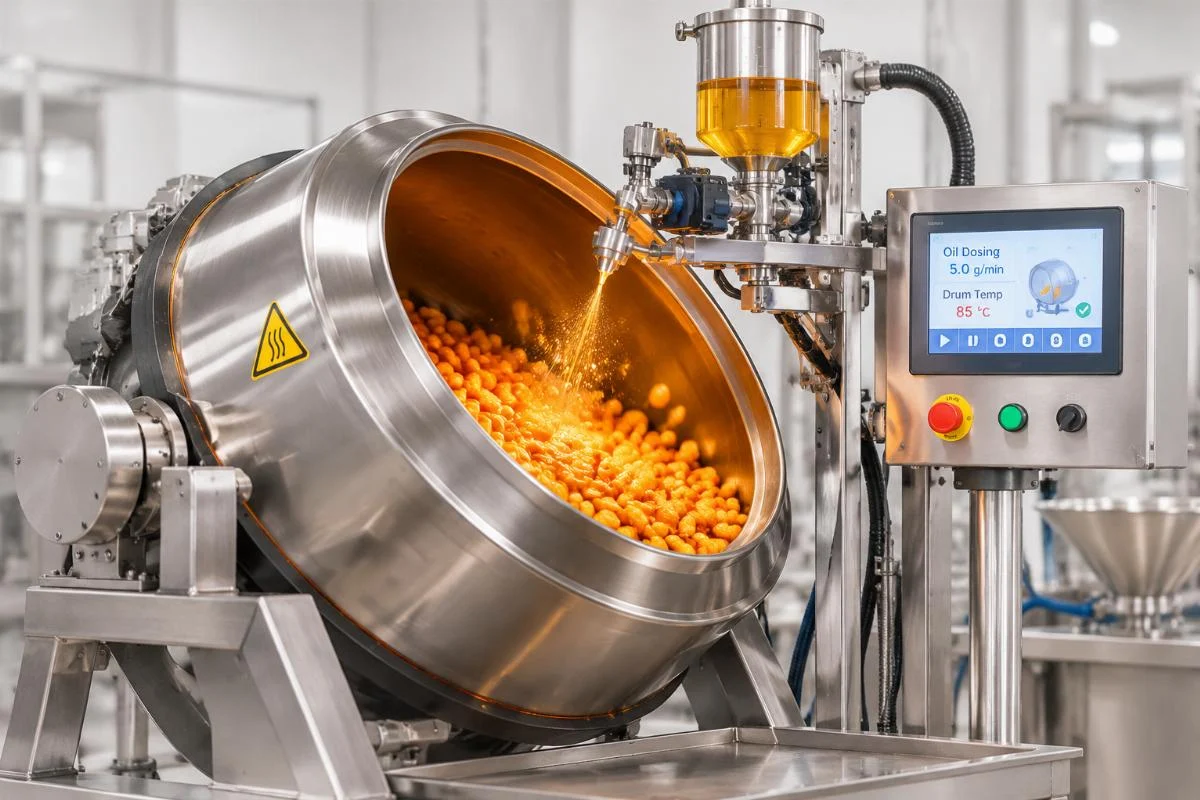
Precise oil dosing combined with heated coating drums is essential for flavor adhesion in tropical conditions.
The success of a puff snack manufacturing machine Philippines relies heavily on the flavoring stage. In high-moisture environments, seasoning powders tend to clump and fail to adhere to the pellet surface if the surface temperature and oil-to-powder ratio are not strictly controlled.
During a site visit to a contract manufacturer in the Philippines, I observed operators struggling with uneven seasoning distribution. The ambient humidity caused the seasoning powder to absorb moisture from the air before it could bond with the oil on the snacks. The solution involved installing a heated coating drum to maintain the pellet surface temperature above the dew point, paired with a precision oil dosing system. This ensured the oil remained fluid enough to act as a proper binding agent, drastically reducing powder waste and ensuring uniform taste.
Risk Checklist for Flavor Coating:
- Unheated coating drums causing rapid temperature drops in humid air.
- Manual oil spraying leading to inconsistent oil-to-powder ratios.
- Seasoning storage without climate control resulting in pre-application clumping.
Why is local formula adaptation crucial for snack extrusion?
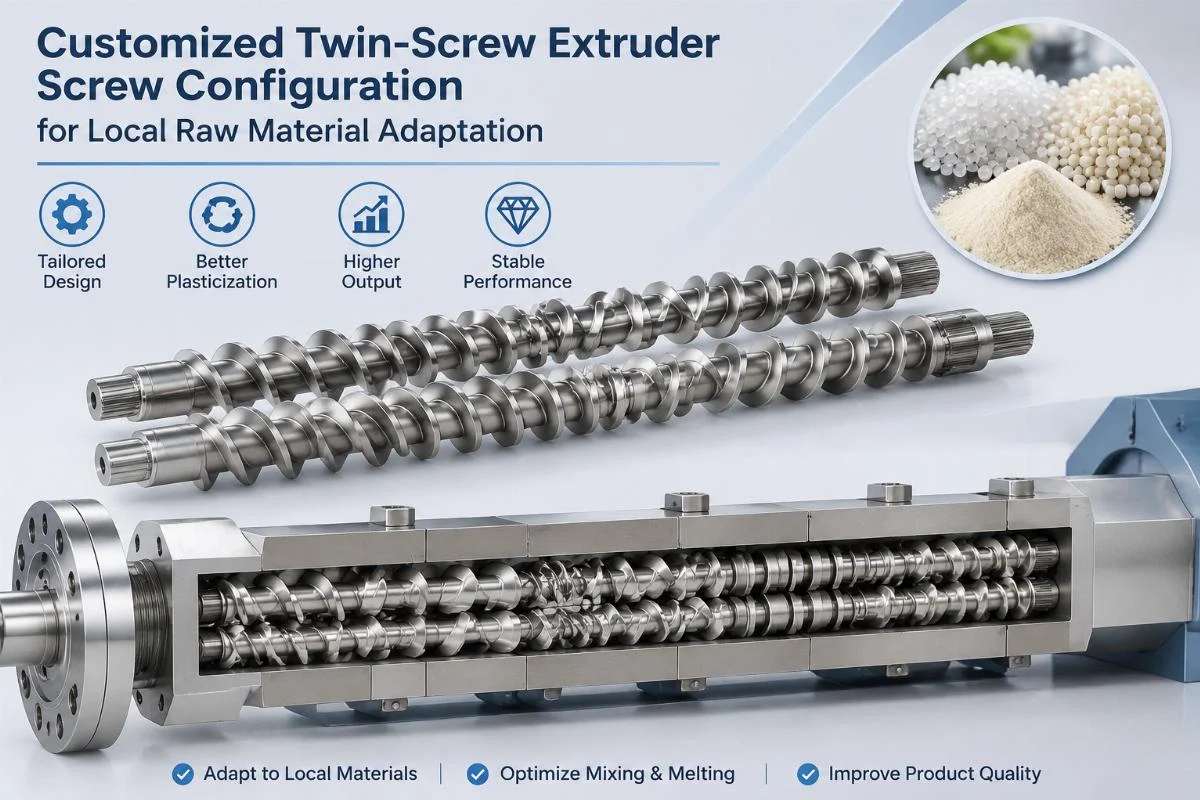
Local raw materials require specific screw configurations and moisture control to achieve optimal expansion and texture.
A major pitfall in Snack Pellet Line Procurement is assuming that a standard recipe from a temperate climate will work identically with local ingredients. Local agricultural variations, such as the specific moisture content and starch structure of regional corn or rice flours, directly impact the specific mechanical energy required during extrusion.
A buyer in Jakarta attempted to substitute imported corn meal with a locally sourced variant to reduce costs. The local flour had a different starch gelatinization profile, causing the extrudates to collapse rather than expand properly. By adjusting the screw L/D ratio and modifying the screw configuration to increase the shear zone, the specific mechanical energy was optimized for the local flour. This formula debugging transformed a failing product into a market-ready snack with the desired crunch.
Risk Checklist for Formula Adaptation:
- Ignoring the moisture content variations in local raw material batches.
- Using standard screw profiles unsuited for the rheology of local flours.
- Failing to recalibrate feeder speeds when switching raw material suppliers.
What does a true turnkey solution include for Southeast Asian buyers?
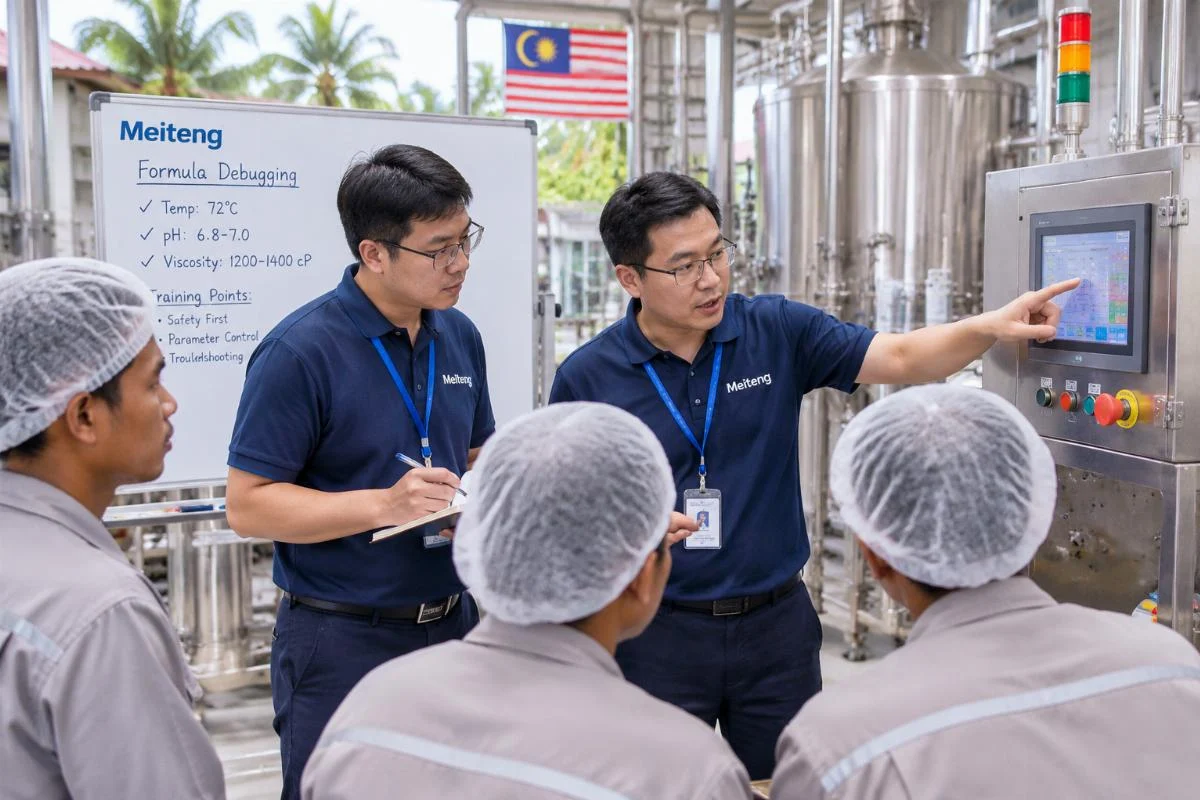
A genuine turnkey snack food production line Southeast Asia must encompass on-site installation, formula debugging, and comprehensive operator training.
Many suppliers claim to offer turnkey solutions, but merely shipping the machines and providing a manual does not constitute a true partnership. The real investment lies in the knowledge transfer and process validation.
Meiteng approaches Snack Pellet Line Procurement as a holistic project. Our CE and ISO-certified food-grade stainless steel lines are just the foundation. The true value is delivered when our engineers arrive on-site to calibrate the multi-stage dryers for the local monsoon season, debug the formula using the client’s exact local raw materials, and train the operators to troubleshoot minor issues independently. This comprehensive support ensures that the twin-screw extruder snack line Indonesia or the puff snack manufacturing machine Philippines operates at peak efficiency from the very first batch.
Risk Checklist for Turnkey Solutions:
- Suppliers offering only remote video guidance instead of on-site commissioning.
- Lack of formula debugging support tailored to local ingredient profiles.
- Absence of hands-on operator training leading to prolonged downtime.
Conclusion
Equipment is only as good as the process engineering behind it.
Navigating Snack Pellet Line Procurement in tropical regions requires prioritizing multi-stage drying, precise flavor coating, and local formula adaptation over mere extruder specifications. Securing a true turnkey solution with on-site support ensures long-term production stability and product quality.
Equipment Mentioned in This Article
 3D papad machine
3D Snack Pellet Production Line Fried Extruder Machine
3D Snack Pellet Production Line for Starch-Based Snacks — twin-screw extrusion processes potato, cassava, and corn starch into diverse shapes.… View Machine Details 3D papad machine
Fully Automatic 3D Snack Pellets Extruder Making Machine for Chips
Chips 3D Snack Pellet Extruder Line for 2D/3D Shapes — co-rotating twin-screw extrusion processes potato and cassava starches into papad,… View Machine Details 3D papad machine
2D 3D Snack Pellet Production Line Manufacturer
2D 3D Snack Pellet Production Line for Diverse Shapes from Starches — twin-screw extrusion handles wheat, corn, and cassava. The… View Machine Details 3D papad machine
Automatic 3D Pellet Extruded Corn Puffed Snack Food Production Line
3D Pellet Extruded Snack Food Production Line for Starch Pellets — processes potato, corn, and cassava starch into papad and… View Machine DetailsRelated Applications

Engineering Perspective
An In-House R&D Team Behind Every Line
Jinan MT Machinery develops its process technology in-house. The team concentrates on the four areas that decide pellet shape, expansion and line stability.
- Expansion technology
- Twin-screw extrusion
- Die design
- PLC/MCC automation
Related Articles
 Nov 10, 2026 · Procurement & Trade FAQs
Snack Pellet Line for UAE: Twin-Screw Extruder Manufacturer & Turnkey Service
Buying a snack pellet line UAE requires engineering systems that survive extreme heat and voltage fluctuations, not just finding the lowest price. You must… Read This Article Nov 10, 2026 · Procurement & Trade FAQs
Fast Replacement Pellet Dies from China Manufacturer Meiteng
Minimize extruder downtime by understanding that replacement pellet die delivery time relies on precise formula matching and custom compression ratios rather than just express… Read This Article Nov 10, 2026 · Procurement & Trade FAQs
Snack Pellet Line for Poland & EU: Meiteng Twin-Screw Extruder Manufacturer
Importing a snack pellet line into Poland and the EU requires navigating strict CE machinery directives, EORI customs registration, and adapting equipment to local… Read This ArticleFree Process Check
Send Your Recipe for a Process Check
Jinan MT Machinery engineers review your recipe and return a free process plan within 24 hours. Tell us the product, output, raw material, local voltage and heat source.
Send Your Recipe on WhatsApp