

Bigger motors do not guarantee better output in arid climates; adequate cooling surface area is the true determinant of stable production.
When evaluating a Snack Pellet Line Buying Checklist for the Middle East, the absolute priority must be extreme-heat cooling capacity and local formula adaptation, rather than basic extruder specifications. Standard global configurations will inevitably fail in desert environments without these critical modifications.
Setting up a production facility in the region teaches you hard lessons quickly. I recall a project in Riyadh where we were installing an extrusion setup for a local food plant. We followed a standard global configuration, but we failed to account for the extreme summer heat pushing ambient temperatures well above forty degrees Celsius. The cooling system lacked the necessary margin. The result was catastrophic: the extruded corn pellets stuck together entirely, and a massive batch of raw material was scrapped before we even finished the initial runs. That failure completely reshaped how I approach every Snack Pellet Line Buying Checklist for this region. You are not just buying iron; you are buying a system that must survive and perform under brutal thermal stress.

Moving past basic machine specs is the first step in a reliable Snack Pellet Line Buying Checklist.
What Cooling Capacity is Critical for Middle East Summers?
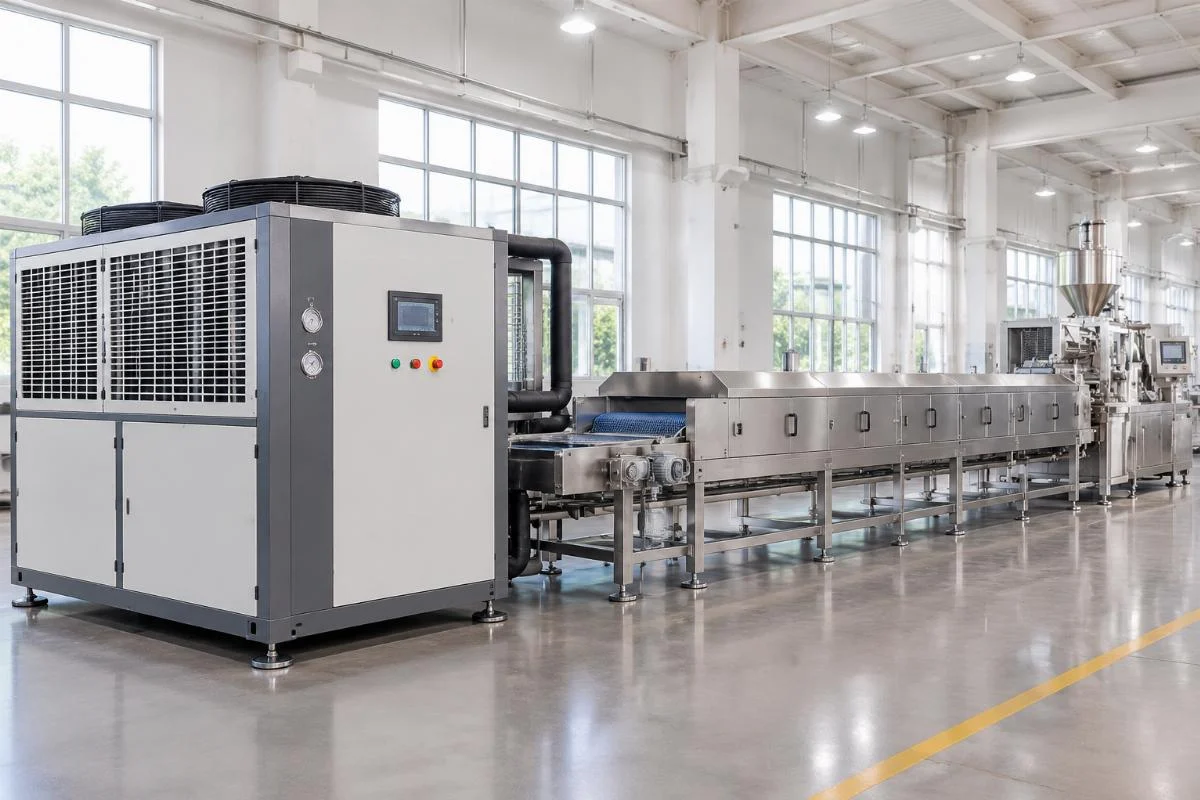
Oversizing chillers and cooling conveyors is non-negotiable to prevent melt-sticking when ambient heat exceeds forty degrees Celsius.
Most buyers assume that upgrading to a larger main motor will solve output issues. This is a fundamental misunderstanding of extrusion physics in hot climates. The real enemy is melt-fracture and product adhesion caused by insufficient heat dissipation. When the environment is already baking the equipment, the standard cooling loops simply cannot reject heat fast enough.
To build a robust Snack Pellet Line Buying Checklist, you must demand a high-temperature cooling snack machine design. This means the chiller capacity must be substantially oversized compared to European or North American standards. Furthermore, the cooling conveyors and vibration coolers need extended surface areas and forced-air configurations to bring the product temperature down before it enters the flavoring drum.
| Cooling Component | Standard Global Spec | Middle East Adapted Spec |
|---|---|---|
| Chiller Capacity | Baseline Calculation | Substantially Oversized |
| Cooling Conveyor Length | Standard Linear Footage | Noticeably Extended |
| Airflow Design | Passive / Basic Fan | Controlled Forced-Air |
| Thermal Retention | Basic Insulation | Advanced Thermal Barriers |
If your Snack Pellet Line Buying Checklist ignores the cooling loop, you are guaranteeing product waste.
How Do Local Ingredients Affect Screw Configuration?
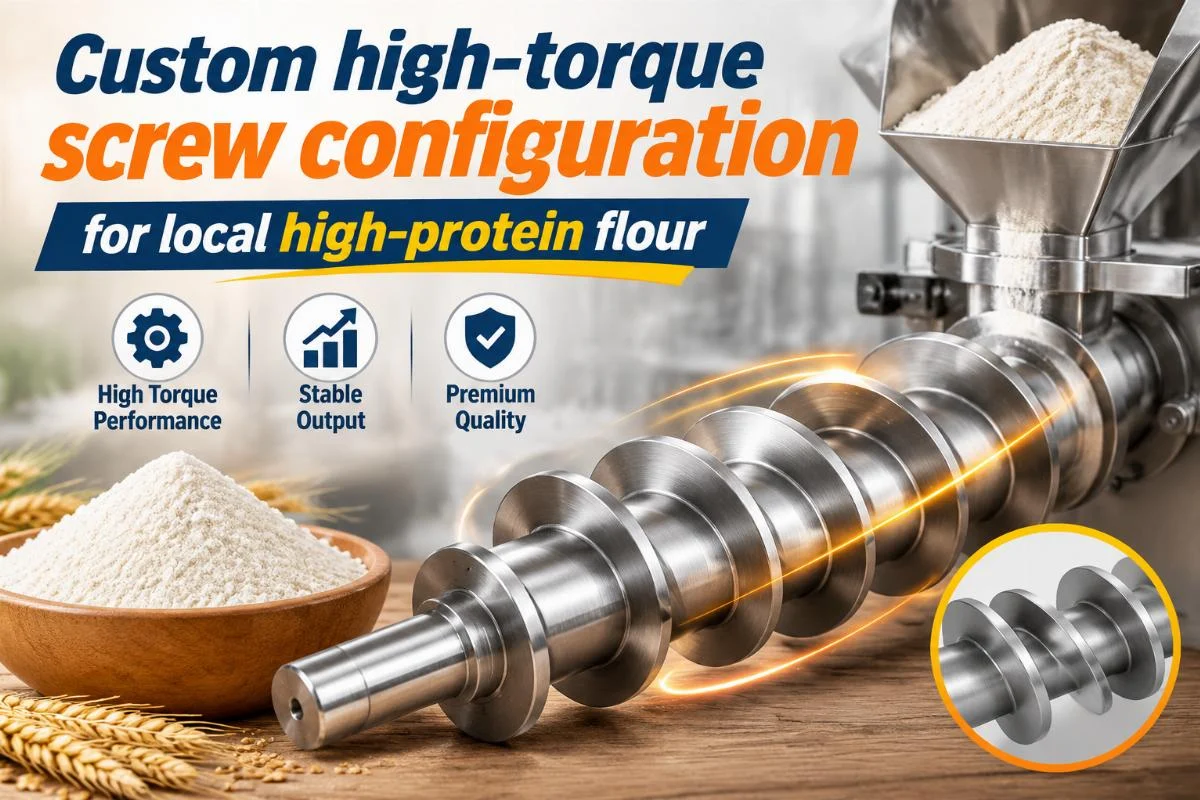
Local high-protein flour blends demand high-torque twin-screw setups and custom barrel temperature profiles for uniform puffing.
Another major trap in a typical Snack Pellet Line Buying Checklist is assuming standard recipes and screw configurations work globally. They do not. The moisture content and protein structures of local grains in the MENA region differ significantly from the wheat or corn used in standard testing facilities.
Using local high-protein flour blends requires much more shear and energy to achieve the desired expansion. A standard screw profile will either choke the barrel or produce dense, under-puffed pellets. You need a twin-screw snack production line equipped with high-torque gearboxes and customizable screw elements. The barrel temperature profiles must also be tailored to handle the specific hydration and gelatinization points of these local ingredients.
When reviewing your Snack Pellet Line Buying Checklist, ensure the supplier offers screw configuration optimization based on your exact raw material analysis.
Which Turnkey Components Prevent Commissioning Delays?
Pre-audited utility matching and comprehensive on-site training cut startup time significantly and prevent hidden operational failures.
A food factory extrusion line MENA project often faces severe delays not because of the machinery itself, but because of utility mismatches. Local power grids, water quality, and compressed air standards can vary wildly. If the equipment arrives and the site utilities do not match the machine’s requirements, commissioning stalls for weeks.
A comprehensive Snack Pellet Line Buying Checklist must include turnkey integration services. This means the supplier conducts pre-site audits to verify utility compatibility before manufacturing begins. It also includes complete drying, cooling, and flavor-coating system integration, ensuring the entire line flows seamlessly.
This is where Meiteng’s approach to the Snack Pellet Line Buying Checklist proves its value. We provide full turnkey line design from raw material intake to packaging. Our engineers conduct rigorous pre-site audits to match local utilities, eliminating the guesswork. Furthermore, we provide on-site installation, commissioning, and operator training. We do not just drop off the machines; we ensure your local team knows how to run the twin-screw extruders and single-screw extruders efficiently, adapting to the specific local conditions.

How to Verify Food-Grade and Safety Compliance?
Demanding verifiable material certifications and international safety standards ensures export-ready hygiene and regulatory compliance.
The final section of any professional Snack Pellet Line Buying Checklist focuses on hygiene and safety. In the food industry, especially when targeting export markets or premium local retail, material compliance is not optional.
You must verify that all food contact parts are constructed from certified food-grade stainless steel. Specifically, look for 304 or 316 stainless steel construction, which resists corrosion and maintains hygiene even in harsh, humid cleaning environments. Additionally, the equipment must carry recognized international certifications.
| Compliance Factor | Basic Supplier | Professional Manufacturer |
|---|---|---|
| Food Contact Material | Self-Reported | Verifiable 304/316 SS |
| Safety Certifications | Not Provided | Certified CE / ISO |
| Sanitary Standards | Uncontrolled | 3-A Sanitary Standards |
| Documentation | Incomplete | Full Export Documentation |
Ensure your Snack Pellet Line Buying Checklist explicitly demands CE and ISO certifications, alongside 3-A sanitary standards where applicable. This guarantees that your snack pellet line meets global food safety requirements.

Conclusion
Purchasing extrusion equipment for arid environments requires prioritizing thermal management and material adaptability over basic output ratings.
A reliable Snack Pellet Line Buying Checklist must center on oversized cooling systems to combat extreme heat, customized screw configurations for local high-protein ingredients, and rigorous turnkey utility matching. By focusing on these critical operational realities rather than just motor sizes, manufacturers ensure stable, high-quality production from day one.
Equipment Mentioned in This Article
 3D papad machine
2D 3D Snack Pellet Production Line Manufacturer
2D 3D Snack Pellet Production Line for Diverse Shapes from Starches — twin-screw extrusion handles wheat, corn, and cassava. The… View Machine Details 3D papad machine
3D Snack Pellet Production Line Fried Extruder Machine
3D Snack Pellet Production Line for Starch-Based Snacks — twin-screw extrusion processes potato, cassava, and corn starch into diverse shapes.… View Machine Details 3D papad machine
Fully Automatic 3D Snack Pellets Extruder Making Machine for Chips
Chips 3D Snack Pellet Extruder Line for 2D/3D Shapes — co-rotating twin-screw extrusion processes potato and cassava starches into papad,… View Machine Details 3D papad machine
Automatic 3D Pellet Extruded Corn Puffed Snack Food Production Line
3D Pellet Extruded Snack Food Production Line for Starch Pellets — processes potato, corn, and cassava starch into papad and… View Machine DetailsRelated Applications

Engineering Perspective
An In-House R&D Team Behind Every Line
Jinan MT Machinery develops its process technology in-house. The team concentrates on the four areas that decide pellet shape, expansion and line stability.
- Expansion technology
- Twin-screw extrusion
- Die design
- PLC/MCC automation
Related Articles
 Nov 7, 2026 · Buying Guide
Energy Efficient Snack Pellet Extruder Line Manufacturer for Sale
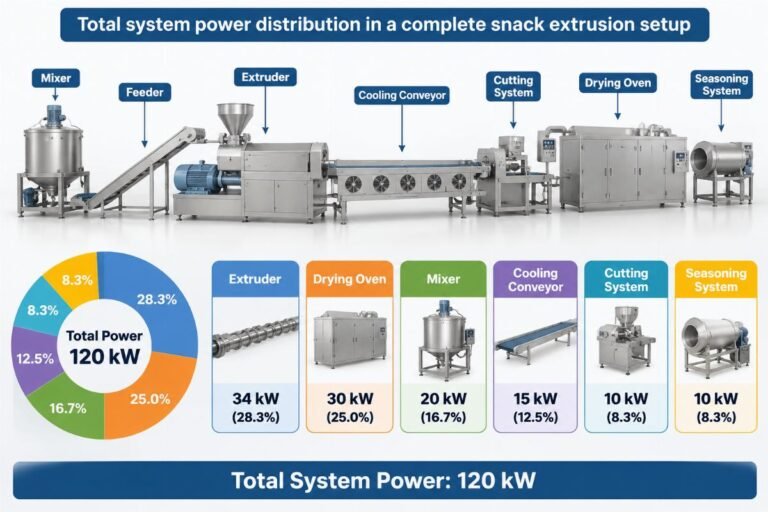
Evaluating an energy efficiency snack pellet production line requires looking beyond single motor ratings to total system power and heat recovery to eliminate hidden… Read This Article Nov 7, 2026 · Buying Guide
De-Oiling Machine for Pellet Chips Fryer Line | Meiteng OEM Manufacturer
A properly matched de-oiling machine for pellet chips controls residual surface oil to extend shelf life and ensure seasoning adhesion without shattering fragile snacks.… Read This Article Nov 7, 2026 · Buying Guide
Twin-Screw Extruder for Snack Food: Wholesale Manufacturer
Selecting a twin-screw extruder for snack food requires matching machine specifications with local factory conditions and raw material intake rather than merely comparing price… Read This ArticleFree Process Check
Send Your Recipe for a Process Check
Jinan MT Machinery engineers review your recipe and return a free process plan within 24 hours. Tell us the product, output, raw material, local voltage and heat source.
Send Your Recipe on WhatsApp