
Snack Pellet Machine Payment Terms: T/T, L/C & Deposits Explained
- By Jinan MT Machinery

Payment Terms for Snack Pellet Machines: T/T, L/C & Deposits Explained
Most buyers assume a Letter of Credit is the ultimate safety net for importing heavy food extrusion machinery; in reality, hidden soft clauses can trap your capital far worse than a direct bank transfer.
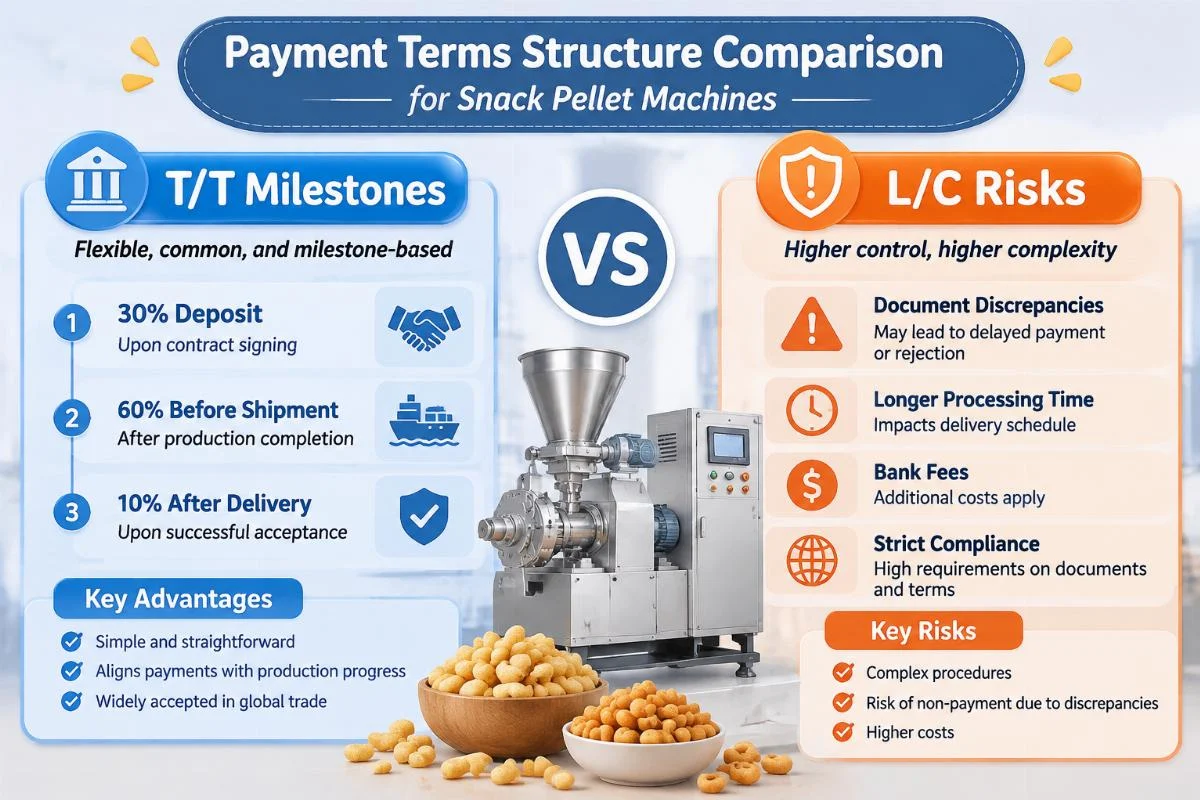
The industry baseline for secure payment terms for snack pellet machines is a T/T structure requiring a minimum thirty percent deposit, with the balance paid against the copy of the Bill of Lading. This specific ratio prevents capital lock-up while ensuring the manufacturer prioritizes your production slot and raw material procurement.
I learned this the hard way after starting my career handling shipping documents at a busy port in Qingdao, where I spent years fighting over bill of lading discrepancies. When I transitioned to managing trade routes across Latin America, the true danger of payment structures revealed itself. We once shipped a complete puffed snack production line to Mexico. The buyer insisted on a Letter of Credit, which seemed secure on paper. However, the L/C contained a devastating soft clause requiring the buyer’s on-site acceptance signature before the bank would release funds. When the twin-screw extruders and dryers arrived at the Port of Veracruz, the buyer simply refused to sign the acceptance document. The final payment was completely frozen. To avoid the machinery rotting at the port and facing endless demurrage fees, we had no choice but to accept a massive discount just to buy out the contract and walk away. Since that mid-six-figure loss, I enforce a strict rule for all extrusion line orders in this region: deposits must exceed thirty percent, the balance is strictly against the B/L copy, and any L/C containing subjective acceptance clauses is immediately rejected.
Understanding the mechanics behind these terms is critical before you sign any contract for a food extrusion line.
What Are the Standard Payment Terms for Snack Pellet Machines?
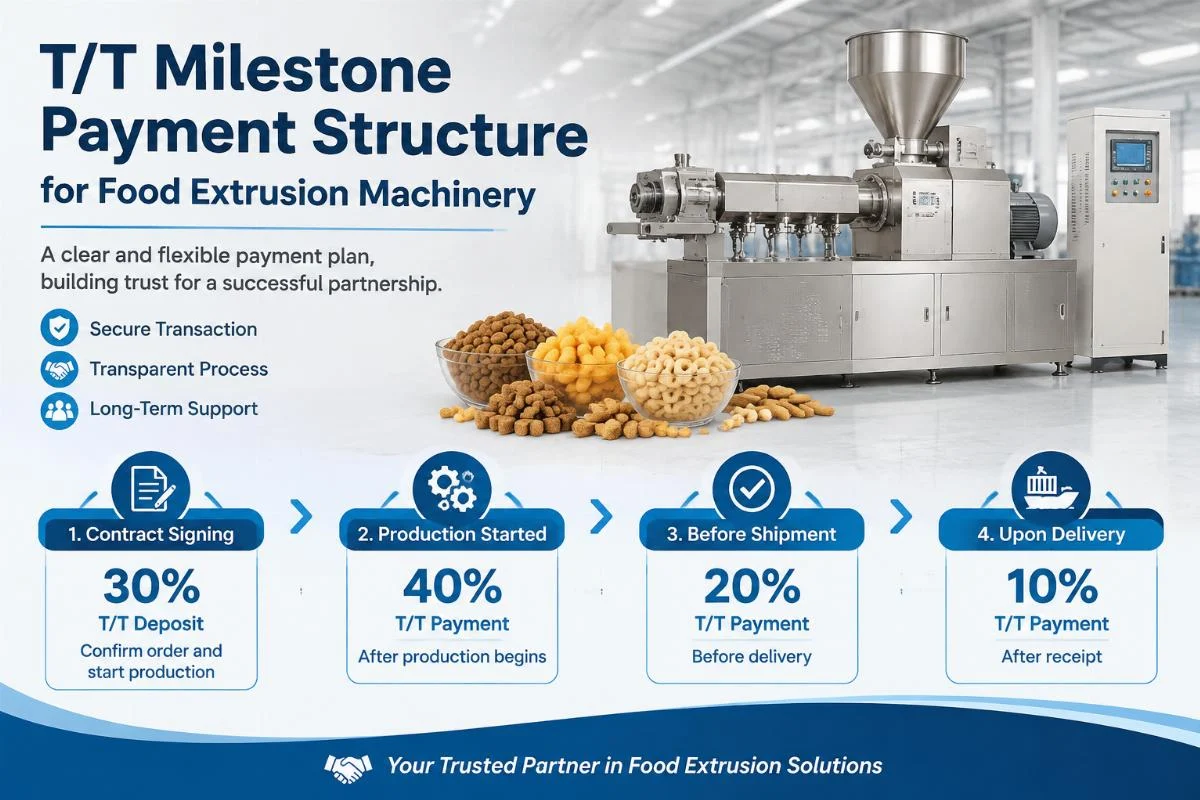
A T/T structure with a thirty percent advance and a seventy percent balance against the B/L copy is the global baseline for extrusion lines. This structure aligns the risk between the buyer and the manufacturer. The initial deposit covers the manufacturer’s upfront costs for food-grade stainless steel and specialized motor procurement, while the balance ensures the machinery is fully manufactured and loaded before the final funds are released.
When importing complex systems like a corn puff line or a pet food extrusion setup, the manufacturing cycle is long. Suppliers need to secure raw materials, machine the screws and barrels, and assemble the control panels. If a buyer demands a zero-deposit or extremely low-deposit structure, the manufacturer bears all the financial risk. Consequently, your order gets pushed to the back of the production queue. Conversely, a substantial deposit secures your slot in the manufacturing schedule and guarantees that high-quality components are allocated to your project.
A startup owner in the Middle East once tried to negotiate a minimal deposit to preserve their local cash flow. They assumed this was a smart financial move. However, because the manufacturer received no immediate capital to lock in material prices, the production was constantly delayed whenever steel prices fluctuated. The entire project stalled for months, costing them far more in lost market opportunity than they saved in interest. The lesson is clear: a healthy deposit is not just a payment; it is a production priority ticket.
Why Is T/T Often Safer Than L/C for Food Extruders?
T/T offers predictable cash flow and clear milestone control, whereas L/C soft clauses can delay negotiations and freeze funds indefinitely. Many procurement managers believe that a Letter of Credit issued by a top-tier bank is completely risk-free. They focus on the bank’s guarantee but ignore the documentary conditions attached to that guarantee.
In the machinery sector, an L/C requires the presentation of flawless documents. If there is even a minor typo on the commercial invoice or the packing list, the bank will refuse payment, turning the L/C into a simple collection process. Worse, buyers often unknowingly agree to soft clauses—conditions that are impossible to fulfill or entirely dependent on the buyer’s subjective approval.
Consider a pet food producer in Africa who initially planned to use an L/C for their floating fish feed extrusion line. Their legal team reviewed the draft and noticed a clause requiring a “certificate of satisfactory installation” issued by the buyer’s local engineer. Since the manufacturer’s engineers were handling the installation, the buyer could theoretically withhold this certificate indefinitely, claiming the machine wasn’t “satisfactory” according to their own internal, undefined standards. Recognizing this trap, they shifted to a T/T structure with milestone payments tied to the Factory Acceptance Test. This allowed them to verify the machine’s performance via video and third-party inspection before the final balance was paid, completely bypassing the L/C documentation nightmare.

How to Identify and Avoid L/C Soft Clauses?
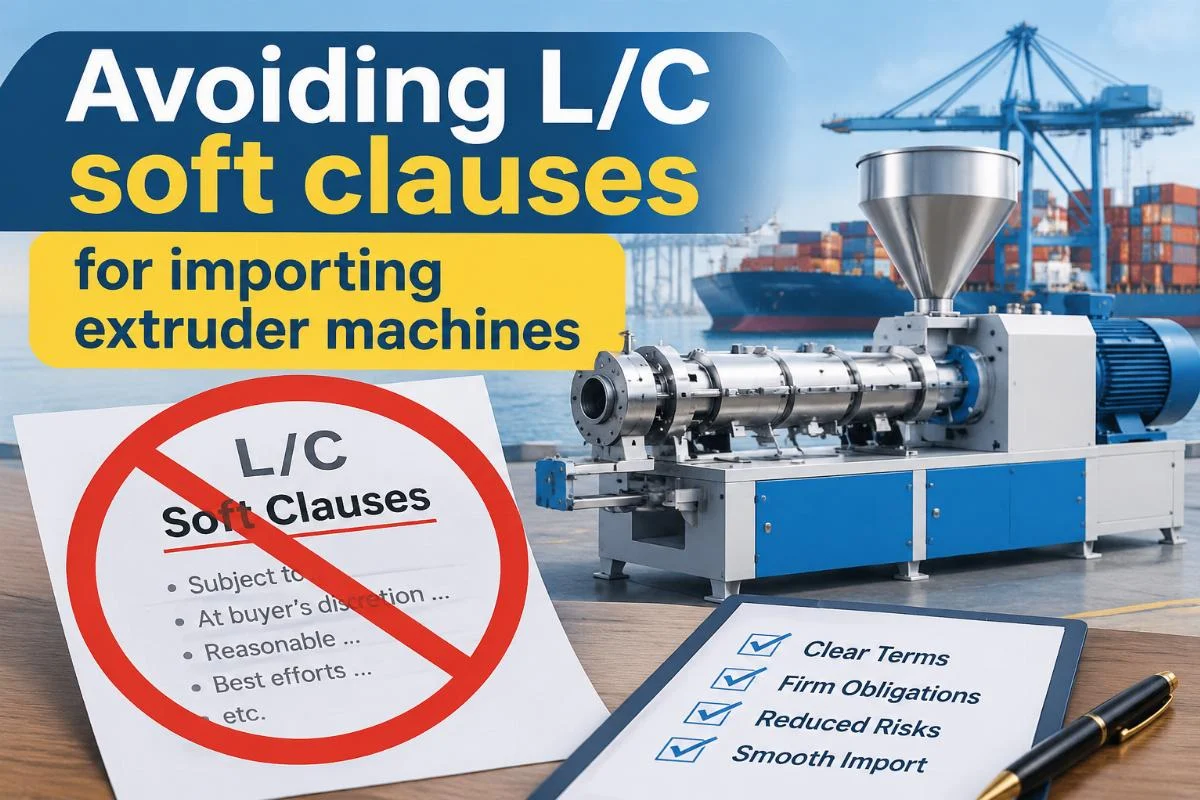
Always verify acceptance criteria and document requirements with your bank and legal team before issuing the L/C. If you must use a Letter of Credit due to local government regulations or specific financing requirements, you must ruthlessly eliminate any clause that gives the buyer unilateral power to block payment.
Soft clauses often hide in plain sight. They look like standard quality assurance requirements but are actually traps. Here is how to identify them:
- Subjective Acceptance Certificates: Any document requiring the buyer’s signature to confirm “quality” or “satisfactory operation” without referencing a specific, pre-agreed technical standard is a massive red flag. The manufacturer cannot control the buyer’s mood or willingness to sign.
- Third-Party Inspection Controlled by the Buyer: If the L/C requires an inspection certificate from a specific agency, but the buyer is responsible for booking and paying for that agency, the buyer can simply delay the booking, causing the shipment to miss the L/C presentation deadline.
- 1/3 Original B/L Mailed Directly to the Buyer: This is a classic trap. If the manufacturer sends one original Bill of Lading directly to the buyer via courier before presenting documents to the bank, the buyer can claim the goods and bypass the bank entirely. The L/C becomes useless because the buyer already has the title to the goods.
A snack producer in South America faced a situation where their bank demanded a “certificate of origin” legalized by a specific local chamber of commerce that did not actually exist in the manufacturer’s country. The documents were presented, the bank rejected them due to this impossible condition, and the funds were frozen until a formal L/C amendment was negotiated—costing weeks of delay and hefty amendment fees.
What Deposit Percentage Secures Your Production Priority?
A deposit of thirty percent or more ensures raw material procurement and prioritizes your twin-screw extruder in the manufacturing queue. In the heavy machinery industry, manufacturers operate on thin margins and high material costs. The extrusion process requires specialized food-grade alloys, heavy-duty gearboxes, and precise electrical components.
When you pay a substantial deposit, you are essentially funding the manufacturer’s supply chain. This is particularly crucial during peak seasons or periods of global material shortages. A higher deposit signals that you are a serious, financially stable buyer, prompting the manufacturer to allocate their best engineering resources to your project.
For example, when structuring orders for turnkey snack food lines, a thirty percent deposit allows the manufacturer to immediately lock in the prices for food-grade stainless steel and schedule the assembly of the complete line. Without this upfront capital, the manufacturer might delay purchasing steel, leaving your project vulnerable to sudden price hikes and supply chain bottlenecks. The deposit effectively bridges the gap between contract signing and the physical reality of machines being built on the factory floor.
Furthermore, a solid deposit structure protects both parties. It prevents the buyer from walking away after the machine is built, and it ensures the manufacturer has the liquidity to produce a high-quality product without cutting corners on component sourcing. Safe payment methods for importing extruder machines always prioritize this mutual financial commitment over abstract bank guarantees.

Conclusion
Secure your capital and your production slot by mastering the mechanics of T/T structures and rejecting subjective L/C conditions. The difference between a smooth equipment installation and a frozen bank account lies entirely in how you structure the initial deposit and the documentary requirements. By demanding a solid upfront commitment and tying the final balance to verifiable shipping documents rather than subjective buyer approvals, you ensure that your snack pellet machine arrives on time, built to spec, and fully paid for.
Equipment Mentioned in This Article
 3D papad machine
3D Snack Pellet Production Line Fried Extruder Machine
3D Snack Pellet Production Line for Starch-Based Snacks — twin-screw extrusion processes potato, cassava, and corn starch into diverse shapes.… View Machine Details 3D papad machine
Fully Automatic 3D Snack Pellets Extruder Making Machine for Chips
Chips 3D Snack Pellet Extruder Line for 2D/3D Shapes — co-rotating twin-screw extrusion processes potato and cassava starches into papad,… View Machine Details 3D papad machine
2D 3D Snack Pellet Production Line Manufacturer
2D 3D Snack Pellet Production Line for Diverse Shapes from Starches — twin-screw extrusion handles wheat, corn, and cassava. The… View Machine Details 3D papad machine
Automatic 3D Pellet Extruded Corn Puffed Snack Food Production Line
3D Pellet Extruded Snack Food Production Line for Starch Pellets — processes potato, corn, and cassava starch into papad and… View Machine DetailsRelated Applications

Engineering Perspective
An In-House R&D Team Behind Every Line
Jinan MT Machinery develops its process technology in-house. The team concentrates on the four areas that decide pellet shape, expansion and line stability.
- Expansion technology
- Twin-screw extrusion
- Die design
- PLC/MCC automation
Related Articles
 Nov 10, 2026 · Procurement & Trade FAQs
Snack Pellet Line for UAE: Twin-Screw Extruder Manufacturer & Turnkey Service
Buying a snack pellet line UAE requires engineering systems that survive extreme heat and voltage fluctuations, not just finding the lowest price. You must… Read This Article Nov 10, 2026 · Procurement & Trade FAQs
Fast Replacement Pellet Dies from China Manufacturer Meiteng
Minimize extruder downtime by understanding that replacement pellet die delivery time relies on precise formula matching and custom compression ratios rather than just express… Read This Article Nov 10, 2026 · Procurement & Trade FAQs
Snack Pellet Line for Poland & EU: Meiteng Twin-Screw Extruder Manufacturer
Importing a snack pellet line into Poland and the EU requires navigating strict CE machinery directives, EORI customs registration, and adapting equipment to local… Read This ArticleFree Process Check
Send Your Recipe for a Process Check
Jinan MT Machinery engineers review your recipe and return a free process plan within 24 hours. Tell us the product, output, raw material, local voltage and heat source.
Send Your Recipe on WhatsApp