
Meiteng DS65 Twin-Screw Extruder for 2D/3D Snack Pellets Manufacturer
- By Jinan MT Machinery
Most buyers assume complex 3D snack shapes rely entirely on expensive molds, but the real secret lies in the dynamic matching of feed moisture and screw speed.
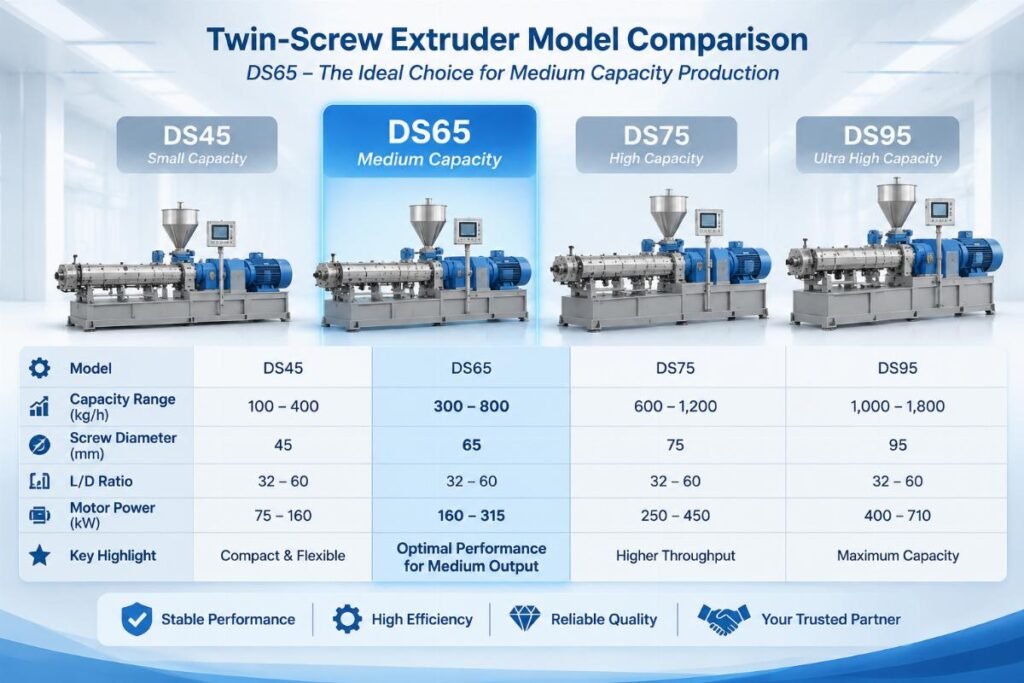
The DS65 Twin-Screw Extruder solves 2D and 3D snack pellet forming challenges through precise mold and parameter dynamic matching, making it the core equipment for snack startups to achieve efficient mass production.
I remember standing next a machine in Riyadh, watching a batch of 3D立体膨化零食 (3D puffed snacks) come out with uneven expansion and collapsed立体形状 (3D shapes). The client was visibly frustrated. I squatted by the equipment, recalibrated the feed moisture to a highly controlled narrow range, and adjusted the screw speed while fine-tuning the die plate hole diameter. Only then did the shapes stabilize. Making 2D and 3D snack pellets means the mold and parameter matching is the critical bottleneck; when on-site conditions change, the underlying principles must be applied flexibly. The DS65 Twin-Screw Extruder handles this exact dynamic balancing act..
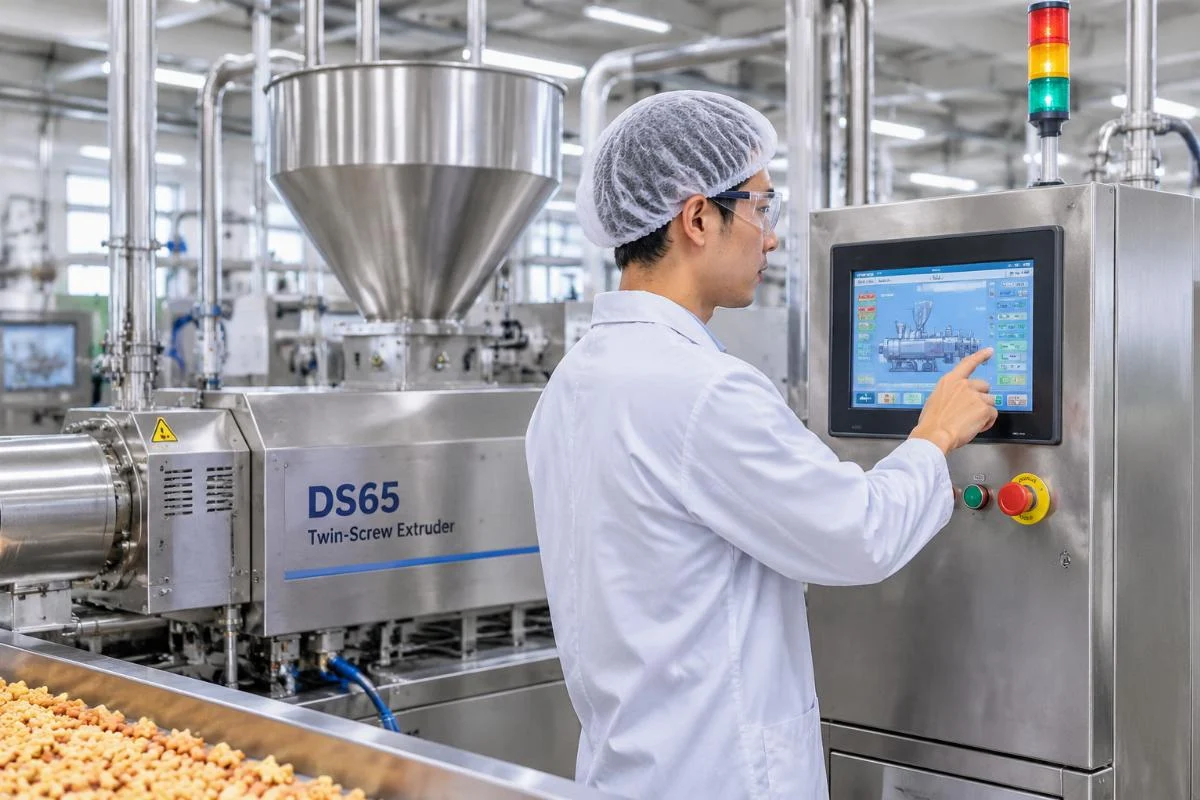
Let us break down how this dynamic matching works across different production scenarios and model comparisons.
What Makes the DS65 Ideal for 2D and 3D Snack Pellets?
The high-torque and advanced temperature control design of the DS65 Twin-Screw Extruder form the foundation for complex 3D立体成型 (3D three-dimensional forming).
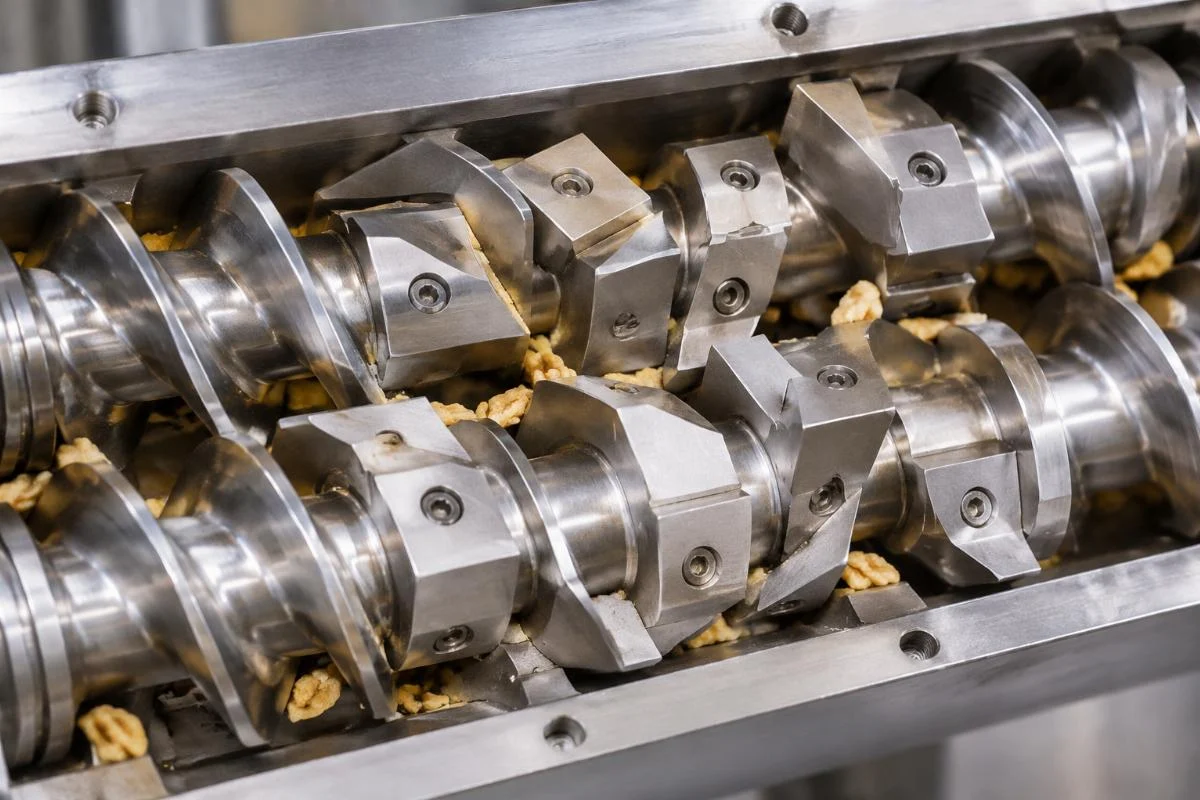
When producing intricate 3D shapes, the material undergoes intense shear and friction inside the barrel. If the temperature fluctuates even slightly, the starch structure breaks down prematurely, leading to collapsed shapes upon exiting the die. The DS65 Twin-Screw Extruder utilizes independent heating and cooling zones along the barrel, ensuring a precise temperature gradient..
Furthermore, the screw combination design—specifically the ratio of conveying, kneading, and shearing sections—dictates the expansion degree of the物料 (material). For 3D snacks, a higher kneading section ratio is required to ensure complete gelatinization without degrading the polymer chains. The DS65 extruder for 2D 3D snack pellets allows for modular screw element rearrangement, giving producers the flexibility to tweak the shear intensity based on the raw material recipe. This level of control is what separates a consistent production run from a batch of deformed废品 (scrap).
DS65 vs. Other Models: Which Extruder Fits Your Snack Line?
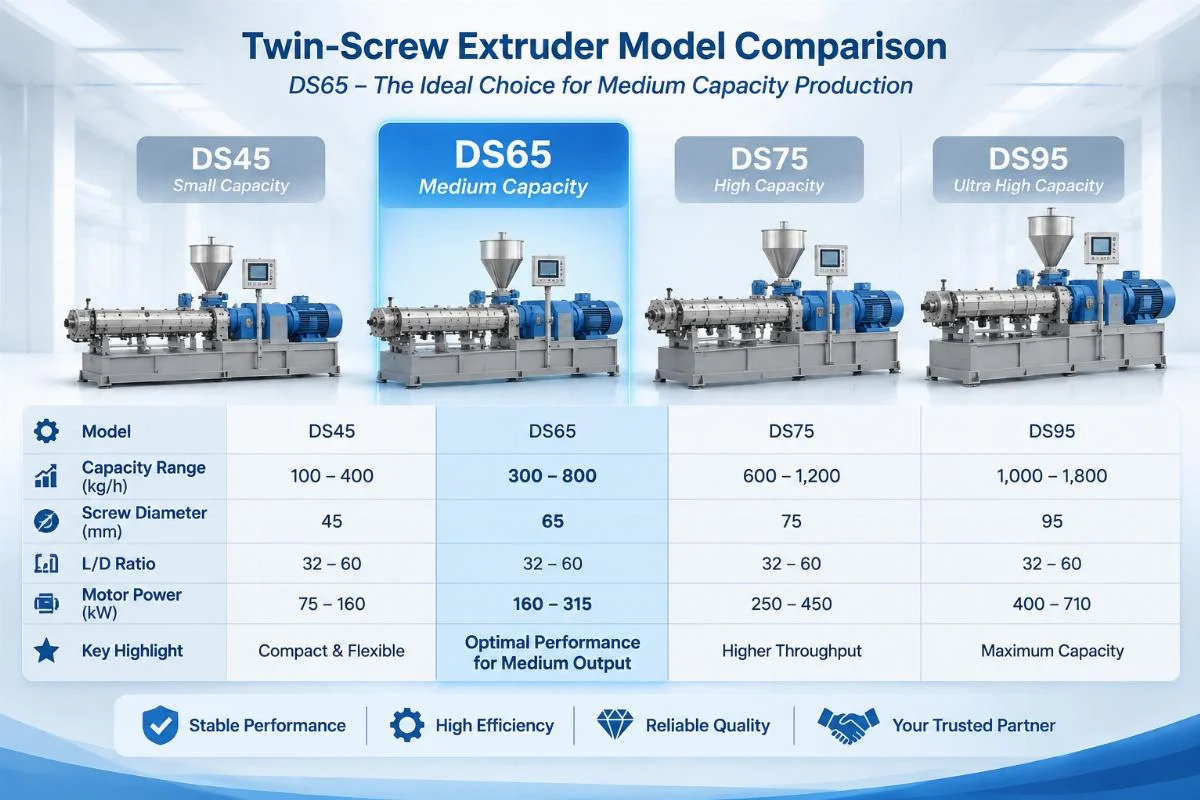
Selecting the right capacity and forming capability requires comparing the DS65 against smaller and larger models to find the optimal balance for medium-capacity 3D forming.
Many startup food businesses struggle with capacity sizing. Going too small limits growth, while going too large wastes energy and increases the risk of material degradation due to prolonged residence time. The DS65 Twin-Screw Extruder sits in the sweet spot for medium-capacity lines.
Here is how the DS65 compares to other models in the series regarding 3D snack production capabilities:
| Feature | Smaller Model (e.g., DS50) | DS65 Twin-Screw Extruder | Larger Model (e.g., DS70) |
|---|---|---|---|
| Torque Capacity for 3D Shapes | Basic | Robust | Extremely High |
| Temperature Gradient Control | Standard | Controlled | Highly Controlled |
| Screw Modularity for Shear Tuning | Limited | Full batch-level | Full batch-level |
| Suitability for Complex 3D Molds | Vulnerable | Resistant | Robust |
| Energy Efficiency at Medium Load | Noticeably reduced | Optimized | Substantially extended |
A snack startup in Latin America initially considered a larger model for maximum output. However, their core product was a delicate 3D animal-shaped pellet. The larger model generated excessive shear heat, destroying the starch structure and causing the shapes to hollow out. Switching to the DS65 Twin-Screw Extruder provided the necessary torque without the destructive heat buildup, significantly improving the internal structure and crispness of the颗粒 (pellets)..
Key Specifications & Parameter Tuning for Perfect Expansion
Mastering the core parameters of screw speed, moisture, and temperature is essential for achieving perfect expansion in 2D and 3D snacks.
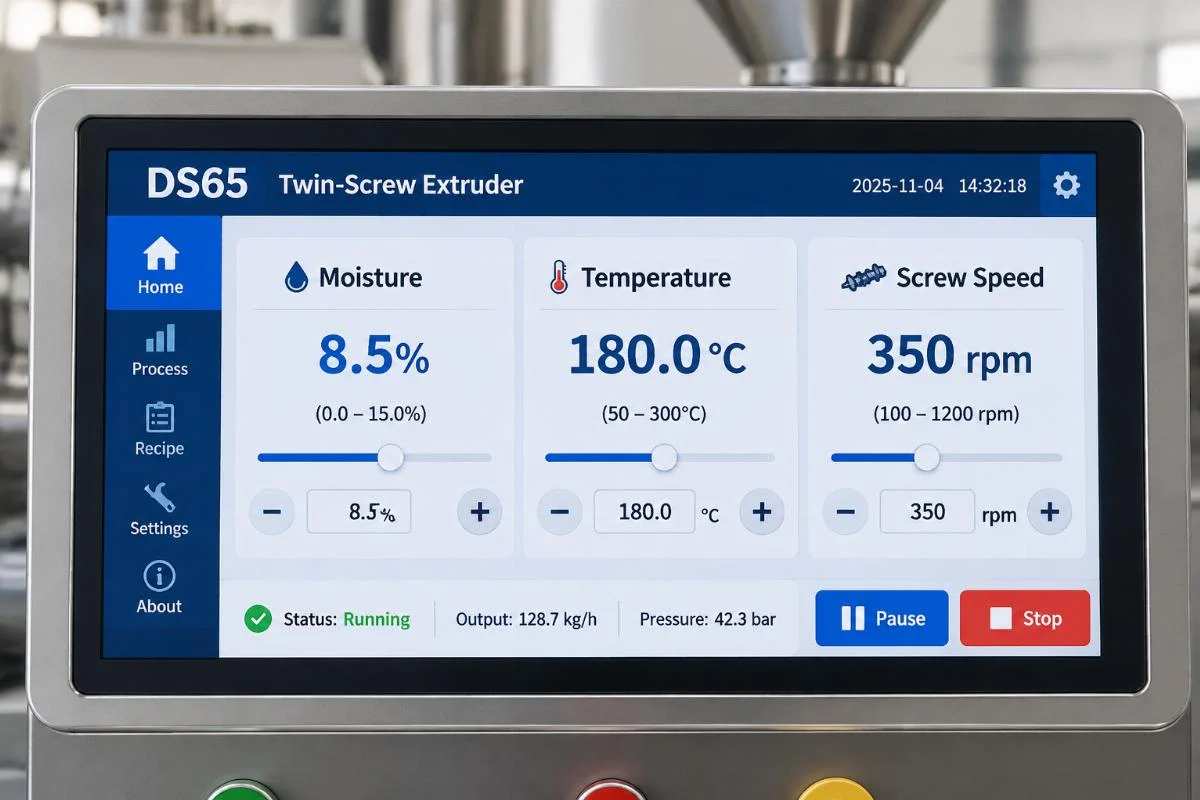
Operating a twin-screw extruder for snack food production is not about setting static numbers; it is about managing a multi-variable system. The raw material moisture, barrel temperature, and screw speed interact continuously.
- Feed Moisture Control: The moisture content of the raw mix must be kept within a highly controlled narrow range. Too much moisture prevents adequate expansion, resulting in dense, hard pellets. Too little moisture causes excessive friction, leading to burnt flavors and unstable shapes.
- Barrel Temperature Gradient: The temperature must increase progressively from the feed zone to the die zone. This ensures gradual melting and mixing before the final high-pressure push through the mold.
- Screw Speed Adjustment: This is the most critical variable for 3D shapes. The screw speed determines the shear heat and residence time.
Many operators mistakenly believe that faster screw speeds always yield higher output. In reality, excessive speed generates too much shear heat, which breaks down the starch structure and causes the 3D pellets to collapse immediately after exiting the die. The DS65 Twin-Screw Extruder features a variable frequency drive that allows for micro-adjustments of the screw speed, enabling operators to find the exact tipping point between maximum output and shape retention..
Common 3D Snacks Defects and How DS65 Solves Them
Addressing defects like collapsing, hollow centers, and uneven expansion requires precise mold and parameter matching solutions.
Every production run faces anomalies. The key is how quickly the system can adapt. The DS65 Twin-Screw Extruder, combined with proper technical support, resolves these common issues systematically.
Defect 1: 3D Shape Collapsing
- Root Cause: Usually caused by feed moisture fluctuating outside the optimal narrow range or screw speed being too high, leading to insufficient melt strength upon exiting the die.
- Solution: Recalibrate the feeder to stabilize moisture. Reduce the screw speed slightly to lower the shear heat and increase the melt viscosity, allowing the 3D shape to hold its structure during the initial cooling phase.
Defect 2: Hollow or Weak Internal Structure
- Root Cause: Improper temperature gradient or insufficient kneading in the screw combination, leading to incomplete gelatinization and poor gas retention during expansion.
- Solution: Adjust the barrel heating zones to ensure a smoother temperature ramp-up. Reconfigure the screw elements to include more kneading blocks, which improves the mixing and gas-cell dispersion within the melt. The DS65 extruder for 2D 3D snack pellets makes this screw reconfiguration straightforward.
Defect 3: Uneven Expansion and Size Variation
- Root Cause: Mismatch between the die plate hole opening ratio and the cutter speed, or uneven feed distribution.
- Solution: Calculate and match the die plate aperture and open area ratio with the cutter rotational speed. Ensure the feeder provides a consistent, pulsation-free material flow.
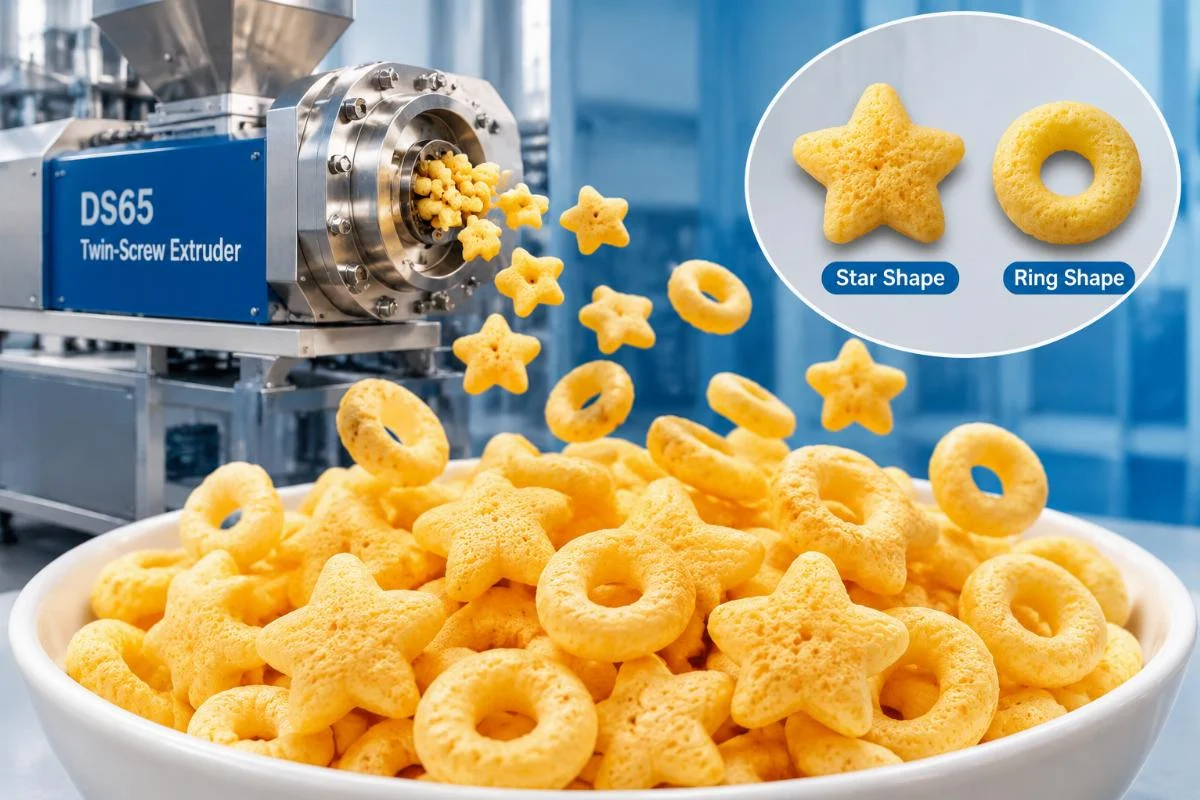
In a case involving a client in the Middle East who frequently switched between 2D rings and 3D stars, the frequent changeovers caused extended downtime and high rejection rates. By optimizing the template aperture and cutter speed matching protocols, and utilizing the DS65 Twin-Screw Extruder’s quick-clamp die design, the changeover time was drastically reduced, and the forming yield rate improved noticeably. This level of operational efficiency is supported by comprehensive on-site installation, commissioning, and operator training, ensuring the team can handle these dynamic adjustments independently..
Conclusion
Successful 2D and 3D snack production relies on the dynamic balance of moisture, temperature, and screw speed rather than just the mold itself. The DS65 Twin-Screw Extruder provides the precise control and modular flexibility required to master these variables, turning complex forming challenges into consistent, high-yield mass production.
Equipment Mentioned in This Article
 3D papad machine
2D 3D Snack Pellet Production Line Manufacturer
2D 3D Snack Pellet Production Line for Diverse Shapes from Starches — twin-screw extrusion handles wheat, corn, and cassava. The… View Machine Details 3D papad machine
3D Snack Pellet Production Line Fried Extruder Machine
3D Snack Pellet Production Line for Starch-Based Snacks — twin-screw extrusion processes potato, cassava, and corn starch into diverse shapes.… View Machine Details 3D papad machine
Fully Automatic 3D Snack Pellets Extruder Making Machine for Chips
Chips 3D Snack Pellet Extruder Line for 2D/3D Shapes — co-rotating twin-screw extrusion processes potato and cassava starches into papad,… View Machine Details 3D papad machine
Automatic 3D Pellet Extruded Corn Puffed Snack Food Production Line
3D Pellet Extruded Snack Food Production Line for Starch Pellets — processes potato, corn, and cassava starch into papad and… View Machine DetailsRelated Applications

Engineering Perspective
An In-House R&D Team Behind Every Line
Jinan MT Machinery develops its process technology in-house. The team concentrates on the four areas that decide pellet shape, expansion and line stability.
- Expansion technology
- Twin-screw extrusion
- Die design
- PLC/MCC automation
Related Articles
 Nov 16, 2026 · Product & Series Guides
Meiteng Extruded Corn Chips Frying Line Manufacturer for Sale
Optimizing an Extruded Corn Chips Frying Line requires treating it as a complete thermal management system to precisely control final oil content and moisture.… Read This Article Nov 16, 2026 · Product & Series Guides
DS135 Twin-Screw Extruder Manufacturer for Large Output Pellet Plants
Scaling up with a DS135 Twin-Screw Extruder fails when producers rely solely on nameplate capacity instead of matching screw configurations to specific recipes. Real… Read This Article Nov 16, 2026 · Product & Series Guides
Meiteng Deoiling & Cooling Conveyors for Frying Chips Line Manufacturer
Properly matching Deoiling and Cooling Conveyors prevents moisture condensation and oil retention that ruin fried chips after packaging. Synchronizing mesh speed with extruder output… Read This ArticleFree Process Check
Send Your Recipe for a Process Check
Jinan MT Machinery engineers review your recipe and return a free process plan within 24 hours. Tell us the product, output, raw material, local voltage and heat source.
Send Your Recipe on WhatsApp